The Citizen Potawatomi Nation’s Cultural Heritage Center provides resources to keep the Tribe’s history safe and accessible for generations to come. One key way the Nation does this is through the CHC’s archives and video interviews. To highlight some of the archive’s holdings, the Hownikan is featuring photographs and family history of every founding Citizen Potawatomi family. If interested in assisting preservation efforts by providing copies of Citizen Potawatomi family photographs, documents and more, and to schedule family interviews, please contact the CHC at 405-878-5830.
Protecting the people
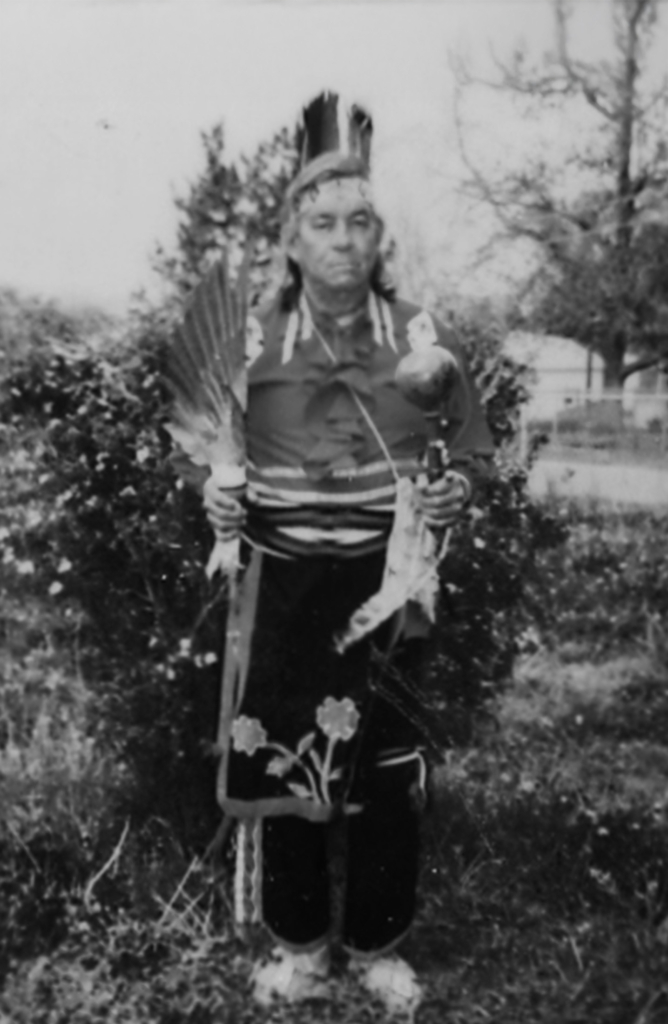
Wamego was among the Potawatomi who worked to protect his people as they experienced countless hardships during the removal period. The Potawatomi, part of the Three Fires Confederacy, had flourished in the Great Lakes region, which included parts of present-day Wisconsin, southern Michigan, northern Indiana and northern Illinois. Trade routes along the rivers and trails spanning from Indiana to Chicago allowed the Potawatomi, Ojibwe and Odawa to connect and communicate with each other.
In 1830, the U.S. Congress passed the Indian Removal Act and forced all tribes to relocate from their ancestral homelands to reservations west of the Mississippi River. The U.S. government believed this could stop the conflict between tribes and settlers squatting on tribal lands.
The 1833 Treaty of Chicago set the terms for the Potawatomi to be forced from the Great Lakes area. The Potawatomi were to receive more than 5,000,000 acres of land, cash payments and tracts of land west of the Mississippi River. Many Potawatomi believed the settlers, backed by the U.S. government, would continue to push into Native lands. They believed it was in the best interests of their people to find a peaceful solution and ensure their survival.
After the treaty was ratified in 1835, it wasn’t until 1838 that tribes had to leave. This would lead to an unimaginable tragedy for the Potawatomi.
Trail of Death
In September of 1838, Wamego was among the Potawatomi who were tricked into meeting with the U.S. government. Instead of a meeting, Potawatomi leaders were shackled in the back of a wagon. Potawatomi homes and fields were burned to discourage them from returning.
From there, 859 Tribal members were forced to walk 660 miles from northern Indiana to eastern Kansas with little food, hardly any water and no shelter. Those on the journey also faced oppressive heat and illness. More than 40 people died before the survivors finally arrived in Kansas in November of 1838.
Adapting to the new lands in present-day Kansas was difficult. The lack of provisions promised by the federal government and the lack of many of the resources that had been familiar to the Woodland Potawatomi made adaptation challenging. However, some members of the Tribe established successful businesses and took advantage of the Oregon Trail that cut through the Potawatomi Reservation.
In Kansas, Wamego had a son named Joseph Che-quas Wamego. Che-quas was baptized on Jan. 19, 1858, at St. Marys, Kansas. Joseph Che-quas married Julia Battese in 1880. Their children were Harry, Willie, Catherine, Eli, Rose, Thomas, Agnes, Fannie and George.
A record within the CHC archives lists an 1887 allotment record for Che-quas and his wife, only noted as “a Kickapoo woman.” Joseph appears on both the Kansas rolls and the CPN rolls after he accepted allotment in Indian Territory.
Life in Kansas
The children of Che-quas and Julia would go on to establish their own families in their adopted home of Kansas.
Harry Wamego married Charlotte Bruno. Their children were William Oliver, Genevieve Theresa (Smith), Raymond, Gladys Josephine (McCune) and Paul “Dutch” Aloysius.
Thomas Wamego married Angeline Pratt. Their children were Perry John, Mike, Lavina (Wichita) and Elizabeth Mae (Morris).
Fannie Anna Wamego married Charlie J. Pappan. Their daughter was Minnie Elizabeth (Murphy Alsip).
The town of Wamego, Kansas, later received its name in 1866 in honor of Wamego of the Potawatomi, whose pursuit of peace helped to ensure the survival of his people.
George and Harry were listed on the 1887 land allotment of the Prairie Band Potawatomi. A directory for the Ship Shee Cemetery in Jackson County, Kansas, lists Joseph, Julia and several family members buried there.
Joseph Che-quas walked on Dec. 10, 1927, in Kansas. Julia walked on Jan. 15, 1923, in Kansas.
Creating a new Nation
As the later generations of the Wamego family settled into life in Kansas, they helped establish a new and thriving community. But later, some would be offered the opportunity to change their lives and create a new Nation in then-Indian Territory.
During the 1860s, the Potawatomi were faced with a significant decision. Under pressure from settlers and railroad companies, the U.S. government offered citizenship and individual allotments to the Potawatomi in Kansas in order to obtain the land.
Wamego was a signatory on the Nov. 15, 1861, Treaty of the Kansas River Agency. The group that accepted U.S. citizenship and individual allotments in Indian Territory became known as the Citizen Band. The group that preferred to live communally in Kansas became known as the Prairie Band. Some members of the Wamego family continued to live in Kansas while others made the move to Indian Territory.
Thomas and Angeline’s son, Perry John, married Betty Jean Wong. Their children were Mary A. (Romero), Gregory Micco, Anthony T. and Sherrill L. (Toledo.)
Mike married Rita Tyre. Their son was Michael George.
Lavina married Atwood Wichita. Their children were Qwen (Pickering), Byron and Gordon “Howdy.”
Elizabeth Mae married Allen Morris. Their children were Zack Thomas and Timothy Eli.
Minnie Murphy Alsip had a son named Francis Eugene Murphy and daughters named Phyllis Evelyn (McCreary) and Thelma Mae (Case).
Fannie Pappan had Nellie Josephine (Parker).
It was because Wamego continually worked for the safety of his Potawatomi people that his descendants endure today as one of the founding families of the Citizen Potawatomi Nation. Their contributions to life in Kansas and their willingness to confront the unknown in Indian Territory are a testament to their strength and courage.
If interested in assisting preservation efforts by providing copies of Citizen Potawatomi family photographs, documents and more, and to schedule family interviews, please contact the CHC at 405-878-5830. Schedule interviews online at portal.potawatomi.org. Learn more about the Family Reunion Festival at cpn.news/festival, and find research resources online at potawatomiheritage.com.