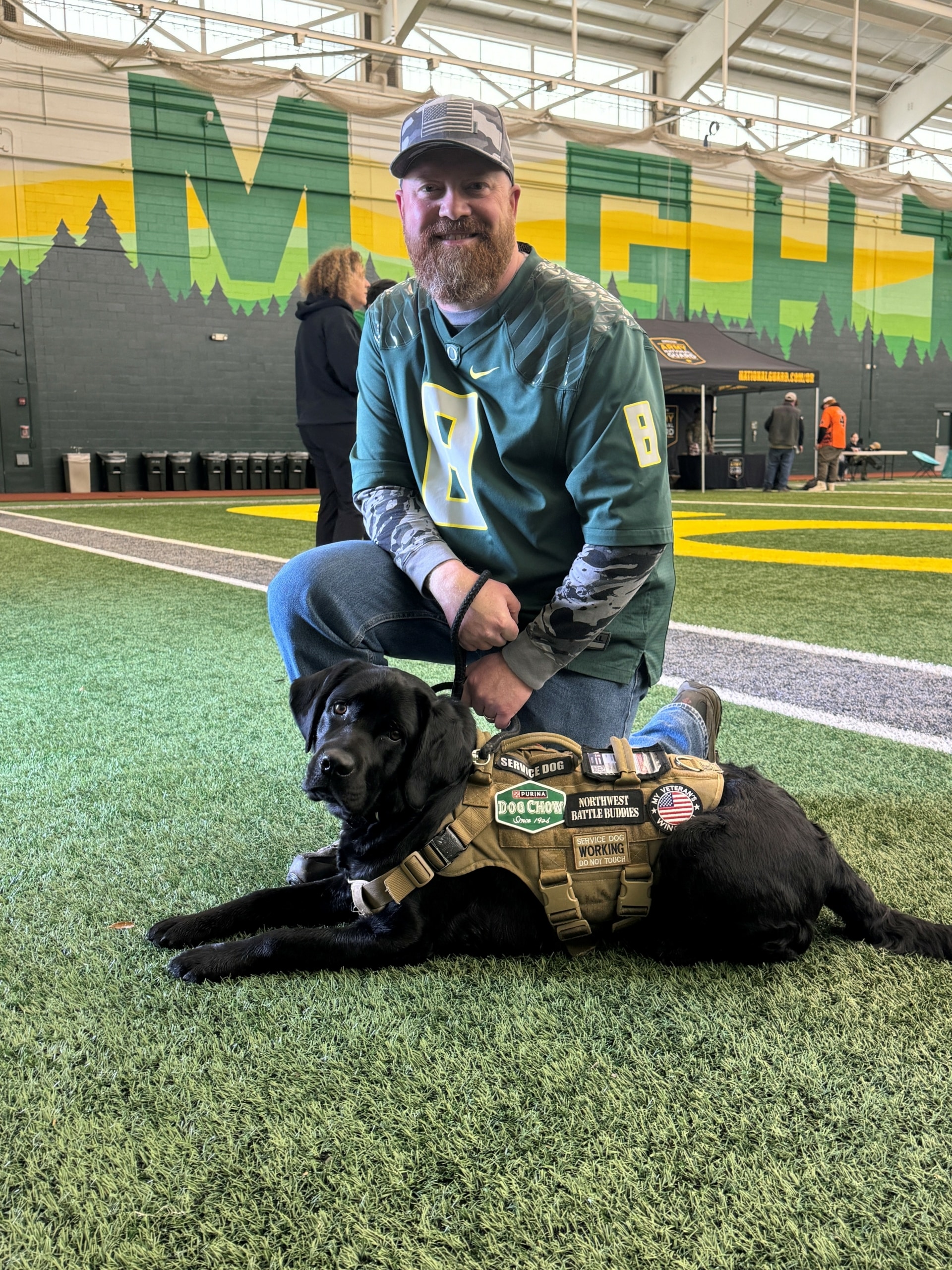
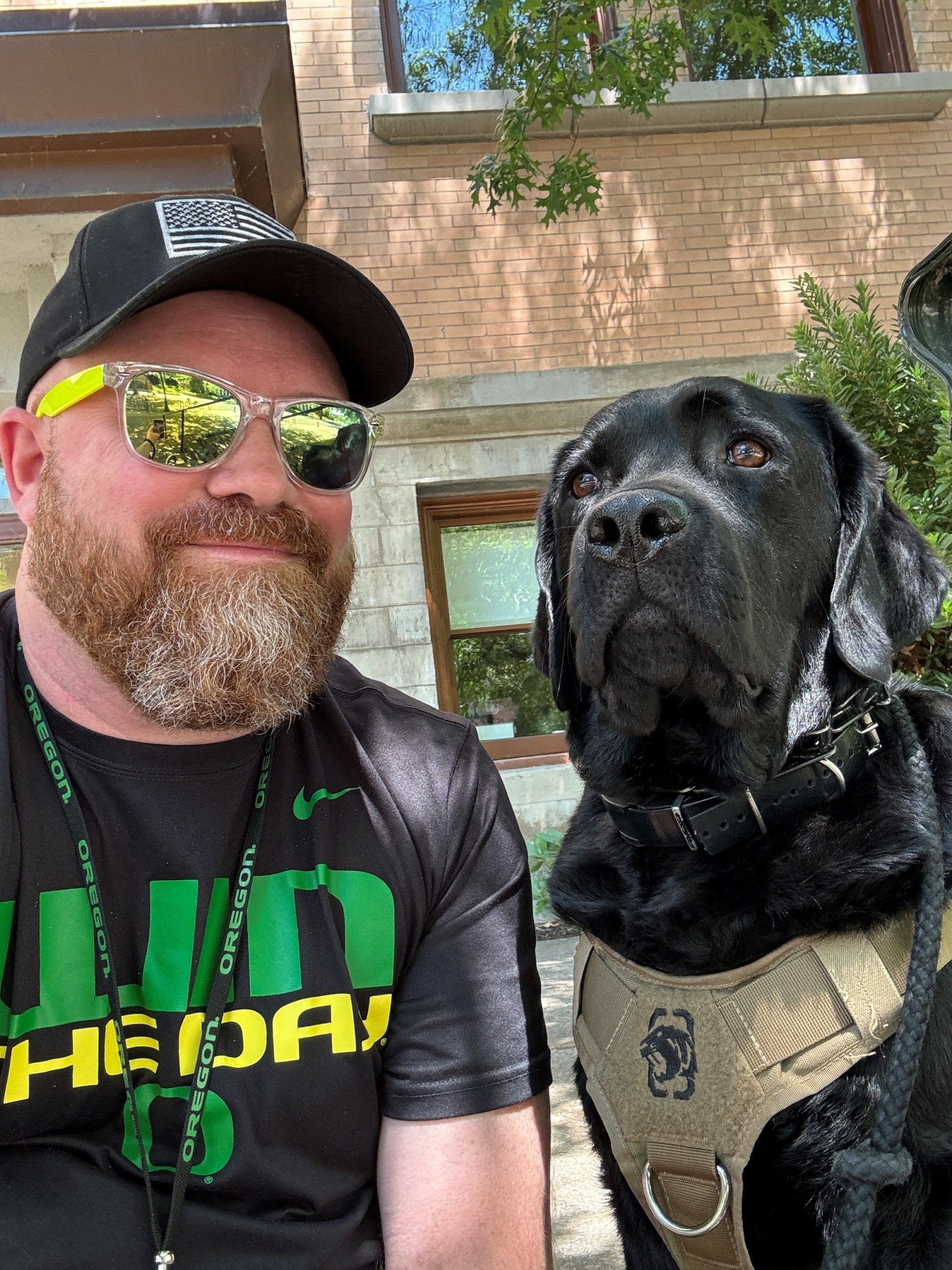
Muller and Spencer family member Scott Hill goes everywhere with his service dog, Nikki — to work, to movie theaters, to restaurants. Nikki provides him a sense of comfort in places he might not otherwise be comfortable.
Hill, who raised three boys in Oregon with his wife, was able to pair up with Nikki through an organization called Northwest Battle Buddies, which provides veterans with PTSD with service dogs. Now, he tries to spread the word to other veterans in the hopes they might also find a greater sense of independence through the use of a service dog.
How it all started
Though Hill was not diagnosed with PTSD until a couple of years ago, his story starts long before that.
In 1996, he and his wife had a toddler and he was serving as an F-15 avionics technician for the Air Force, mostly stationed out of Langley Air Force Base in Virginia. He was on his second deployment to Saudi Arabia when, on June 25, terrorists used a tanker truck as a bomb, which they set off near a fence line close to buildings that housed airmen.
The truck contained the equivalent of 20,000 pounds of TNT, Hill said, and when it exploded, it could be heard 20 miles away and left a crater 85 feet wide and 35 feet deep. The explosion killed 19 airmen and injured close to 500.
At the time the bomb went off, Hill was sleeping in his room a couple buildings behind the one that was hardest hit.
“I have the time 9:52 p.m. kind of seared in my brain, because that was the time I woke up and heard that explosion and looked at the clock, and that’s what I remember seeing,” he said.
He remembers someone yelling that they were being attacked and to get out of the building, and everyone gathering in the courtyard, where they started to administer first aid to those who were injured.
He also recalls a lot of uncertainty, including rumors of another bomb being found. Many of the details they did receive came from watching the news later that night. All that uncertainty, he said, caused a lot of anxiety.
“It was surreal to be so far away from home,” and go through all of that, Hill said. “I was married and I had a toddler, my first little boy. And so, my heart, my mind were certainly on them, not sure what’s happening, not sure if I’d get home to see him again.”
In the days that followed, Hill helped load some of the injured onto medivacs to receive further care and assisted the FBI with tasks like sifting through sand for truck parts as evidence.
The day following the attack, an SUV backfired and the next thing Hill remembered was getting up off the ground. That reaction told him the attack had had a profound effect on him.
Once he returned home to the States, he noticed other changes.
“I did find myself experiencing high anxiety by loud noises,” he said.
He said it was hard to be in dark spaces like theaters, or in crowds or restaurants. He always needed to sit where he could see the door, and he would often begin to question the intentions of the people around him.
“But when you are who you are, you don’t really see that stuff. It just becomes normal life,” he said. “I figured everybody’s sort of like that. I never really thought of myself as being different.”
Getting Nikki
In 2020, Hill said several things started happening that put increasing pressure on him. The Covid-19 pandemic was sweeping through the country. There was political unrest and demonstrations in the streets. The Pacific Northwest had fires raging in the area. And Hill was watching his mother battle kidney disease and cancer in the time leading up to her death.
“Things were rising up, and suddenly I couldn’t really handle life,” he said.
It was then his brother, a veteran working at a VA Hospital, suggested Hill seek help from the VA, which led Hill to counseling and a diagnosis of PTSD that stemmed from the attack in 1996.
Then, through another source, Hill heard about Northwest Battle Buddies, located about 150 miles from him in Washington. He loves dogs, but said he was hesitant to try to apply for a service dog.
“I just always felt like I want to reserve a resource like that for someone who’s a lot worse off than me. I can at least go out into public. I know a lot of people can’t even leave their house,” he said.
However, he was encouraged not to think of it that way and to give it a try, so he applied, then went through the training program to learn to be a handler for his service dog.
His wing man in life
Hill has had Nikki now for two and a half years.
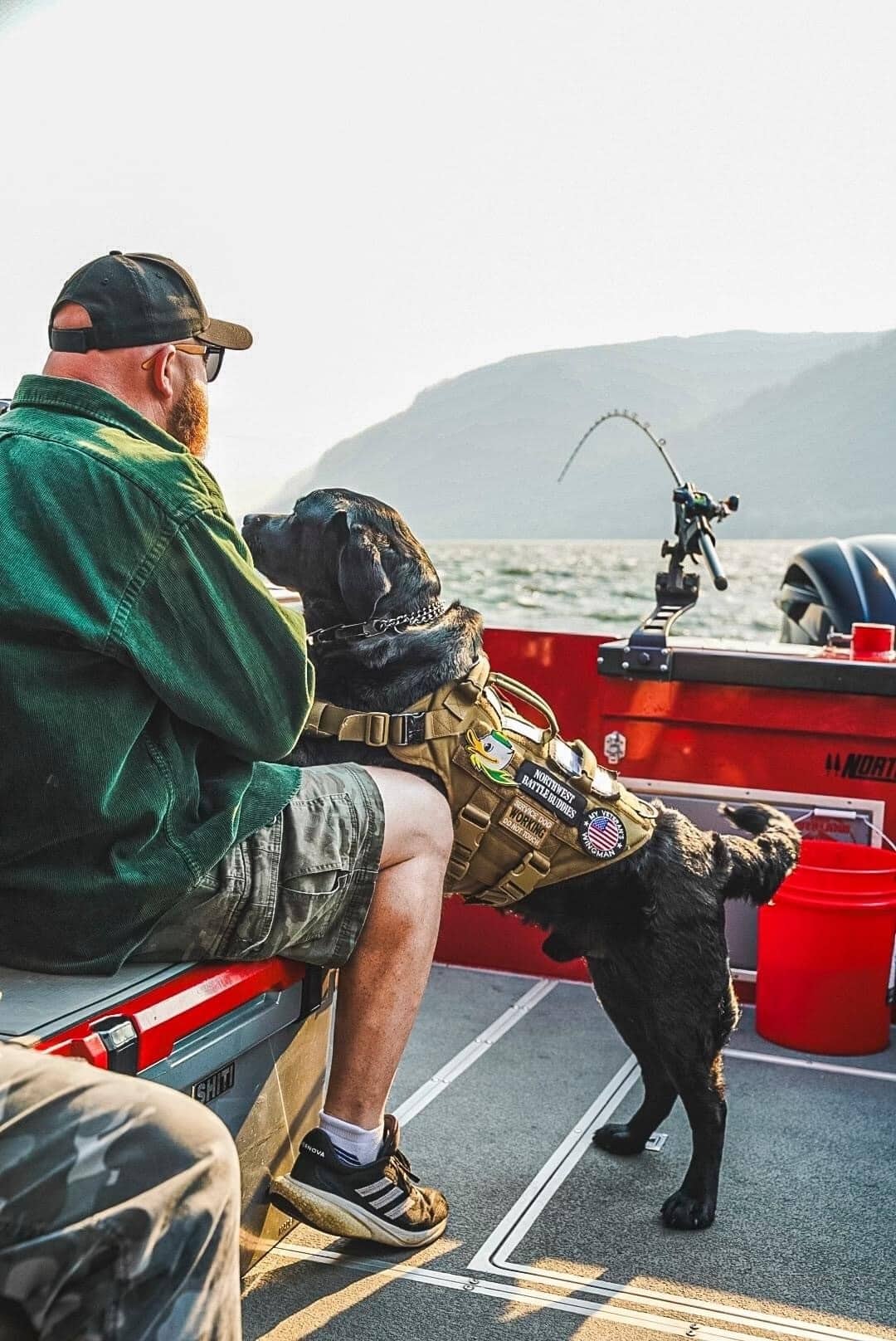
“They do say dog is a man’s best friend. For me, though, that’s reserved for my wife. She’s my best friend,” Hill said. “Nikki’s my wing man in life, is what I like to say.”
Aside from offering companionship, Nikki has specialized training and can go with Hill anywhere and everywhere, from Hill’s job on campus at the University of Oregon, to airplanes, trains, and everywhere else.
If Hill is experiencing nightmares, Nikki will wake him to bring him back to the present. Nikki can provide pressure therapy to ground Hill whenever he needs it. He can act as a social barrier to give Hill space. If Hill begins to feel uneasy in a crowd, just knowing that Nikki’s incredible senses of hearing and smell would pick up any trouble far in advance gives Hill comfort.
“I know that if he’s OK, then I can be OK,” he said.
While he was able to go out into public before, Nikki has provided him with peace of mind.
“I had learned to be OK in most situations, but it would be uncomfortable. He allows me to be comfortable,” Hill said. “I’m comfortable in every scenario, where before I couldn’t be … He keeps me stable.”
Northwest Battle Buddies
Hill said he now tells his story as a way to reframe a horrific event into something good by advocating for other veterans with PTSD to consider getting service dogs.
Northwest Battle Buddies works to supply veterans who struggle with PTSD with service dogs free of charge.
“By the time they’re trained, these dogs are valued at over $25,000 a piece, and it doesn’t cost the veteran a dime,” Hill said, adding that the organization will also work to supply veterans with another dog if their dog becomes too old to serve effectively or passes on.
“Northwest Battle Buddies is just amazing. They take the time to teach us how to handle our dogs, take them up escalators, elevators, be in crowds,” he said.
Though they are located in Washington state, he said veterans from all over the country traveled to get service dogs through them, including one veteran who has moved to England but travels back for recertifications.
Hill added that service dogs are so much more than pets.
“They’re life changing. I never thought I would be so dependent — lovingly dependent, happily dependent — on my dog to go through life with,” he said.
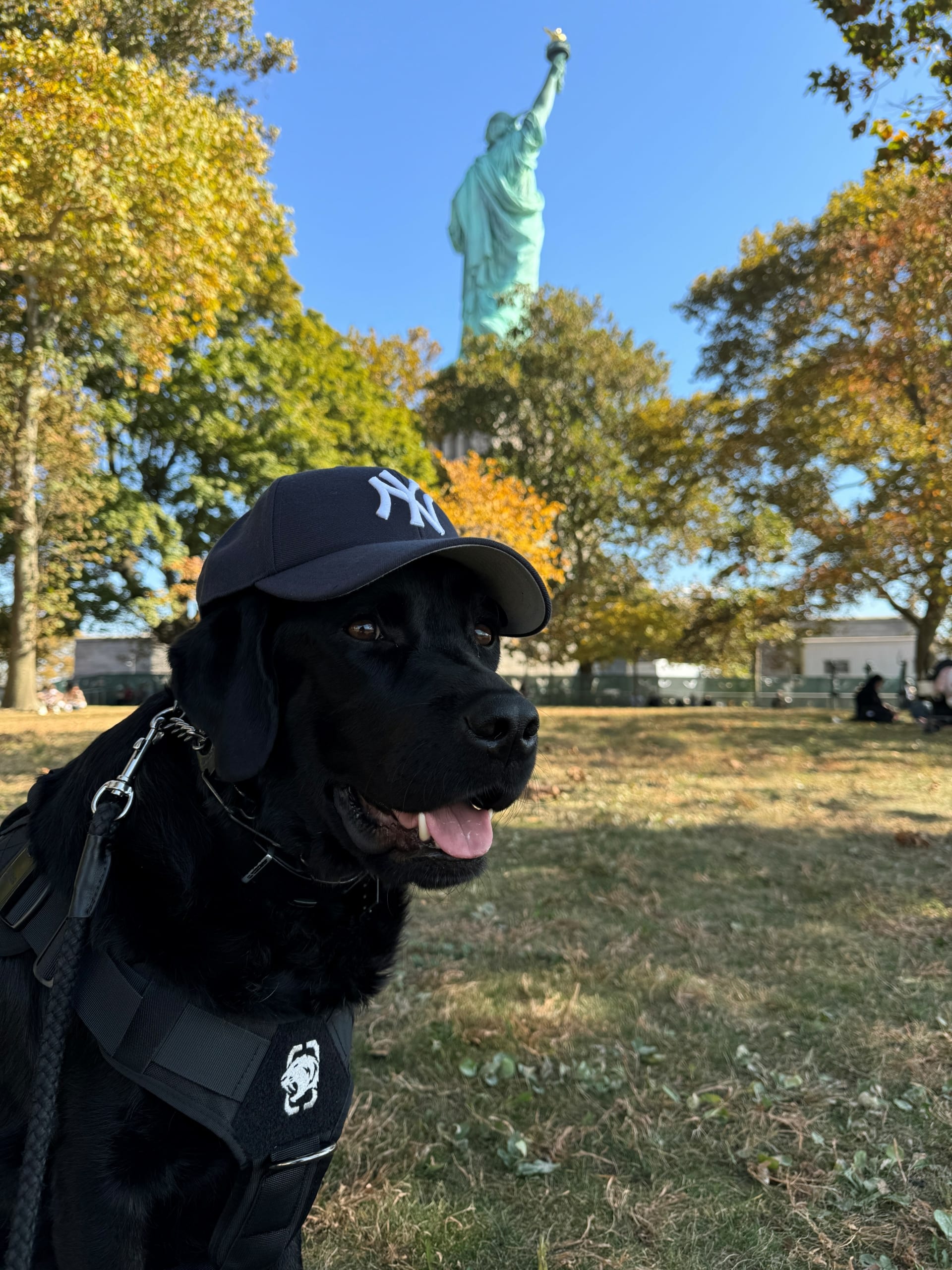
Hill hopes any veterans struggling with things like leaving the house or suicide ideation will look into getting a service dog.
“These dogs are saving lives,” he said. “One thing I’ve learned is that if you can’t trust people, I want to encourage veterans to try trusting a dog. Because that’s a great place to start.”
Hill hopes that someday, the VA will cover service dogs for veterans the way they would any other medication or counseling. Until then, he tries to advocate and to get the word out.
He and Nikki also appear in the short film, “Nikki,” produced by Sam Eckholm in partnership with Purina Dog Chow. It premiered at the New York Dog Film Festival last October and can be seen at cpn.news/nikki.
Learn more about Northwest Battle Buddies at northwestbattlebuddies.org.