John “Rocky” Barrett
Tribal Chairman
Bozho, nikan, (Hello, my friend),
In recent weeks you may have read about the state capitol in Oklahoma. State legislators tried and failed to pass a bill allowing sports betting in Oklahoma under the existing tribal gaming compacts. The legislation was supported by most tribes in the Oklahoma Indian Gaming Association, including the Citizen Potawatomi Nation. While no piece of legislation is perfect, it was a step in the right direction. In political and legislative matters, that is often as good as it gets.
For several reasons, the bill failed to garner enough support in the State Senate. Legislators across the political spectrum cited moral, budgetary and societal justifications as to why they couldn’t support it. Many legislators representing tribal districts, where tribes and their gaming enterprises are the largest employers, cast votes in opposition.
We will continue to educate people on the basics about sports book. It is not a significant revenue generator, but it does generate revenue none-the-less. The benefits of having legal sports betting codified under the existing tribal compacts are significant for all Oklahomans. So called “prediction markets” are currently conducting sports betting in all but name. They are hiding behind a wave of litigation and — in my opinion — an incorrect interpretation from the Commodities Future Trading Commission that what they engage in is not wagering. These “prediction” platforms are generating significant revenues for themselves while contributing zero dollars to the state’s education funds which Oklahoma tribal casinos, the state’s horse racing industry and Oklahoma Lottery do.
Okies using these platforms are sending a cut of every “prediction” to an out-of-state company like Kalshi and Polymarket (both headquartered in New York) or Robinhood (headquartered in California). That means zero revenue is going to the state from these “predictions.” These companies have captured the market in Oklahoma while facing no competition from existing entities like tribes. This is because we are tied to the regulatory structure of the Indian Gaming Regulatory Act. Another aspect that these platforms bypass that tribal casinos are subject to is strict regulations on problem users or enforcement for age limitations.
In Oklahoma, it is a two-tiered system. “Prediction markets” get a free pass. Meanwhile, the full regulatory weight sits on local Oklahoman businesses (AKA tribes) whose gaming enterprises contribute to the state. This is what was at stake with the recent Senate vote.
Should this bill have passed the Oklahoma Senate, and then moved through the House, it most certainly would have been vetoed by our lame duck governor. I feel confident in this prediction given he has stated as much. Unfortunately, it did not even get to that step.
That said, I would like to thank the bill sponsors in Rep. Ken Luttrell (R-Ponca City) and Sen. Bill Coleman (R-Ponca City) and Oklahoma Indian Gaming Association leadership for their efforts to codify sports betting under the law. Efforts to raise revenue for Oklahoma education are worth it. Hopefully with a new governor and fresh legislative session in 2027, the push can begin anew. For now, Oklahoma will forego millions in exclusivity fees that are now directed to for-profit companies on the coasts with no stake in our state’s future.
As we enter the final stages of Tribal election season, begin preparations for Family Festival and the Gathering of Potawatomi Nations in Wisconsin, I again want to thank you for the honor of serving as your Tribal Chairman these past 40 years. It is the greatest honor of my life.
Migwetch (Thank you),
John “Rocky” Barrett | Keweoge (He Leads Them Home) | Tribal Chairman
Linda Capps
Vice-Chairman
Bozho (Hello),
Greetings to CPN Tribal members during this beautiful spring weather. I hope you are enjoying the same in your district. I want to continue with my recognition of important occurrences during my tenure. There are so many important dates that have influenced CPN progress in some manner. One that I have mentioned several times is our constitutional change in 2007. It was brought to light this past week as I was visited by members of an out-of-state tribe that was having difficulties with their form of government. Once again, the topic of the old constitutions that had elections every two years seemed to be at the forefront of this tribe’s difficulties. That, along with five elected officials running the government of the people, seemed inadequate for their tribe’s economic and structural development.
I am so thankful that our Tribe took the initiative to obtain the vote by our Tribal members to amend our constitution. The U.S. Secretary of the Interior authorized the special election that ratified a new governing document that resulted in the transfer of power from a five-member business committee with representatives from only Oklahoma to a 16-member legislative body with district representatives for all citizens of CPN, in whichever state they live. It also established checks and balances to further clarify the roles and responsibilities within the government. CPN’s constitutional reform received an award in 2013 for Honoring Nations Profiles from the Harvard Kennedy School Project on Indigenous Governance and Development.
A significant part of the 2007 constitution change that we rarely make known are other important clauses within the constitution that are important to our government. One is in Article 16 — Rights of Persons. It is the same rights that are outlined in the United States Constitution. In addition, to further the power of the Nation’s authority, the clause that required the U.S. Secretary of the Interior to approve future changes to CPN’s constitution was removed from the new document. This change was monumental! I would be remiss if I did not acknowledge Chairman John Barrett for his role in writing the 2007 CPN Constitution.
I want to backtrack to February 1996. Citizen Potawatomi members from across the U.S. cast their vote during a special secretarial election to officially change the Tribe’s name from the Citizen Band Potawatomi Tribe of Oklahoma to the Citizen Potawatomi Nation. This reform also required authorization for the U.S. Secretary of the Interior for a Tribe-wide election. The change reflects the Tribe’s status as a sovereign nation. With our Tribe’s frequent conflicts with the state of Oklahoma, the change is more important than it ever has been in the past. The Citizen Potawatomi Nation has every right to be a nation — to stand proud with a proven historical context, cultural identity, constitution, governance, legal recognition, sovereignty (the cornerstone of its identity), and self-determination. We are a strong, vital, viable, resilient nation — a nation that garners respect, even from tribes outside of our state.
With the name change in 1996, a new seal had to be designed. Prior to that, the seal featured a black circle and included the words “Great Seal of the Citizen Band of Potawatomi Indians of Oklahoma.” Chairman Barrett drew the Nation’s current seal with colored pencil, pen and ink. A digital version was designed in 2003, which is still in use today. The seal serves as a visual representation of the strength of the nation, its sovereignty, and its rich history and culture.
The above three topics contain points in history that I value and are certainly valuable to our Nation. I cherish the time I have spent as your Vice-Chairman with this great Nation.
Migwetch (Thank you),
Linda Capps | Segenakwe (Black Bird Woman) | Vice-Chairman | Work: 405-275-3121 | Cell: 405-650-1238 | [email protected]
Steve Livingston
District 1

Bozho (Hello),
Come this June, we will say goodbye to a devoted servant who has led her community with integrity, compassion and respect. Vice-Chairwoman Linda Capps is a woman of character who has led with quiet strength and grace.
What stands out to me most about Ms. Capps is not that everyone agreed with her on everything. That is not what leadership is, and it’s not what made people love and respect her. What made her special was the way she treated people. Over a lifetime of service as an educator, community leader and Vice-Chairwoman since 1990, she built a reputation for showing up, helping others and making people feel seen.
Over this past year in the Legislature, she made me feel welcomed and valued. That should be normal, but too often it is not. She responds to every email and goes out of her way to find answers. She made sure I had what I needed, and she always made me feel respected as a partner in serving our Nation. She will be greatly missed and has my deep respect.
I had a conversation last year with Charles Scott, a current candidate for Vice-Chairman, about the role of leaders. He said something that stayed with me: “Leadership is putting the needs of others ahead of your own.” That is exactly what Vice-Chairwoman Capps has done for decades. She has been present, accessible and grounded in the people she serves.
Her leadership gives us something to reflect on, because that kind of leadership feels harder to find these days. All around us and across the country, public life has taken on a different tone. People are quicker to dismiss than to listen, quicker to make things personal than to try to understand one another. When that becomes the example set by people in positions of influence, it wears on a community.
That is why this June’s election matters. We will be choosing leaders for District 5, District 7 and Vice-Chair, and I hope our citizens will take that responsibility seriously. I hope people will read about the candidates, reach out and listen for more than promises. Listen for where their heart is, what they value and whether they carry themselves in a way that will strengthen this Nation.
Respect is one of our core values, not just in words, but in how we carry ourselves, especially when we disagree. Real respect is tested in those moments, and if we lose that, we lose more than civility. We lose trust.
Linda Capps showed us what that kind of leadership looks like in practice. She led without intimidation. She disagreed without disrespect. She made people feel heard, even when she saw things differently.
As she steps away from this role, I hope we do more than thank her. I hope we learn from her. I hope we hold onto the qualities that made her such a steady leader: compassion, humility, patience and the ability to disagree without making it personal. That is how trust is built. That is how people feel welcome to participate. That is how a community stays strong.
We are a strong Nation, but strength is not measured by how we treat those who agree with us. It is measured by how we treat those who do not.
If we want our people to re-engage, vote and believe in our institutions, then we must give them leadership that reflects the best of who we are.
Vice-Chairwoman Capps set that example for many years. The question now is whether we have the wisdom to follow it.
Steve Livingston | Legislator, District 1 | [email protected]
Eva Marie Carney
District 2
Bozho, nikanek (Hello, friends),
Florida CPN District 2 Meeting
Another great CPN District 2 family meeting is in the books! We had a sizeable group
of Potawatomi family and friends meet up at Hillsborough River State Park outside of Tampa, Florida, in mid-March. The weather held, conversation flowed, lunch was delicious and we enjoyed each other’s company. Dennis Nawgishgok Johnson, our host and key presenter, prepared a timeline for the Potawatomi and Seminole people from 1600 to 1907, demonstrating the parallels in our respective histories. He also prepared and gifted each family a flash drive of source and reference documents supporting his presentation. Attendees found the parallels intriguing and were excited to share their own family histories with the group. Another delightful elder, Ina Frances (Rhodd family), brought a table full of her watercolors, impressing us all with her talents. Ina was honored with a blanket for being our wisest attendee.
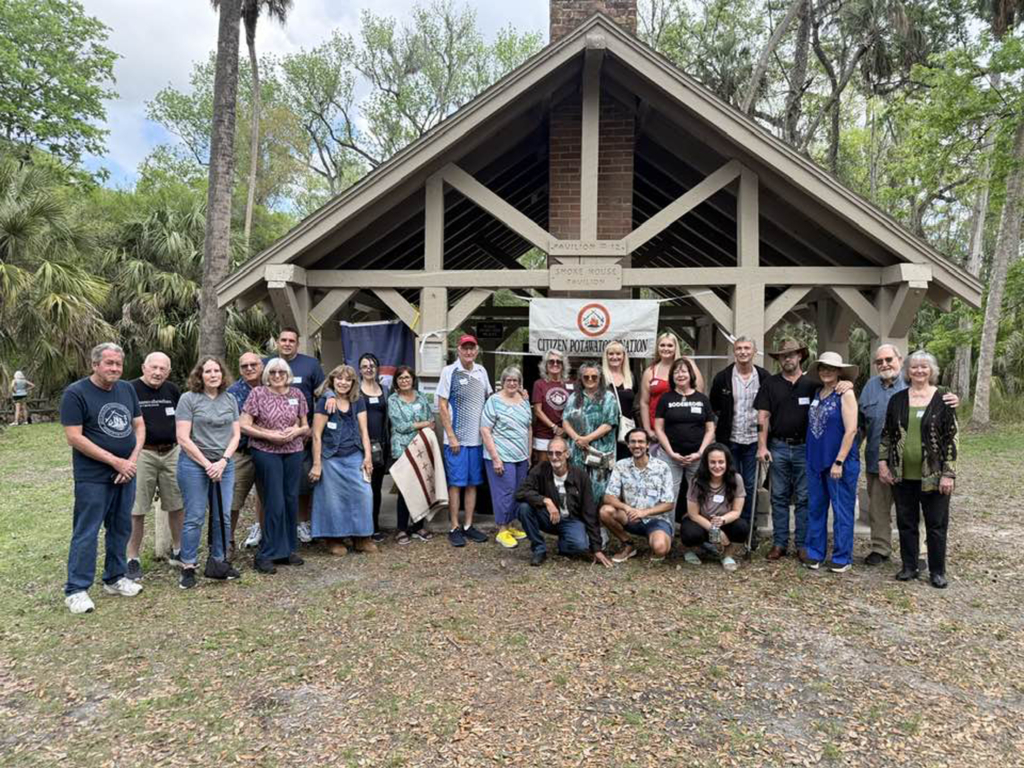
My second cousin Tom Gshipto Adornetto surprised me by driving several hours to attend the meeting; it was great to have another Juneau in attendance, and to catch up with him on our family news. I am grateful to Dennis and his adult children Denise Beil and Eric Johnson, for their hard work and graciousness — among other activities, they arranged for the venue, purchased drinks and supplies, carted everything we needed to the venue, and picked up our lunch from some distance away. Igwien (Heartfelt thanks) for your support!
Family Updates: Condolences and Graduation/College-Bound News
A dear Potawatomi kwe (woman), Shirley Kinne, walked on in late March. Shirley is from the Bergeron/Bazhaw family. She was trained as a registered nurse and was a loving, kind person who I admired for her grace and grit. District 2 was fortunate to have Shirley’s help, back in 2009, in obtaining for us information about IHS-funded clinics in our District — this was before there was a comprehensive website providing that information (ihs.gov/findhealthcaremap). My thoughts go out to all her dear family. May her memory be for a blessing forever.
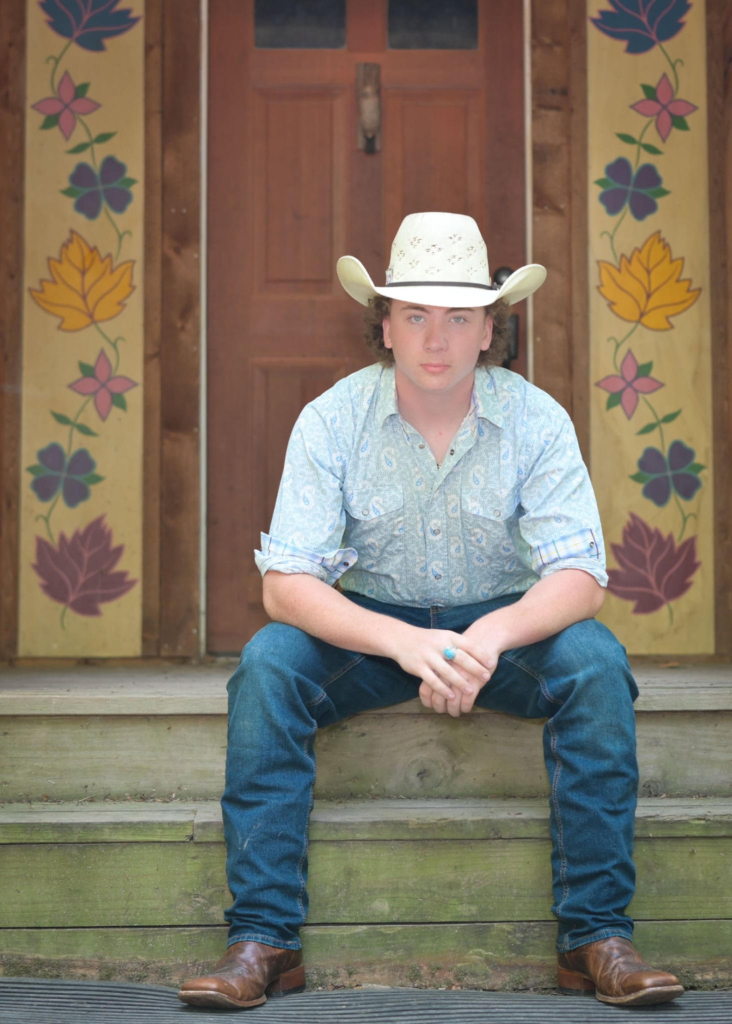
A young man I have known since he was a little guy is graduating high school and headed to the University of Wyoming! As of May 16, 2026, Kent Giwéden Mattena, of Westmoreland, Tennessee, is a Class of 2026 graduate of Westmoreland High School. He will be studying farm and ranch management, focusing on administration and operations. Let us send him off with best wishes and prayers for his bright future doing vital work.
Hand Games Team 2026
Are you attending the Family Reunion Festival this year? Are you interested in joining our seven-member D2 hand games team? Beginners and veteran players are welcome. Please let me know if you are interested. I already have team hats for participants and a few slots are filled! The Hand Games Tournament will take place starting at 6 p.m. Friday, June 26, at the CPN Festival Grounds Roundhouse. Game rules can be found at cpn.news/handgamesemc — or you can wait for pre-game instruction.
Request to Share Future Meeting Location Ideas and Family Updates
Do you have a suggestion for a future D2 meeting location? It should fit at least 40 and ideally 75 people comfortably. Please let me know if you do! Our best meeting locations have been suggested by local residents (like Dennis Johnson’s suggestion of Hillsborough River State Park).
Do you have family news to share? Please send me a note as I would love to include it in a future column.
Migwetch (Thank you),
Eva Marie Carney | Ojindiskwe (Bluebird Woman) | [email protected] | [email protected] | evamariecarney.com | PO Box 5595 | Arlington, VA 22205 | Toll Free: 888-849-1484 (voicemail)
Brenda Trevino
District 3
Bozho jayek (Hello, everyone)!
Our Georgetown Meet-and-Greet was about the same size as the one in The Woodlands (20+). Thank you to those who took the time to travel to our mini reunion. The facility was nice and the weather cooperated until the meeting was over. We discussed information provided by our language department. We also shared the importance of understanding what a large part the language plays in our continued sovereignty. As with our earlier meet-and-greet meetings, information was provided on the CPN Care App, the upcoming Family Reunion in June in Shawnee, Family Gathering with other Potawatomi in July, naming ceremonies and the current progress of construction in Shawnee.
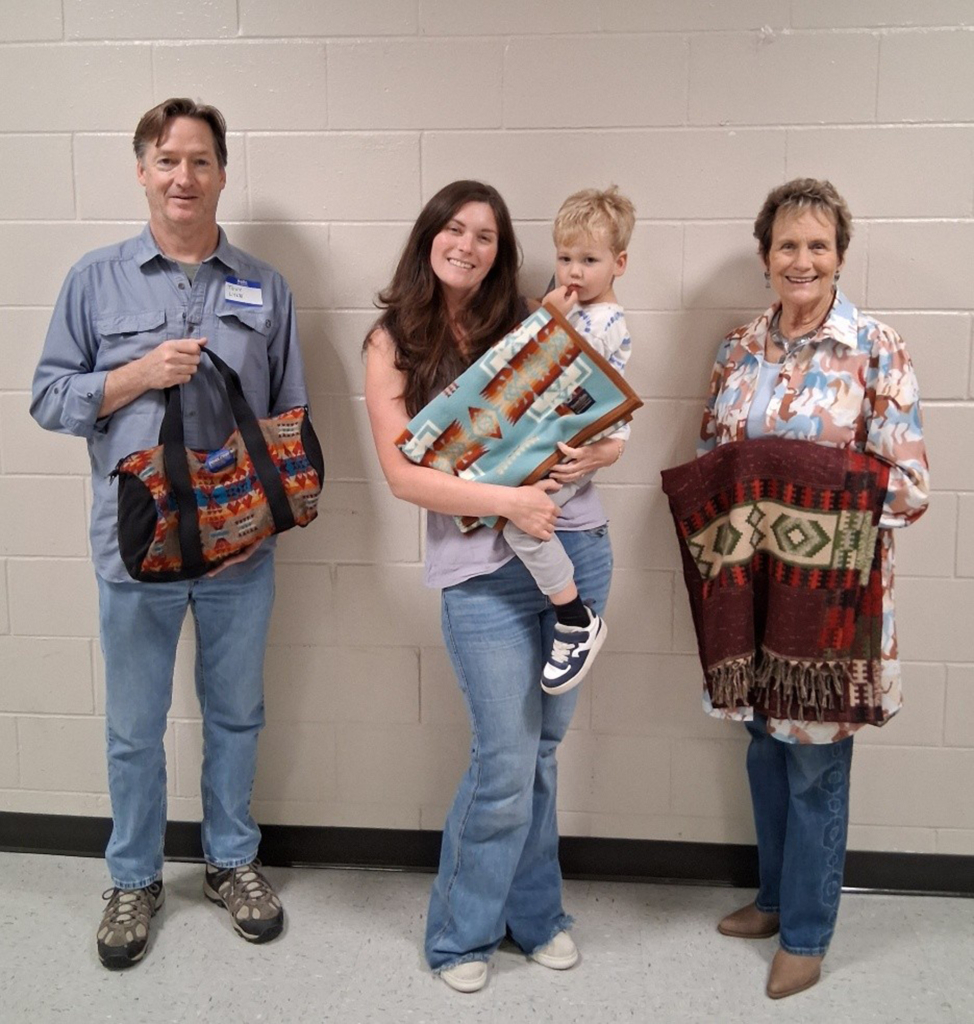
The wisest (Karen Gallagher), the youngest (Ari Sears with mom, Katie) and the one who traveled the farthest to attend (Tony Lyle) were in attendance.
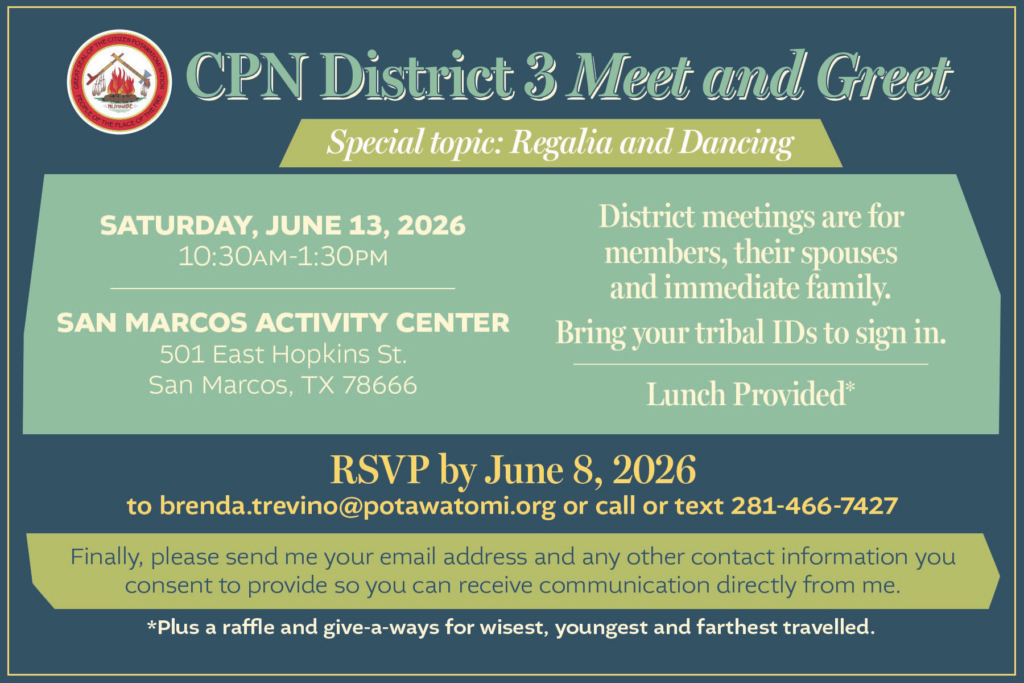
After our May Tyler meeting, one more is planned for June 13 in San Marcos. There won’t be a meeting scheduled to compete with the Family Reunion in Shawnee (last weekend in June) or the Family Gathering (last week in July).
2026 is a year of discovery and connection. I ask those who plan to come to Tyler also to bring questions and ideas about what you would like to see for our district in the future. If you have a particular interest in learning a specific aspect of our culture or services, I want to know. A suggestion box will be provided if you would like to share your ideas that way.
New feedback from the Georgetown meeting reflected an interest in learning our art mediums, specifically beading. Several of those present were also added to the District email list.
Many of you know that travel is a passion of mine. I recently travelled to Antarctica to witness our creator’s handiwork on the most uninhabited continent on earth. It takes little to remind me of the beauty I witness each day, but this trip reminded me of ALL our relatives (jagenagenan); humpback whales, orcas, seals and penguins to name a few. How wonderous is our creator and how amazing it is to experience the marine environment with such little human impact!
May the peace of our God and Creator be with you always. Aho!
Migwetch (Thank you) for allowing me to serve each of you! Please reach out if I can be of assistance.
Brenda Trevino | Mkedewankwetkwe (Black Cloud Woman) | [email protected] | 281-466-7427
Jon Boursaw
District 4

Native American Unmarked Burial Site on Buffalo Mound
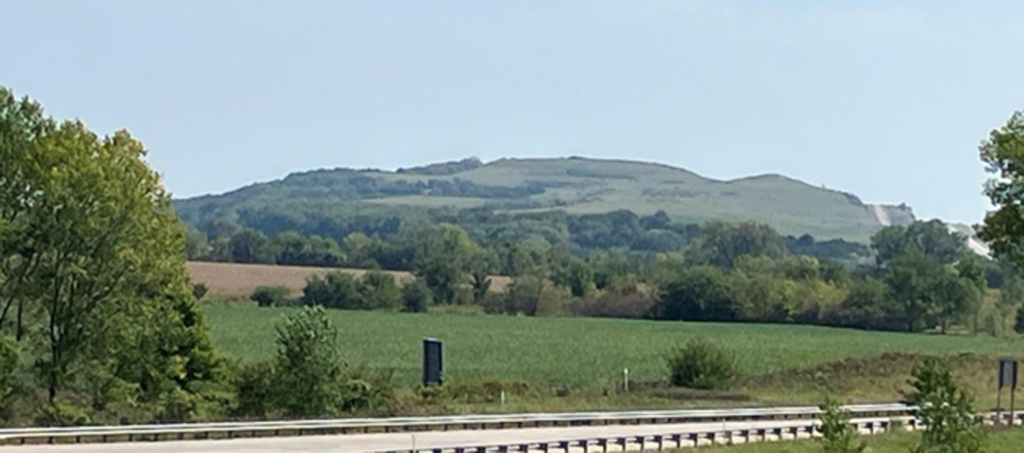
I’ve been involved in another issue involving someone wanting to place a cross on the top of Buffalo Mound. The Mound is located on the north side of I-70 between the small towns of Paxico and Maple Hill approximately 20 miles west of Topeka. The silhouette of the Mound definitely resembles the outline of a buffalo. It doesn’t matter which direction you are headed on the Interstate, you can spot Buffalo Mound 15 miles away. Recently an individual purchased a very large tract of pasture land that includes Buffalo Mound. Then it was disclosed that he planned to erect an 85-foot cross on top of the Mound with an access ramp to and from the Interstate. The plan included a road to the top of the Mound so travelers could enjoy the views or conduct religious services. The only problem was that on top of the Mound is a Native American Unmarked Burial Site. This means the owner cannot make any changes to the Mound including erecting a cross 85 feet tall. I have spoken with the State of Kansas Archaeologist and she informed me that the new landowner has been told that his request to construct the cross has been denied. He does have the right to submit an appeal to the Unmarked Burial Site Board.
Native American unmarked burial sites are protected by the Native American Graves Protection and Repatriation Act of 1990. The State of Kansas has adopted the provisions of NAGPRA as there are over 400 unmarked burial sites in the state, with the vast majority being Native American. Wabuansee County, where Buffalo Mound is located, has eight such sites, of which only one is not Native American.
This is the second request to place a cross on Buffalo Mound. This earlier one occurred about 10 years ago. It was from a state-wide religious group who wanted to place a replica of the famous statue titled Christ the Redeemer (Cristo Redentor) on top of Buffalo Mound. The original of this statue is located near Rio de Janeiro, Brazil. The same individual who alerted me to the latest request is the same one who contacted me 10 years ago. We worked together then to alert the State Archaeologist, William Hoard, now retired. We also contacted Dr. Kelli Mosteller, then the Director of the CPN Cultural Heritage Center, who wrote a very comprehensive letter explaining NAGPRA. We have resurrected her letter for use in defending against this second request.
Upcoming CPN Elders’ Potlucks
Date for the Elder Potlucks held in Rossville at noon are:
June 12 | Hamburgers & Hot Dogs | RSVP by the 9th
Bring your favorite side dish or dessert. Please RSVP to 785-584-6171.
Looks like I had a typo in March’s article
I’ve been made aware of my error. It seems I mistakenly placed South Bend and Twin Lakes in Illinois, when they are both actually in Indiana. I knew that; I’ve been there numerous times. Maybe there should be a map check on our systems like we have spell check.
Migwetch (Thank you),
Jon Boursaw | Wetase Mkoh (Brave Bear) | [email protected] | 785-608-1982 | 2007 SW Gage Blvd. | Topeka, KS 66604 | Office Hours: Tuesday 9-11 a.m. | Thursdays 3-5 p.m. | Other times as requested
Rande K. Payne
District 6

Bozho nikanek (Hello friends),
It all began in 2008. The Tribe was in transition from the old Business Committee era to our current form of government. Prior to the ratification of the new constitution, my siblings and I took our mother to the regional meetings. Those regional meetings seemed more like a family reunion to me and my siblings. It was mostly the elders sitting around eating and socializing. But our mother always had the best time visiting with cousins and other Tribal members she knew from Oklahoma now living in California.
That spring, we attended our first district meeting. This was a radical change from the informal regional meetings. Tribal Rolls was set up for issuing new Tribal ID cards on the spot for Tribal members. There was even a traveling gift shop set up. It was the first time we met Chairman Barrett and Vice-Chairman Capps. We were all so impressed with what we were hearing about what was going on in Oklahoma. After hearing the Chairman speak and visiting with them afterwards, we felt like we were part of something special. After their personal invitation to come to Shawnee for Festival, we went home and began planning our trip. The morning I woke up to get ready to head to the airport, there was an alert on my phone that our flight had been cancelled. I tried finding other flights but due to severe weather issues, there was just no way. Oklahoma had been bombarded with virtually nonstop rain for most of the month of June. We were so disappointed we didn’t get to go but maybe it was for the best as much of the Tribal grounds were either underwater or so saturated it was not usable.
Unfortunately, my mother walked on in January of 2009. My siblings and I attended the District 7 meeting again that spring. It was the first time we had gone to a Tribal event without our mother. I was able to speak with Chairman Barrett and Vice-Chairman Capps after the meeting. The more I learned about what they were doing in Shawnee and the plans they had for the future, the more I realized what great leaders and visionaries they were. Working in the corporate world most of my career, I had a pretty good understanding of what good leadership was and wasn’t.
Most notable to me was Mrs. Capps’ warm and humble way of communicating the achievements of the Tribe. She was quick to credit others with every success. But it was her faith that struck me the most. She shared how she prayed her way through the challenges along the way, again, giving credit to someone else. It became abundantly clear to me that she drew her strength and wisdom from the Lord. I saw a strong inner peace in her and I knew our Tribe was in good hands.
The rest is history, as they say. I’ve had the privilege of working with Mrs. Capps for the last 16 years. Her contributions to the Tribe are countless as many of the most important ones are intangible. I am blessed beyond measure to know her, work with her and call her friend. Her legacy and contributions to the betterment of the Citizen Potawatomi Nation will remain for generations. The love for her people will endure in our hearts forever. I am happy for her and wish her all the best in this new season of life.
Wisdom from the Word: “For even the Son of Man came not to be served but to serve, and to give his life as a ransom for many.” Mark 10:45
Jagenagenan (All our relations).
Migwetch (Thank you), nagetch (later),
Rande K. Payne | Mnedo Gabo | [email protected] | 31150 Road 180 | Visalia, CA 93292-9585 | 559-999-5411
Mark Johnson
District 7

Bozho nikanek (Hello friends),
This past week, there has been quite the discussion from some folks regarding Native Americans and the Fourteenth Amendment to the Constitution as it pertained to the birthright citizenship question before the Supreme Court. The exclusion of Native Americans from the Fourteenth Amendment to the United States Constitution in 1868 was not accidental; it reflected how the United States government legally and politically classified Native peoples at the time. The amendment grants citizenship to “all persons born or naturalized in the United States, and subject to the jurisdiction thereof,” but explicitly excludes “Indians not taxed.” This phrase meant Native Americans who maintained tribal affiliation and lived under tribal governance were not considered fully under United States jurisdiction. At the time, Native tribes were treated as distinct political nations, a concept reinforced by Supreme Court decisions like Cherokee Nation v. Georgia. Granting automatic citizenship would have conflicted with this framework of tribal sovereignty and treaty relationships. The United States policy in the 19th century aimed to manage Native tribes through treaties and federal oversight and encourage or force assimilation on a case-by-case basis. Citizenship was sometimes granted selectively (to individuals who left tribal life), but not broadly, because the government wanted flexibility in how it dealt with tribes. There was also a strong racial component. Many lawmakers in the Reconstruction era after the civil war did not view Native Americans as part of the United States community and considered them members of separate nations rather than citizens. So, while the amendment was expanding rights to formerly enslaved people, it deliberately avoided redefining the status of Native Americans.
Full U.S. citizenship for all Native Americans did not come until the Indian Citizenship Act of 1924, which granted citizenship regardless of tribal affiliation. The Potawatomi Allotment Agreement (1890-1891) was a legal accord between the United States government and the Citizen Band of Potawatomi Indians that implemented the Dawes Act (land allotments) for the Potawatomi in Indian Territory. The Potawatomi Agreement formalized this process for the Citizen Band, enabling each member to receive a personal land allotment and United States citizenship in exchange for ending communal ownership (the reservation). The land allotment fundamentally altered Potawatomi society. While it offered citizenship and legal recognition, it also led to substantial land loss as excess lands passed into non-Native hands. Over time, fragmented allotments and forced sales eroded the tribal land base. The agreement remains a pivotal event in Citizen Potawatomi Nation history, illustrating both adaptation and dispossession under federal assimilation policy. And while citizenship was granted in theory under the Dawes Act and the Indian Citizenship Act of 1924, many still had to go through the process of obtaining their citizenship from the United States government, as evidenced from my grandfather’s paperwork from 1926 from the Department of the Interior, where he agreed to “take a bow and arrow, and shoot the arrow as his last act as an Indian” and to “take the plow handles in his hands, an act having chosen to live as a white man, and a white man is made to work.” Sometimes you just can’t make this stuff up, but it shows what the government thought of us Natives.
Remember to vote! If you didn’t receive your ballot request form, or if it was misplaced, look for one in this publication or online at cpn.news/aballot.
Once again, I would like to say what an honor it is to serve you as your District 7 representative. As always, give me a call and I will be happy to work with you.
Migwetch (Thank you),
Mark Johnson | Wisk Mtek (Strong as a Tree) | 559-351-0078 | [email protected]
Dave Carney
District 8

Bozho, nikan (Hello, friends),
I hope this edition of the Hownikan finds all in District 8 healthy and doing well.
Over the last few years I have become more and more interested in traveling and experiencing local foods and cultures. In December 2025 I was fortunate to be able to travel to Guatemala and experience fabulous Mayan ruins, Spanish colonial plazas with amazing architecture and unique food. This was a once-in-a-lifetime experience, and a special way to experience this part of the world is through their food.
Classic Guatemalan food is an amazing blend of Mayan and Spanish influences, defined by hearty stews (caldos), roasted spices, corn and chili peppers. The national dish, and my personal favorite, is pepian, a spicy chicken or meat stew, followed closely by kak’ik (turkey soup) and jocon (chicken in green sauce).
Applying this lens to our CPN Family Reunion Festival this June in Oklahoma would be an interesting exercise. In a similar blend and clash of cultures, we have Native American foods derived from commodity food, natural and healthy Native American food, southern fried specialties and barbecue.
There’s a lot of joking on the internet about the unlimited brats, hot dogs and fried bologna sandwiches on fairgrounds during the weekend gathering, however I’ve never seen those trailers without a line. Among the more Native offerings are Indian fried bread (with honey and powdered sugar) and Indian corn soup. This corn soup (recipe shared with me by Margaret Zientek) is indescribable unless you have tasted it — and is definitely not vegetarian. It is made in large vats and the recipe (possibly two days in the making and feeding 50) uses the following ingredients:
- 15 to 20 pounds beef
- 24 packages Cope’s dried corn (about one case)
- 1 pound Jamison’s beef soup stock
- 1 large onion
Around our tribal enterprises, there are plenty of good food offerings at various price levels. One of the more expensive, but satisfying, options is “Flame,” located in the Grand Casino Hotel and Resort. This is a Brazilian steakhouse experience with an amazing salad bar, where gaucho-style waiters bring around roasted meat on skewers. On the other end of the cost spectrum are two budget-friendly offerings: FireLake Frybread Taco and FireLake Pizza. They are both worth trying, as are all of the Nation’s culinary endeavors.
There are several barbecue places in Shawnee that are worth seeking out. One of my favorites is Van’s Pig Stand. This is traditional barbecue, including slow cooked brisket and ribs. There are multiple locations, but I like the original location on East Highland. It has been there since 1930 and claims to be the oldest BBQ place in the area. It’s a treat I try to enjoy every time I get to Shawnee, Oklahoma.
A wise man once said to me that he should’ve insured his stomach, because that’s where all his money goes.
Dave Ramsey, the finance guru, says that dining out is not about nutrition, it’s about entertainment.
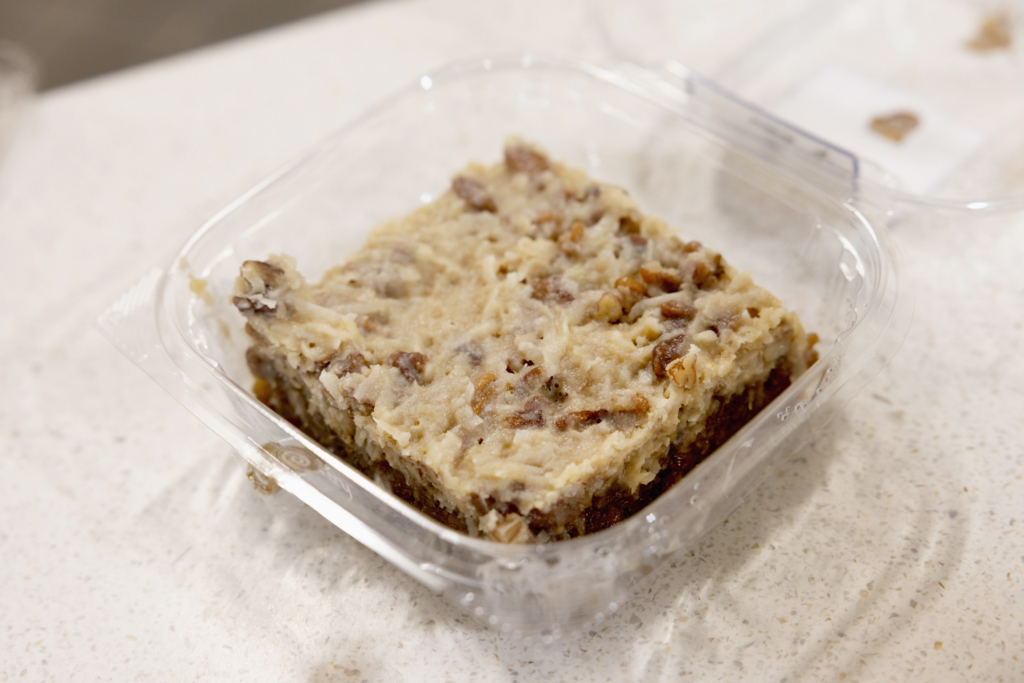
On a final food related note, have you ever heard of the mysterious “Potawatomi cake”? It is both mysterious and famous at the same time. No one knows its true origin, but it is available during the CPN Family Reunion Festival in the bakery coolers at FireLake Discount Foods. If anyone reading this has any information about this cake, I’d love to hear from you. It is very similar to German Chocolate cake.
By the way, save the date — Oct. 24 for the 2026 Fall Feast in Portland.
It is my honor to serve as your Legislator,
Dave Carney | Kagashgi (Raven) | [email protected] | 360-259-4027
Paul Wesselhöft
District 9

Migwetch (Thank you),
I often attend the Oklahoma City Astronomy Club. I enjoy learning and writing poetry about the cosmos. I’ve written a book of poems about the universe. Early Native Americans viewed the Sun as the source of life and the divine power. The moon was regarded as guardian spirit and keeper of time. The stars were considered as ancestors or spiritual entities that provided direction, navigation and wisdom.
I can imagine early Indigenous people being spiritually inspired by the night sky. And I wonder how our Potawatomi ancestors viewed the heavens. Well, for one Potawatomi Indian, below is how I view the planet Saturn:
Saturn
— Paul Chrisstarlon Wesselhöft
Iconic Saturn dressed in the Saturday night sky
Adorned with rings —
A pretty necklace of ice and rocks.
A lovely, stunning figure she is,
This mixture of fluids and fumes,
Invoking the question why?
She orbits the great light as in a dance.
Like a mysterious lady conjuring a trance,
She strikes the eye.
Her two hundred-seventy-four moons
Swirl around her, each like a purse.
Gazing on her inspires verse —
Named after a god,
She’s a wonderful wonder in the cosmos —
This beautiful goddess of the universe.
Paul Wesselhöft | Naganit (Leader) | [email protected] | [email protected]
David Barrett
District 10
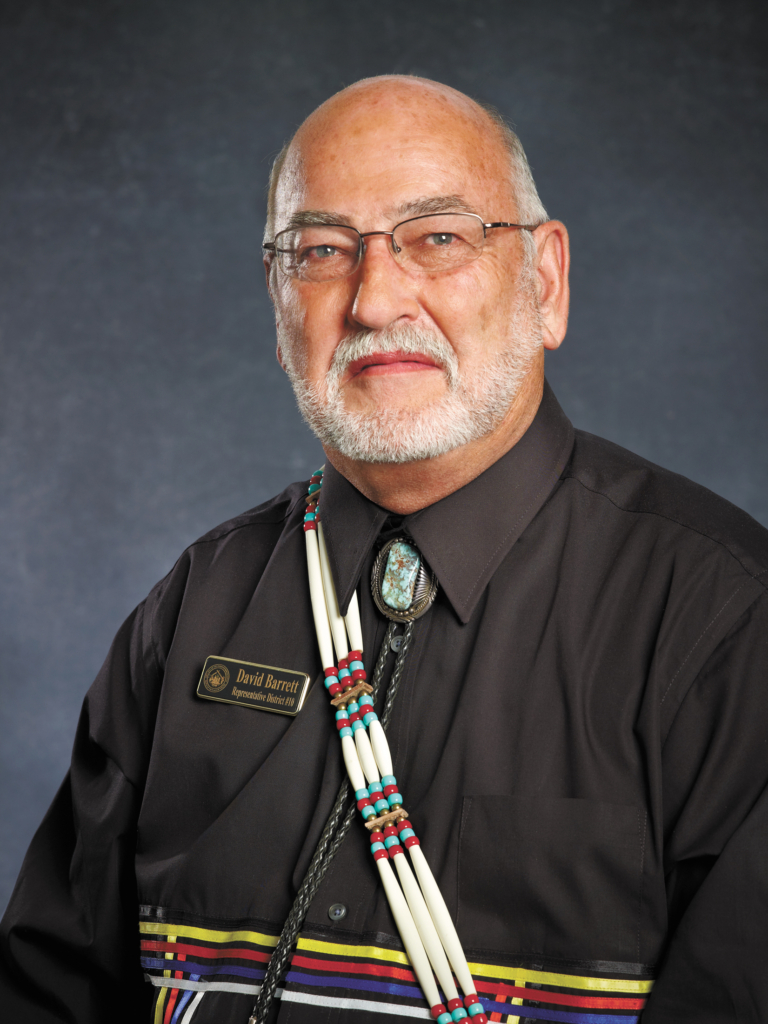
Bozho (Hello),
Allow me to update all the Potawatomi people on what our veterans organization has been participating in for our Nation in the last couple of months. Starting back in October 2025, the Veterans Organization was involved in the Wewoka Sorghum Festival Parade, which is always on the fourth Saturday in October. The Color Guard have been participating in this event ever since the Veterans Organization was formed on June 9, 2009.
We always have a couple of functions on Veterans Day in November. This last year the individual veterans went to their own grandchildren’s programs at different schools but still were able to participate in a veteran ceremory at our local Gordon Cooper Vo-Tech by bringing in the colors and also the folding of the American flag by stating the meaning of each of the 13 folds.
The Honor Guard is made up of some of the Color Guard, but the uniform is completely different, in that we wear a black ribbon shirt with either a gold tie or ascot along with a black beret. The Honor Guard performed two services, one for Mr. Whitehead’s inurnment at the Citizen Potawatomi Columbarium and one for Mr. Bland’s interment at the cemetery.
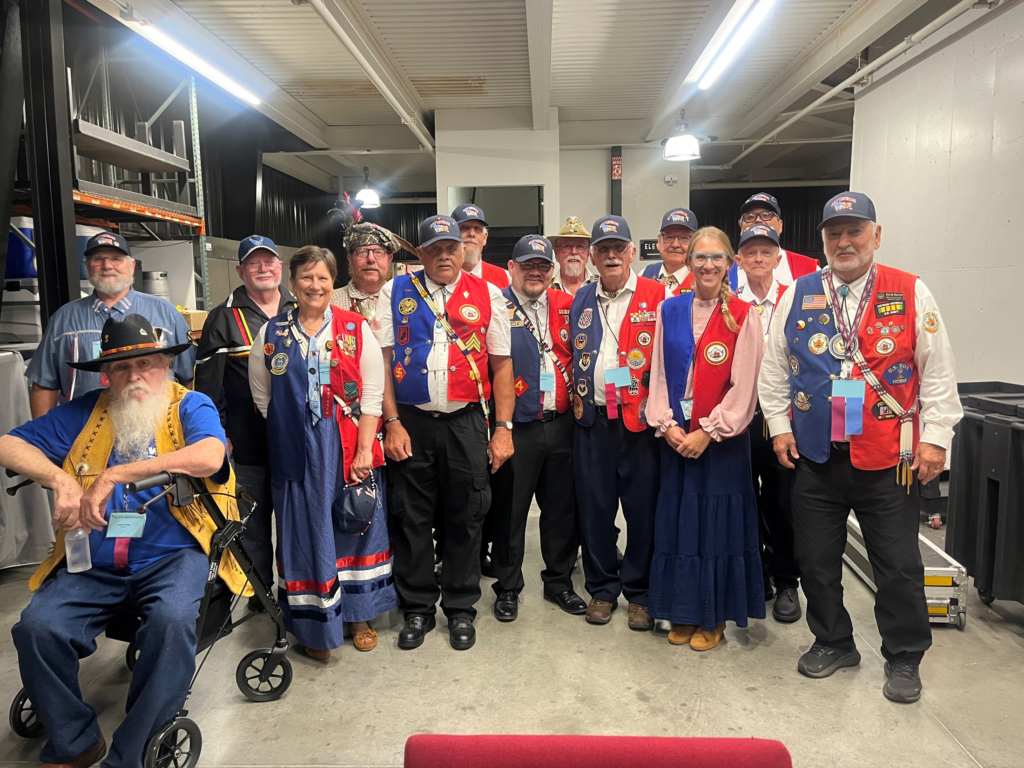
The veteran Color Guard have been asked numerous times to the Shawnee/Tecumseh legislative luncheon where our local state and county officials attended. The meetings are conducted in a manner of telling us what is coming down the pike or they tell us what the problems are and how they are going to attempt to correct them.
Our veterans have always made an effort to oblidge our Nation when they call on us to bring in the colors. It is our pride that we want to be able stand before our Nation and reprensent not only the veterans but also represent our great Nation.
Our veterans meet on the fourth Tuesday usually every month, so if you want to share your Potawatomi veteran pride come to our meeting or catch us when we ride on a trailer in one of the parades that we do. Also, we are hopeful that we will start having Zoom available for our meetings very soon.
I’ve said a lot about our veterans, but I truly think that even as we are veterans, we still are in the need of a dedicated support “machine.” This machine is not “AI” but Always Involved. Vice-Chairman Capps has always mentioned to me how she appreciated me in the realm of the “glue” keeping the organization going strong. Linda, you know what we are talking about and if it wasn’t for you who furnished your personal support “glue,” we might not have the organization as good as it is today. KUDOS to a fantastic supporter and friend. Vice-Chairman Capps and I have talked numerous times and numerous years about getting a Veteran Memorial in order to honor all of our veterans; so far it’s not in the works, but keep hoping!
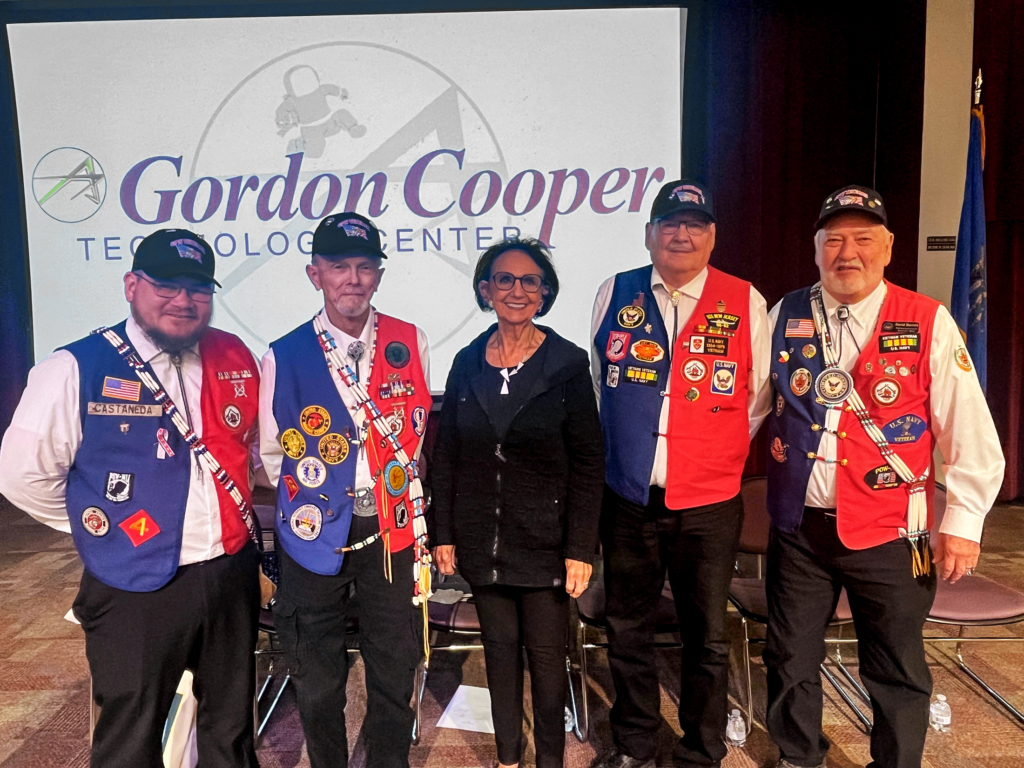
In conclusion, Vice-Chairman Capps and I have talked with each other as friends, as co-workers, as Christians, on family concerns, and always as a person who knows what our veterans means to each of us personally.
I have to mention that my granddaughter Kyla Barrett is graduating this semester from Bethel High School and will be attending Oklahoma Baptist University this fall. As you would expect, we are very proud of her and looking forward to her future endeavors.
Take time to thank a veteran, first responder and a person in blue when you have an opportunity.
It goes without saying that it is both a pleasure and an honor to serve you and our great Nation.
Migwetch (Thank you),
David Barrett | Mnedobe (Sits with the Spirits) | [email protected] | 1601 S. Gordon Cooper Dr. | Shawnee, OK 74801 | 405-275-3121
Andrew Walters
District 11

Bozho (Hello),
We have a problem these days with apathy. Not just in our daily routines, but in our personal Tribal identities. I guess it’s understandable. The Tribe, in everyday life, is not important to a majority of our members. You see, we’re all struggling to get through our daily “white” lives. We are so integrated into that indoctrinated paradigm that the duality of our existence isn’t realized, and hence our identity as “Potawatomi” doesn’t seem to matter. What the government had sought for years, the subjugation and extinction of the Native Tribes, has nearly come to fruition. We have been dropped from the classification of “proud sovereign Nation” to that of “nuisance” by the dominant culture. Our own apathy has contributed to the loss of our personal identity as Native Americans.
Needless to say, our language skills have nearly died out. We dress in the latest fashions. We covet the trendiest homes, gorge the dominant culture’s food and drink. And when we cope with “white” diseases like diabetes, alcoholism, drug abuse, domestic violence, suicide, mental illness, broken families and poverty, we wonder “why?”
We have stopped honoring our elders, supporting our families with generational care, holding our women in high esteem, cultivating our children and helping each other in a collective, compassionate manner. We’ve turned from the Seven Grandfathers teachings. Our prayer smoke seldom reaches the sky.
We’ve lost our skills in “life crafts” that supported the Old Ones. We no longer need to weave baskets, sew moccasins, stitch clothing, or make implements for hunting and processing foods. Those things are considered archaic, useless. We are losing our stories and songs, our deep memories of the past. But even more tragically, our hearts and spirit have changed. That sense of community once cherished by our ancestors has become less important and, in many cases, not felt at all. That deep pride in the accomplishments of the collective Tribe is gone. We no longer participate. We have a “what’s in it for me” attitude. We take. We don’t give.
I am as guilty as anyone. But over the past years I have become acutely aware of the need for Tribal community in my life. I have grown close to others in the Tribe who are now so very important to me. I see things and do things that have great significance to my heart, to my soul. I am changing. I try fervently to walk my own “Red Road.” I falter, fail and fall at times, but I feel deeply compelled to keep trying.
The “Old Ones” lived and worked in a time when Tribal community was important. It was a time of great challenges. A time of formidable hardships, but those hardships acted as a glue, bonding our Tribe together. Back then WE were kinder, WE were caring, WE were respectful to each other. Long ago our children listened to us and understood family, clan and Tribe. Songs were sung and beautiful stories told. The heartbeat of the drum was heard. We knew where we came from. I fear that has been lost.
I don’t know the answer. I don’t have a star to guide me. I don’t know how to get responsible Tribal members involved in a meaningful, sustainable way. I can only hope my words plants seeds and that the seeds find fertile soil and grow. Please, please, find the desire to seek your Tribal roots, your family. Be proud of who and what you are. Find that and hold it close. Somewhere deep in your heart are your ancestors’ songs. Learn to sing them.
Cora and I love y’all.
Andrew Walters | [email protected] | [email protected]
Bobbi Bowden
District 13
Bozho nikanek (Hello friends),
If you’re planning to fly soon, there’s an important update from the Transportation Security Administration (TSA) that Tribal members should be aware of.
Beginning Feb. 1, 2026, travelers who arrive at the airport without a REAL ID or another accepted form of identification will have a new option. Instead of being turned away, they may choose to pay a $45 TSA ConfirmID fee to have their identity verified and continue through security. That verification is valid for up to 10 days of travel. Honestly, $45 is basically the cost of lunch at an airport these days, but it’s still important for people to know their options ahead of time.
What This Means for Tribal Members
The good news is that photo Tribal IDs issued by federally recognized Tribes are still accepted at TSA checkpoints. If you have a valid Tribal ID, you do not need to pay the $45 fee and can proceed through security like any other traveler. This is especially important for Tribal members who may already have acceptable identification and may not realize it.
If a TSA officer needs a little extra time to verify a Tribal ID, that’s normal and does not mean the ID is invalid. Supervisors are available if any questions arise.
When the $45 Fee Applies
The ConfirmID fee only applies if a traveler does not have an accepted form of identification at the checkpoint. TSA recommends completing the ConfirmID process online ahead of time, when possible, as identity verification can take longer than standard screening.
Helpful Travel Tips
- Check the expiration date on your Tribal ID before traveling
- Allow extra time at the airport, especially during busy travel periods
- Bring a backup ID, such as a passport, if you have one
Tribal identification remains a strong and valid form of ID, reflecting both sovereignty and federal recognition. Staying informed helps ensure smoother travel and fewer surprises at the airport.
For the most up-to-date information, travelers are encouraged to visit cpn.news/confirmid, review acceptable identification at cpn.news/id or follow guidance shared by national Tribal organizations such as the National Congress of American Indians at ncai.org.
Migwetch (thank you) and safe travels wherever your journey takes you.
Thank you for allowing me to serve you and our great Nation.
Bobbi Bowden | Pkuhshnoqua (Bald Eagle Woman)