The traditional winter game of snow snake is enjoying a resurgence across Turtle Island. Several Nations, including some Potawatomi, hold snow snake events. Whether tribal Nations are re-introducing the game to youth or hosting competitive tournaments, it is a positive way to bring community together.
“It’s definitely made a comeback in the last several years. I remember someone saying that in the ’50s, it kind of just died out,” said Justin Neely, CPN language director. “But now there are tournaments all over and a lot of different tribes will play it. Whether it’s the Anishinaabe people, the Odawa, Ojibwe and Potawatomi up in the Great Lakes, or the Iroquois Confederacy, there’s quite a few tribes that do have tournaments with snow snakes.”
Neely lived for a few years in Michigan and played the game. Fortunately, whether Potawatomi live up north or down south, there are several ways to play.
The basics
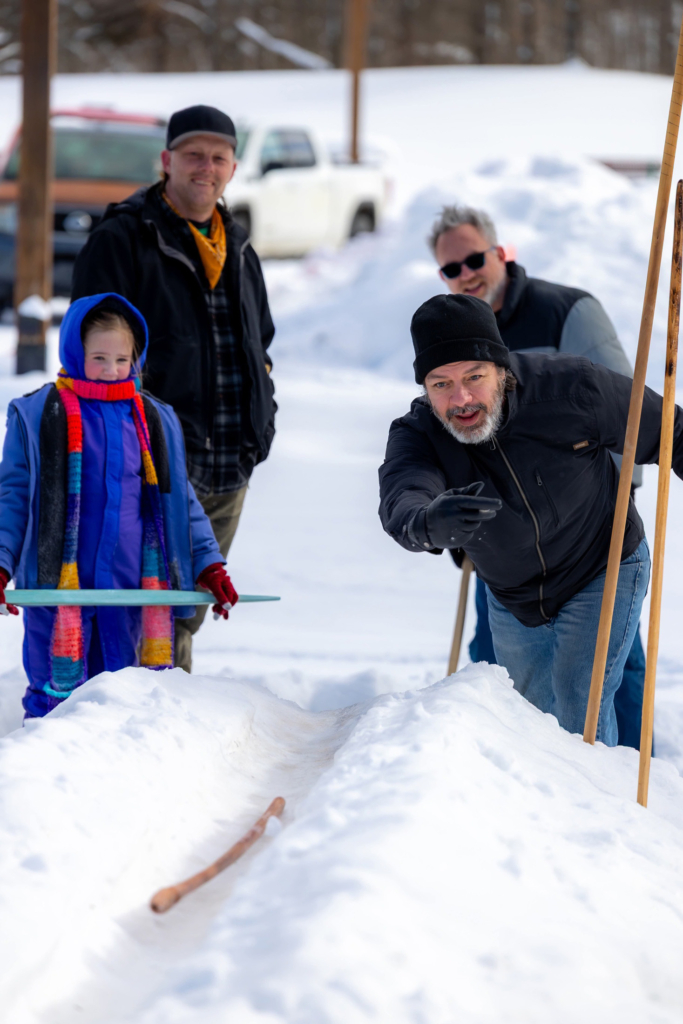
A snow snake track is about 500 ft. long and resembles a trough. The snow can be banked up a few feet high or banked up several inches off the ground. A log or branch is then dragged through the center of the snowbank to create the trough. Water is applied to the trough to create an icy, slippery surface that the snakes glide over.
“I’ve heard it’s pretty strenuous building one of those. A lot of times it might take six guys to do it,” Neely said.
Alternatively, an icy, flat surface may be used, such as a paved area. However, players should use caution when walking along the icy surface. It is also possible to play across the surface of a frozen lake or pond, but only when players can ensure the water is frozen solid and able to hold their weight.
The snake is made from wood, usually maple or hickory. A straight branch about one inch thick and anywhere from two to five feet long is selected, and one end is carved to resemble a snake’s head. The stick is then polished smooth and decorated. A small notch on the underside helps with grip.
Like many competitive sports, individual players have a variety of preferences. Some choose to weight the snake’s head with a pewter tip, Neely said. Other players prefer certain polishing oils or wax to help the snake glide faster over the snow and protect it from water. This also helps preserve the snake over time.
Players use an underhanded motion to throw the snake.
“Someone described it like bowling. You would have your finger in that little notch that would help you hold onto the snake. Then the most important thing is to get a nice flat throw,” Neely said.
He said whether players approach in a running motion or walking is a personal preference. It’s more important to achieve a flat throw, which should increase distance.
“At some of these competitions, most people will have a cloth with them because you don’t want your snake to be wet because it’ll slow it down,” he added.
Winners may be selected in a few different ways. Sometimes the individual whose snake traveled the greatest distance wins, or it could be a team competition. Another game may involve players trying to come closest to a fixed point without hitting it.
The competition rules vary from tribe to tribe.
“The way people do it is going to vary a little bit from area to area,” Neely said. “The individual rules are probably more along the lines of how you throw, in what order, things like that. So it’s hard to pin it down to definitive rules.”
Prizes can vary. Tournament winners may receive cash, trophies, blankets or shawls. Some competitions involve each player putting a dollar in a jar and the winning player receives the cash. Others involve good-natured teasing and bragging rights at the end.
Whatever the prize, Neely is pleased to see the sport making a comeback. Snow snake has created some memorable moments.
“Somebody told me that in the ’80s, Sports Illustrated went to Iroquois country and clocked some of the folks throwing the snow snakes. One of them went for over a mile and was going 65 miles an hour, so they can get going pretty fast. The straightness of your track affects how far you can throw it because if it’s crooked it’s going to slow things down,” he said.
Alternatives
For those without snow, there are other ways to learn the game. Whether using a flat surface or simply using household supplies to hold water and letting it freeze, there are ways to compete.
“If you had a large, open area, maybe a field where you could smooth out the ground, theoretically could put some water down and kind of maybe create a track like that. I guess if you have to, you could do it like a slip and slide,” Neely laughed.
Some online retailers sell small, backyard skating rinks. Across social media, snow snake players have creatively used discarded household guttering, or dug a trench and filled it with water, then allowed the water to freeze.
Neely pointed out that some CPN members who live in colder climates may be able to find a local demonstration or competition. Residents of Illinois, Michigan and Wisconsin and along the northeast, including Pennsylvania, New Hampshire and New York, may be able to attend in person. Some snow snake events welcome the public and include food trucks and traditional singing. It’s best to check with the Nation hosting the event to find out if visitors are welcome.
Neely said he wishes there were more chances to play the sport in the south.
“It’s a community-type event. I wish we had the weather with us. We never know when it’s going to snow. You can’t plan around it like, ‘Oh, it’s supposed to snow.’ If it does snow, it may or may not last more than a couple of days. You have to be ready to move when the weather hits, I suppose.”
For those who live in less snowy conditions, a virtual snow snake game is available via the Cultural Heritage Center both in person and on a mobile device.