During the dedication ceremony for Fire Keepers Circle, Citizen Potawatomi Nation tribal members heard from Minnesota-based artist and architect Aaron Squadroni, who worked on the project.
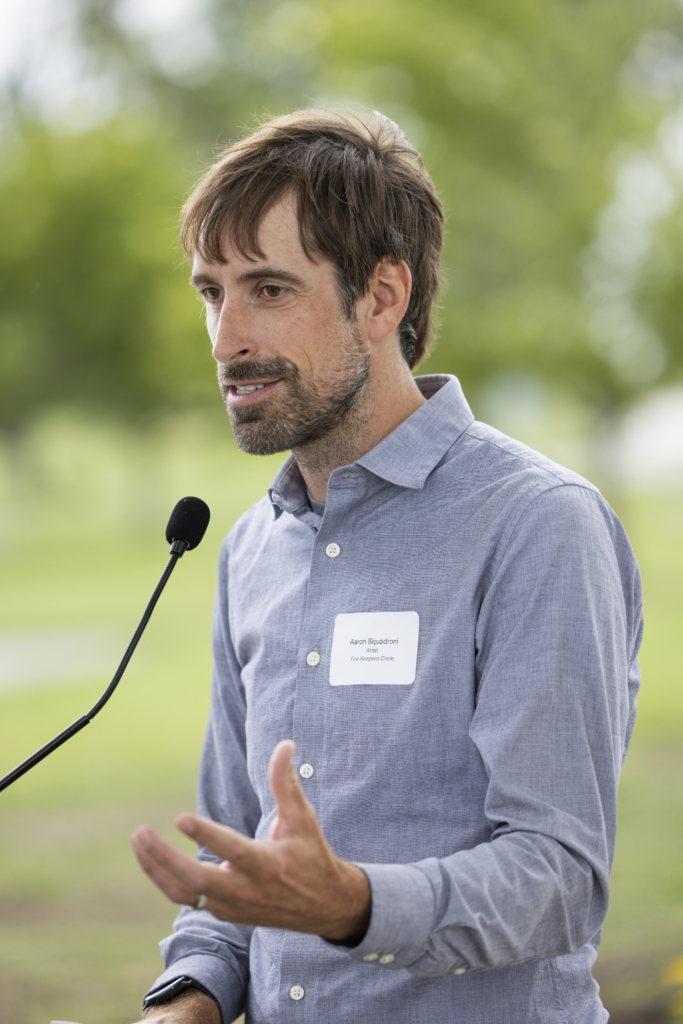
In his remarks, Squadroni thanked the Citizen Potawatomi Nation for embracing the design and contributing to the artwork itself.
He also shared his thoughts on artist Leah Yellowbird (First Nations Algonquin-Métis and Anishinaabe), who also worked on Fire Keepers Circle. Yellowbird walked on in April 2025.
“She was very proud of this project and was really excited about doing the artwork. She will be greatly missed, but I do think her vibrant personality and her warm spirit live on through the people that she’s inspired and through her many artworks,” Squadroni told the crowd.
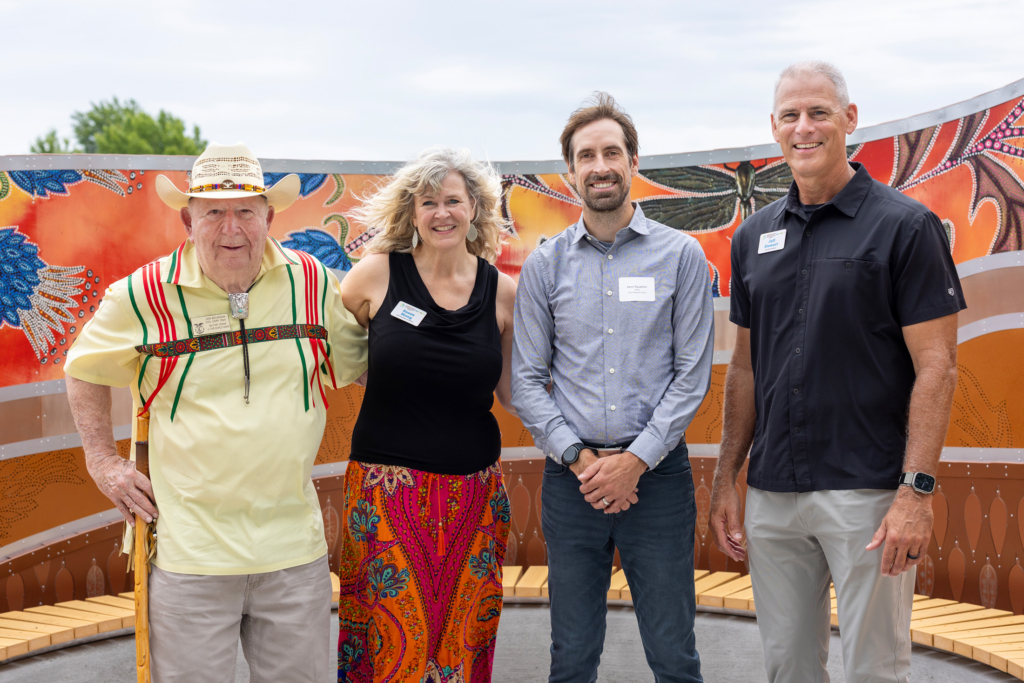
What made Fire Keepers Circle unique is that it was designed to make the viewers feel like they are part of the artwork, he said.
“Typically, when you see a sculpture, you walk around it, and you’re separate from it. We had this idea of artwork that surrounds you. The artwork feels like it’s missing something unless there’s people gathered there. Then we had the idea of a blanket that wraps the seating area and embraces the viewer as they come to look at it,” he said.
The feather designs, contributed by Tribal members, give voice to the ancestors because many of the designs came from an ancestor’s belt or moccasins. They gave the artwork integrity and strength of expression, he said. Squadroni and Yellowbird believed the contributions were a generous gift to all who visit now and in the future.
Creative process
Squadroni and Yellowbird worked on several projects together. Some of the most recent include the metal canoe sculpture “Riverwalk Canoe” in Grand Rapids, Minnesota, “Iron Range Wall Panels” in Virginia, Minnesota, with metal panels and a terrazzo floor design. They also created “Enduring Patterns Community Quilt,” a Covid memorial for Bloomington, Minnesota, that evoked a community quilt to pay tribute to those lost and to healthcare providers.
When working on a project, they often exchanged sketches and ideas back and forth. When they had settled on a creative direction, Squadroni would work on a three-dimensional computer model while Yellowbird refined the painting, selecting color and details.
“We’re trying to do something that’s specific to the place and the nature of the project each time and so we end up working with a completely different set of ideas. The fun thing about doing sculptures is there’s more leeway to be experimental and try out new techniques and materials,” he said.
Special projects
Squadroni said designing memorial projects is different, particularly those like Fire Keepers Circle, which remembers the Potawatomi Trail of Death.
“You’re trying to show honor and appreciate people that made a sacrifice, or people that went through a difficult time, people who are no longer with us. There’s a strong element of remembrance and reflection that is important for communities to have so that they can look back on that and understand the history better,” he said. “The nice thing about public art is it can express values that don’t typically get expressed. That could be spiritual, it could be something about the history of a place. It could be what the community feels is important in relationships between people.”
The dedication ceremony was important, as it gave him an opportunity to finally meet with the descendants of those who survived and those who were lost on the Potawatomi Trail of Death.
“It was nice to interact with the members of the Tribe and some people gave me gifts and I really appreciated that,” he said. “I don’t think I’ve had another public art dedication that’s had that much participation. I really wish Leah could have been there; I think she would have really enjoyed it.”
Remembering Leah
Squadroni said he will remember Yellowbird’s vibrant spirit, quirky sense of humor and her giving nature. A skilled beadwork artist, her paintings often included the smallest details, he said, the attention to detail she carried over into how she treated people.
“Her artwork is a very good representation of her spirit, and I think of her having this very warm, friendly, engaging personality. When I look at her paintings, they’re very colorful and vibrant. There’s a lot of detail, because she’s using a pattern that’s drawn from beading. She gave you her full attention and energy when she was with you,” he said.
Squadroni said Yellowbird treated his 5-year-old son as a grandmother would treat a grandchild.
“She really took on the role of taking him to movies and hanging out with him. Sometimes it was hard for us to get things done on our art project because she would be hanging out with him. They got along really well because she’s really caring and giving,” he said. “It was a sad loss for our community in Grand Rapids because she added a lot to the art community, the greater community and the Native community.”
To view more of Squadroni’s art, visit squadronistudio.com.