Each year at Family Reunion Festival, several of CPN’s founding families are honored.
For 2026, honored families are the Acton, Bergeron, Bruno, Curley, DeLonais, Greemore and Slavin families.
The Hownikan publishes family history articles highlighting honored families throughout the year. Find stories on the Acton, Bergeron and Bruno families in the January, February and March editions. The Curley family will be highlighted in the July issue, with DeLonais, Greemore and Slavin following in subsequent months.
To see the honored families scheduled through 2028, go to cpn.news/honoredfamilies.
What to do at Festival
Are you a member of one of the families being honored? Festival might be a good time to connect to family you haven’t seen in a while or to meet new family.
However, there are also events you can participate in during the weekend.
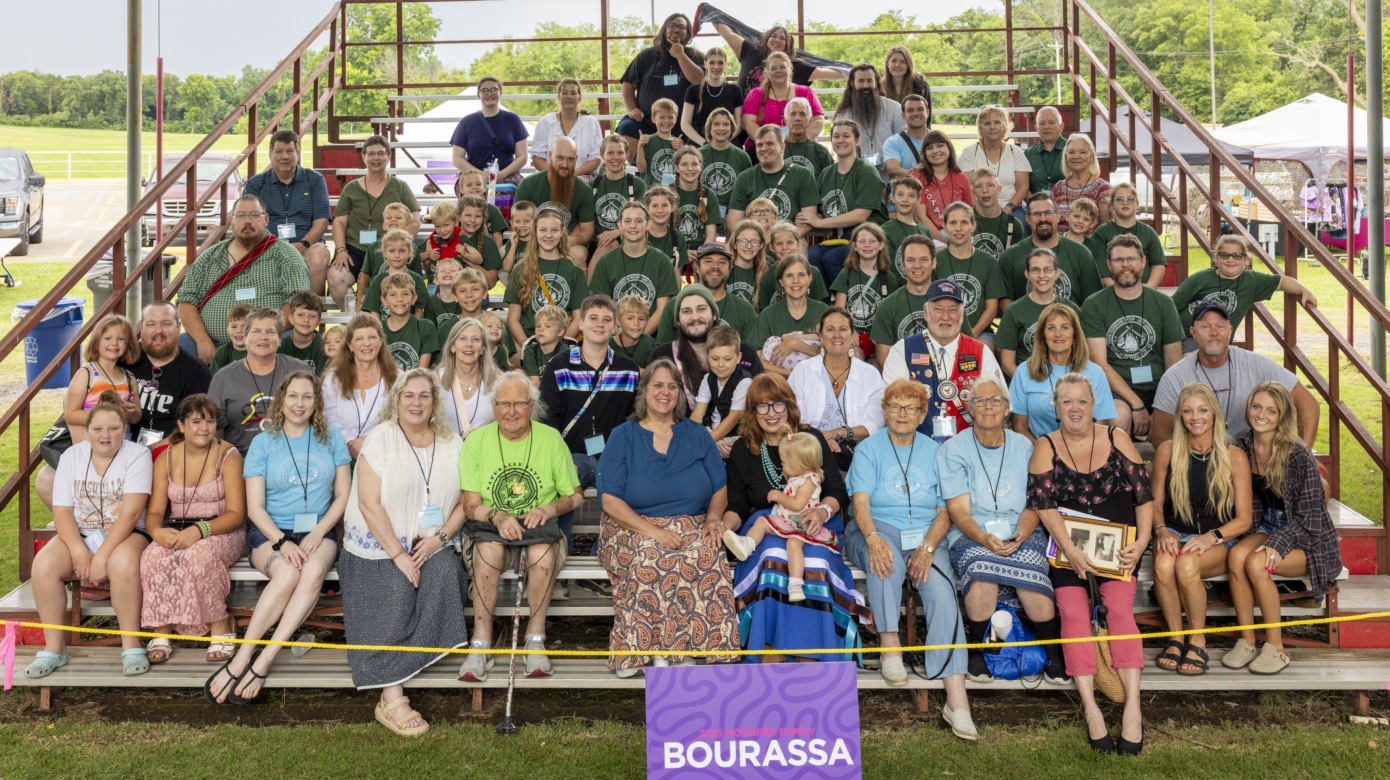
Each year, photos are taken of all of the honored families. Go to the dance arena at 9:30 a.m. on Saturday to join in a group photo for your family.
Honored families also lead the way into the dance circle at Grand Entry during Saturday evening’s powwow.
You might consider participating in heritage interviews at the Cultural Heritage Center. The interviews are intended to capture an oral and visual record of Tribal members and their experiences. Schedule an interview at portal.potawatomi.org under the Festival interviews tab.
If you have ever wanted to research your family history, Festival is a good time to get information on how to start. CHC Collections Manager/Registrar Peter Kavourgias will explain how to navigate the CHC’s research platforms at 10 a.m. Friday and again at 10:15 a.m. Saturday in the CHC classroom.
CPN’s founding families
It is a longstanding tradition for the Nation to recognize the 49 families that make up the Citizen Potawatomi Nation.
The Indian Removal Act of 1830 forced thousands of Native Americans, including ancestors of CPN tribal members, to walk from their homes in the Great Lakes to reservations west of the Mississippi River and eventually south to Indian Territory. Multiple removals took place from the 1830s to 1850s, with ancestors moving from Wisconsin, Illinois, Indiana and Michigan.
Some Potawatomi families were removed to Missouri and later Council Bluffs, Iowa, while others moved to the original Kansas reserve in eastern Kansas. Later, all removed people would be consolidated on a single Kansas reserve near Topeka.
In 1861, members of the Potawatomi Nation met with federal agents to sign a treaty that promised to acquire fee-simple land allotments and a chance to apply for U.S. citizenship (though the majority did not receive citizenship until the 20th century). After signing a subsequent treaty in 1867, families sold their allotments and used the proceeds to purchase a new reservation in Indian Territory, where CPN has its headquarters today.
This information and more is available through the Citizen Potawatomi Nation’s Cultural Heritage Center, which provides resources to keep the Tribe’s history safe and accessible for generations to come.
Those who may have Citizen Potawatomi family photographs, documents or other relevant items and would like to assist with preservation efforts by providing copies can contact the CHC at 405-878-5830.