
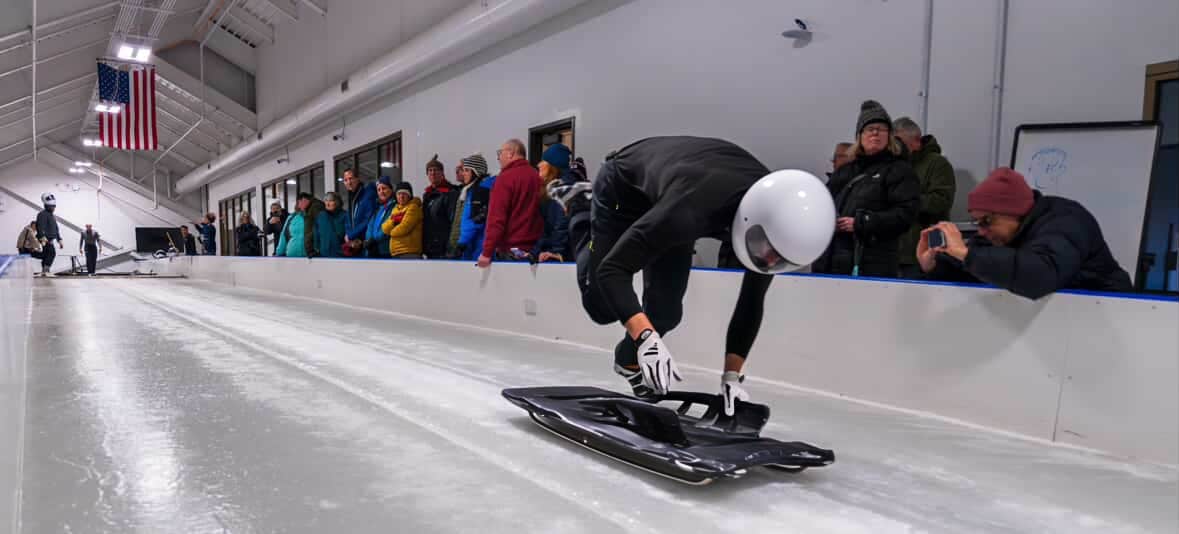
Alex Samples, a member of the Slavin family, found a link online encouraging athletes to try to join Team USA in the Olympics, and now he’s training to qualify in the sport of skeleton.
Skeleton is one of the events in the Winter Olympics in which athletes start with a 30-meter sprint to build speed before launching themselves onto a sled, sliding face down through an ice track. Athletes then steer with knees, shoulders and toes, reaching speeds of around 80 miles per hour.
Samples originally competed in track and field, primarily the long jump, as a D1 athlete at Oklahoma State University. After college, he saw an advertisement online encouraging athletes to try to make Team USA, so he sent the information to his mother, who encouraged him to try.
Samples went to Salt Lake City, Utah, in 2024, where he participated in a combine and was selected to try skeleton.
According to a press release advertising the most recent combine, athletes at the combine are tested in five events: 40-yard sprint, 5-10-5 pro agility shuttle, vertical jump, kneeling power ball toss and prowler push test. Top performing athletes are then invited to attend a rookie camp to take the next steps.
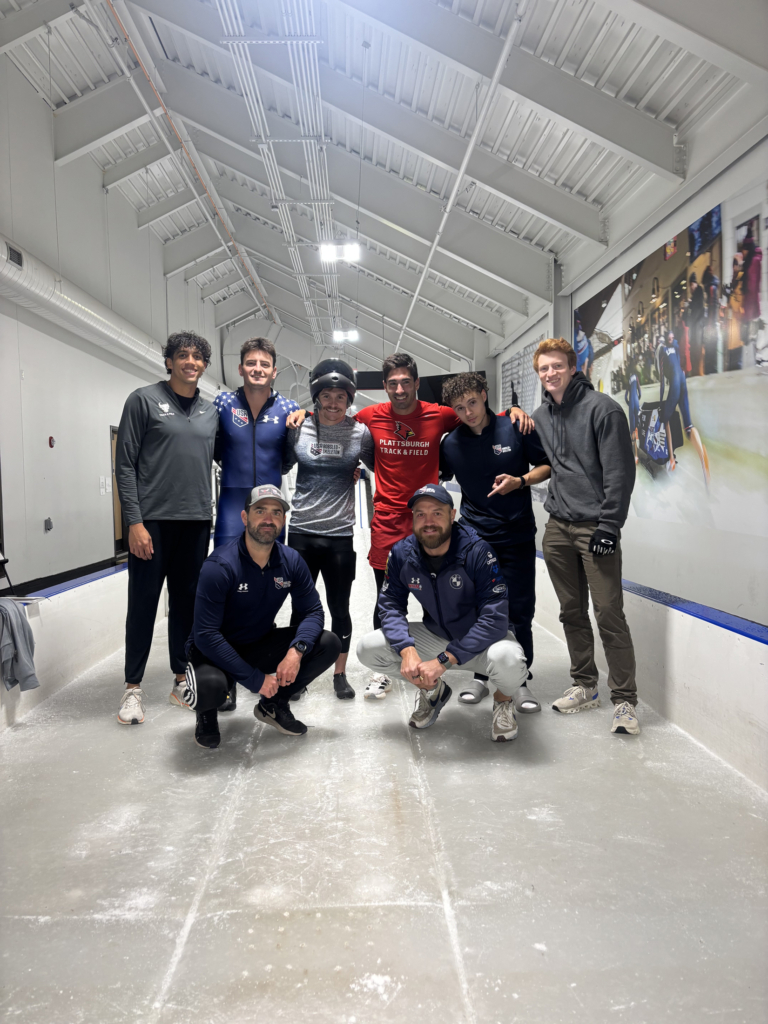
When it comes to changing from track and field to skeleton, Samples said the events are actually similar for about 40 meters when he’s sprinting to start. After that, the experience changes.
“It’s definitely exhilarating,” he said. “I mean, to go head first downhill, being two inches off the ice, going 80 miles per hour … it’s definitely a wild feeling, especially going around some of the curves. We pull about 5Gs when we’re going our fastest. That, to me, was the biggest shock on my body. I’ve never felt anything like that.”
Samples started his first camp in November 2024. Now he is training to try to give himself the best odds for a ticket to the Olympics.
“It’s been very interesting, especially being from Oklahoma. We’re a flat state. No one considers us a winter state by any means. So it’s definitely been something I’ve had to adapt to,” he said.
While at home, he does lifts and strength and speed training. He estimates he probably lifts three or four times per week for an hour.
“We can’t actually slide or push a sled anywhere except Utah and Lake Placid in New York,” he added. “That’s very minimal, because we slide and it takes a minute to get down the track. So our true ice time in a year could be less than an hour. It could be around two hours a year where we’re actually sliding on the ice and getting those reps in.”
Much of training, Samples said, is keeping himself in shape and taking advantage of any opportunities he gets to slide. During the season, which starts around November and typically ends in March, he is able to go to Lake Placid to train about once a month for one or two weeks at a time.
“It’s a lot of travel, a lot of expenses, and a lot of time taken away from work, family, friends,” he said. “I’m getting used to that and getting used to being gone and making that sacrifice, but I’ve enjoyed every minute of it.”
And on top of his Olympic aspirations, Samples also holds down a full-time job as a commercial real estate agent in Oklahoma City. It’s something he said many athletes have to do to financially support their goals.
Now that the 2026 Winter Olympics are in the books, the “quad year,” or the four years between every Olympics, begins. During this time, Samples said he and other athletes will race on a circuit, earning points by competing in races throughout the year. Only 25 sleds go on to the Olympics, so the goal is to get enough points to be in the top 25 and to get a bid to qualify.
When it comes to considering his odds, he said he tries to stay positive.
“I hope they’re pretty high. It’s a sport that doesn’t have a lot of people,” he said. “There’s some great athletes within the program that I’m going to have to compete against throughout my career, but I’m going to do everything I can to put myself in positions to have that opportunity.”
For now, his plan is to race the North American Circuit, then hopefully progress up to a European Circuit or the World Cup Circuit in an Olympic year to get as many points as he can.