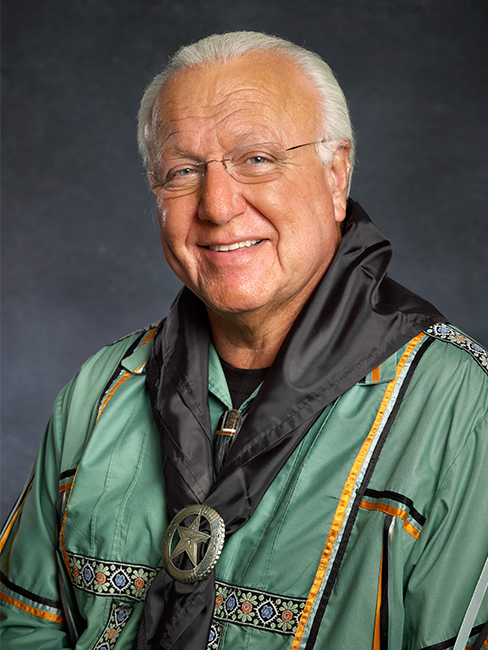
John “Rocky” Barrett
Tribal Chairman
Bozho, nikan, (Hello, my friend),
Our government long ago made the decision to focus on investments that benefit our people, and consequently our local communities. In partnership with Vice-Chairman Linda Capps and dozens of former and current elected Tribal officials, we sought to be a source for Tribal citizens to succeed — ideally, right here with us in our Tribal jurisdiction.
Thanks to qualified leaders like Vice-Chairman Capps, we’ve made significant progress in these efforts. With her declining to run once more, our Tribe is losing a highly intelligent, capable and caring executive who has helped steer the ship for more than two decades. Running our Nation is a massive undertaking. With 46 departments, over 2,300 employees, and a $679 million operating budget, we are the largest employer in Pottawatomie County. Because we manage the interests of nearly 40,000 Tribal members, it’s essential that our team has the high-level skills needed to protect our funds and grow our businesses.
You’ve trusted us to look out for your families, from your children’s education to your own needs as you age. To continue that, we’re focused on growing our economy as fast as our population and turning those earnings into top-tier services and great jobs for our community.
With that in mind, I wanted to note the progress we’ve made in one such community investment that will serve our Tribal citizens and neighbors in southern Pottawatomie County. It doesn’t get all the attention it deserves, but to our citizens and neighbors down south it will be a game changer. We recently advertised a project solicitation seeking a qualified construction manager for a new grocery store in Asher, Oklahoma. The project involves developing a roughly 6–8-acre site to build a full-service grocery store spanning approximately 18,000 to 22,000 square feet, featuring a loading dock and a partial second-story office space. Interested firms are required to notify the Tribe via email by 2 p.m. on April 30, 2026. You can see the solicitation at cpn.news/asher.
This isn’t a flashy investment, and it is not a giant revenue maker like a casino. But it matters. The fresh foods, the jobs, the presence of a reliable enterprise in a community — it’s a game changer. It means customers living there who are in need of groceries won’t need to spend 30 minutes on the road, burning expensive gasoline, to drive to the closest full-sized grocery store in Tecumseh, Ada or Purcell.
Outside, commercial entities do not care about our rural, Oklahoma communities the way those of us who live here do. Our elected officials in Oklahoma City and Washington D.C. forget about these communities. But at Citizen Potawatomi Nation, their success is tied to our success. Having elected leaders who can evaluate these opportunities and put them into practice is vital.
Thank you for the honor of serving as your Tribal Chairman these past 40 years. It is the greatest honor of my life.
Migwetch (Thank you),
John “Rocky” Barrett | Keweoge (He Leads Them Home) | Tribal Chairman
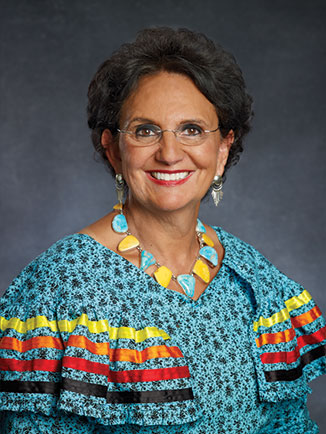
Linda Capps
Vice-Chairman
Bozho (Hello),
My column this month is to pin-point some important occurrences during and right before my tenure with the Tribe as Vice-Chairman since June 1990. Prior to that time, I served on the Grievance Committee for two years. I have also noted what I believe is a monumental component of the Citizen Potawatomi Nation’s economic success. In addition, I included an introduction to my experience working with Indian students and teaching school in Pottawatomie County.
I have a documented timeline of important events that occurred in the 1980s before I became the Vice-Chairman of CPN (June 1990). I began noticing Tribal matters when I became the Indian Education Coordinator for Tecumseh Schools in August of 1977. Tecumseh Public School Superintendent Alva Melot (enrolled member of CPN) informed me of the position in case I wanted to apply. It was the first year Tecumseh Schools had received the grant award. I was honored that the superintendent told me about the position, but there was not adequate grant funding for a full-time position. There was a need for a part-time high school business teacher, so I chose to teach for half a day. The jobs complimented each other, because many of my high school students were also participants in the Indian Education Program.
My late husband was the high school boys’ basketball coach, a driver’s education instructor, and social studies teacher at the school. We enjoyed the community, and I appreciated being close in proximity to the Tribal headquarters, which was a new experience for me. Most tribal students attending the school were members of CPN, Absentee Shawnee, Sac & Fox, Kickapoo and Seminole tribes. Working with the Indian students sparked my love for Indian education and instilled appreciation for the local Indian people of the various tribes.
None of the elected official positions in the Tribe were full-time jobs, and so I continued to teach in public school and later worked at the local vocational education school until I retired from education in the late fall of 1998. At that time, I came to the Tribe as Vice-Chairman and I officed in administration, where I am today.
During the 1990s, progress was beginning to evolve in Indian Country. Our Tribe, too, was making progress with internal structure. There were some strategic developments initiated, of which a major portion was due to Chairman Barrett’s Tribal involvement in the ‘70s and ‘80s when he served as Vice-Chairman and Tribal administrator. He was elected Chairman in 1985. Some of the key developments were the establishment of the Tribe’s Tax Commission (1984), opening of the first Tribal Convenience Store (1984), taking control of High Stakes Bingo with a name change to FireLake Bingo (1985), and establishing the Tribal Court System (1986).
A monumental landmark for all tribes occurred in 1988 with the passing of the Self-Governance Amendment (Public Law 93-638) to the 1975 Self-Determination Law and Education Assistance Act. Although the Rule of Law did not become effective until Aug. 23, 1996, it was the beginning of the framework that helped tribes to increase control of their own programs and services, which contributed to the overall growth and development of Indian Tribes. The change allowed them to improve services, have flexibility of choosing options, concentrate on their tribe as a community and begin to thrive economically. I believe this to be a highly important ingredient to CPN’s success and economic growth that occurred during my tenure.
Thank you for allowing me to represent you for so many years as your Vice-Chairman. It has been a blessing to me and the highlight of my career.
Migwetch (Thank you),
Linda Capps | Segenakwe (Black Bird Woman) | Vice-Chairman | Work: 405-275-3121 | Cell: 405-650-1238 | [email protected]
Steve Livingston
District 1

Bozho (Hello),
As I begin, I want to acknowledge that this column will sound more pointed than what you may be used to from me. Today I am choosing to be more direct. I believe low voter participation is one of the greatest threats to our sovereignty, and it deserves honest reflection.
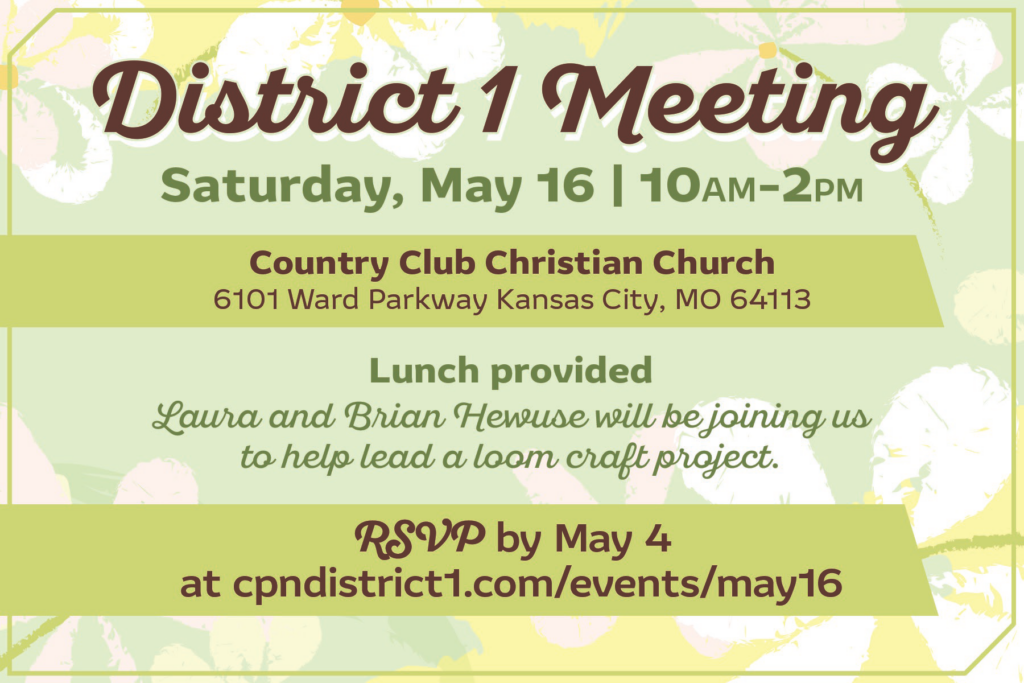
Before I get into that, I want to invite District 1 citizens to join us for our next meeting on May 16 from 10 a.m. — 2 p.m. Laura and Brian Hewuse will be joining us to help lead a loom craft project. For details and to RSVP, visit cpndistrict1.com/events/may16. To stay informed about upcoming events, visit cpndistrict1.com/events.
We are nearly 40,000 citizens strong. That number should represent energy, vision and participation. Yet in recent CPN-wide elections, total ballots cast have hovered under 2,500 voters. Out of nearly 40,000 citizens, that is roughly 6 or 7 percent participation. As our citizenship continues to climb, our civic participation appears to be stagnant or in decline.
What does it mean to be Potawatomi? What does it mean to be a citizen of the Citizen Potawatomi Nation?
Being Potawatomi is identity. Ancestry, language, ceremony and survival all define who we are and where we come from. Citizenship is participation in a sovereign government. It is the community to which we belong. It is how we protect our rights and ensure our Nation continues as a self-governing body with real authority.
Sovereignty is not symbolic. It is practiced.
Our sovereignty has never been guaranteed. We endured forced removal, boarding schools meant to erase our identity, and federal policies during the termination era that openly sought to dissolve tribal governments altogether.
Our constitutional authority, courts, enterprises and elected leadership are not accidental. They exist because previous generations protected them.
When we choose not to vote, we step back from one of the clearest expressions of that sovereignty.
A Nation cannot be sustained by heritage alone. Culture and pride matter, but sovereignty is exercised through participation. When turnout remains in the single digits, it narrows the mandate behind our leadership and weakens the visible strength of our government.
In his October Hownikan column, Chairman Barrett pointed out that I was elected with 121 votes. He was right to note it. In a district of roughly 3,000 citizens, that number should cause all of us to pause.
But when Nation-wide races like last year’s Chairman election were decided by just 1,883 ballots out of nearly 40,000 citizens, the same reality exists at every level of government.
This is not about any one office. When turnout stays low, leadership across the board is supported by only a small fraction of our community. That should concern us all.
I understand why some people do not vote. Some do not feel informed. Some feel disconnected. Some believe one vote does not matter. We are busy and life pulls on all of us. Those concerns are real.
Still, participation is not optional if we want to remain a Nation that governs itself. Citizenship requires more than pride in who we are. It requires engagement in how we are governed.
If we want stronger mandates, stronger institutions, and a stronger voice as a sovereign Nation, that begins with us. It begins with conversations in our homes. It begins with reminding one another when elections are approaching. It begins with taking the time to learn about candidates and casting a ballot, even when the choices are imperfect.
We have endured too much in our history to drift into the background of our own government.
The next chapter of the Citizen Potawatomi Nation is ours to write.
Steve Livingston | Legislator, District 1 | [email protected]
Eva Marie Carney
District 2
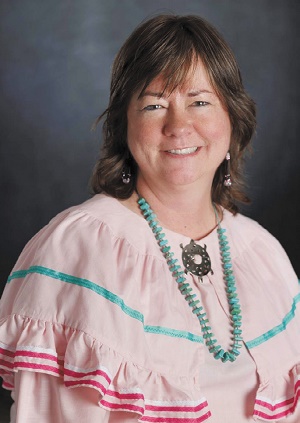
Bozho, nikanek (Hello, friends),
Legislative Meeting Update
At our end of February legislative meeting we voted to admit to our citizenship rolls 104 persons living across the U.S. (Folks outside the country who qualify for membership can be enrolled, as well — I did not see anyone in that category on this quarter’s enrollment resolution.) I consider voting on enrollment to be one of our most exciting and hopeful legislative actions — we Citizen Potawatomi are still here, and our descendants will be Citizen Potawatomi, long after we, here today, have walked on.
Migwetch for Beading Instruction and Class Participation
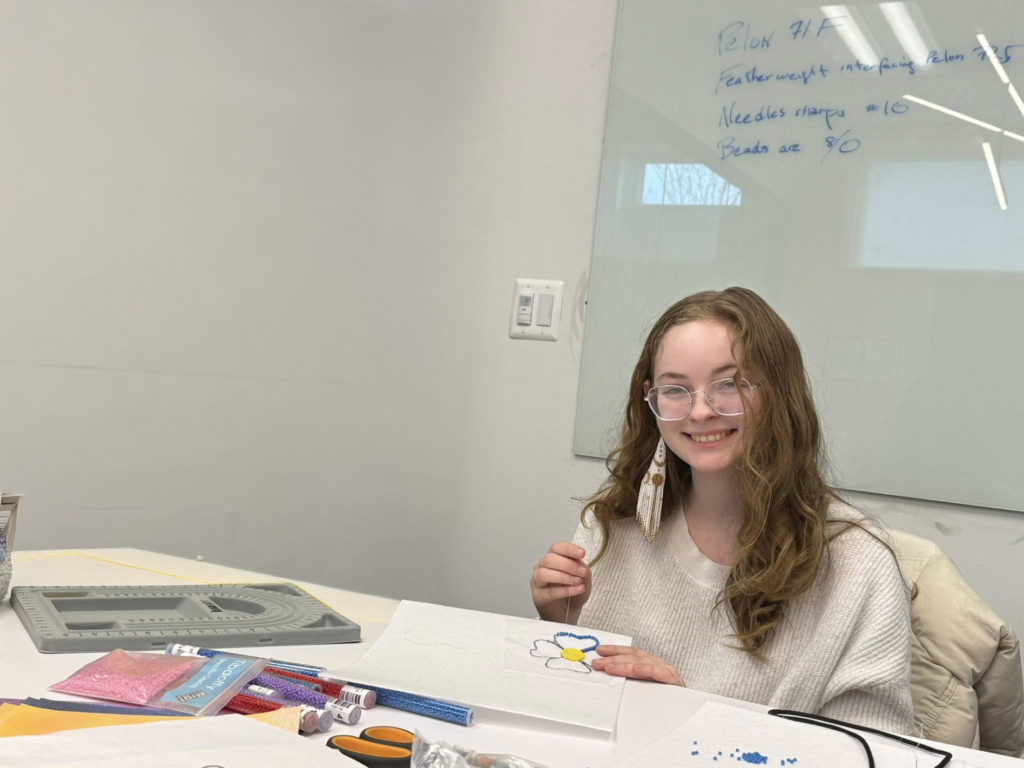
Maryland Institute College of Art student and CPN citizen Mars Pursley did a terrific job instructing a group of us in two needle flat stitch beading on Feb. 21. I even got the hang of it! One needle is used to hold the beads on the top of the beading foundation; the second needle is used to secure the beads. I have included some photos taken during the workshop.
An easy-to-follow video is at cpn.news/twoneedle. This channel also includes an edge beading demo and a single needle beading technique video. Another good beginner tutorial can be found at cpn.news/begtutorial. We used 8/0 beads, Pellon 71f interfacing, standard nylon thread, and size 10 John James sharps (needles), among other supplies, to start a simple medallion.
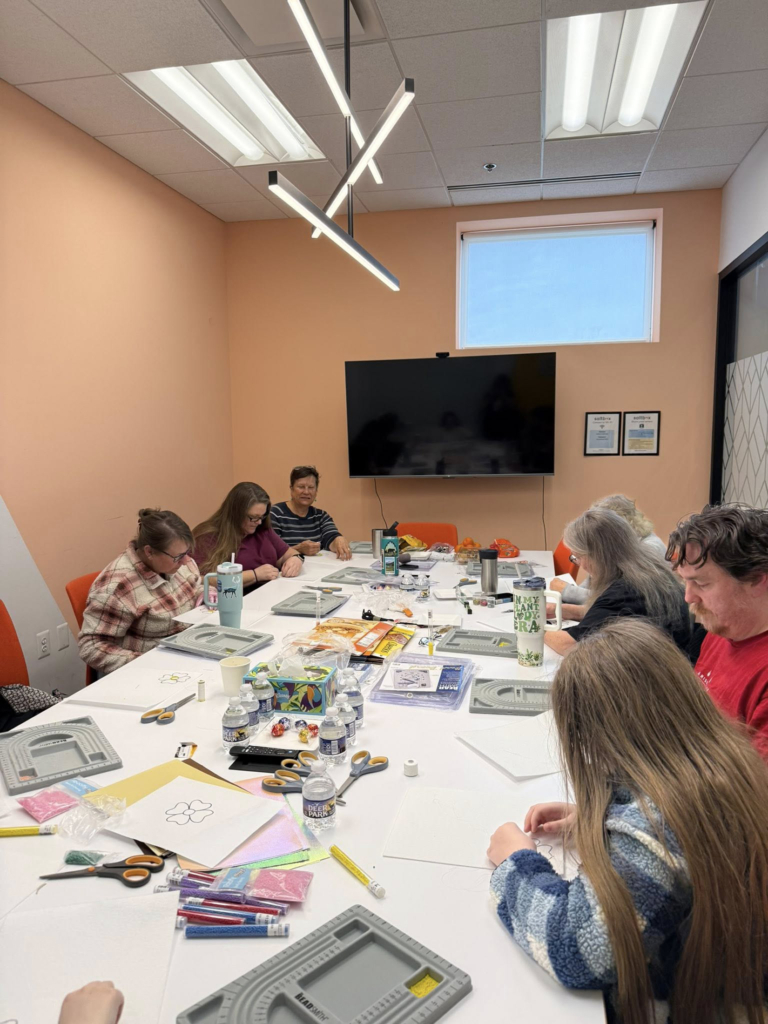
The visiting we did during the workshop was terrific as well. Folks joined us from across the DMV (D.C., Maryland, and Virginia) and shared sewing tips, moments of sewing frustration and family stories. Migwetch to Mars for making the trip from Baltimore to teach us; migwetch to everyone who made the time to participate.
Next month I will report on our March 14 meeting outside Tampa, Florida.
Hand Games Team 2026
Are you attending the Family Reunion Festival this year? Are you interested in joining our seven-member D2 hand games team? Beginners and veteran players are welcome. Please let me know if you are interested. The Hand Games Tournament will take place starting at 6 p.m. on Friday, June 26, at the CPN Festival Grounds Roundhouse. Game rules can be found at cpn.news/handgamesemc — or you can wait for pre-game instruction.
Louise Erdrich’s Latest Novel
I recently read U.S. Indigenous author Louise Erdrich’s latest novel, The Mighty Red. I loved it and recommend it. Set in North Dakota’s Red River Valley, it is a book about family and community. Here is an excerpt from my favorite review, written by Ron Charles in The Washington Post (cpn.news/mightyreview):
In The Mighty Red, humor and sorrow are fused together like twined tree trunks that keep each other standing. … Erdrich is so good at romantic comedy, with her special blend of Austen sense and Ojibwe sensibility. As the funny scenes flow one after another, you may not even notice the stray drops of blood scattered along the novel’s margins. … As usual when closing a book by Louise Erdrich, I’m left wondering, how can a novel be so funny and so moving? How can life?
Request to Share Future Meeting Location Ideas and Family News
Do you have a suggestion for a future D2 meeting location? It should fit at least 40 and ideally 75 people comfortably. Please let me know if you do! Our best meeting locations have been suggested by local Citizen Potawatomi.
Do you have family news to share? Please send me a note as I would love to include it in a future column.
Migwetch (Thank you),
Eva Marie Carney | Ojindiskwe (Bluebird Woman) | [email protected] | [email protected] | evamariecarney.com | PO Box 5595 | Arlington, VA 22205 | Toll Free: 888-849-1484 (voicemail)
Brenda Trevino
District 3
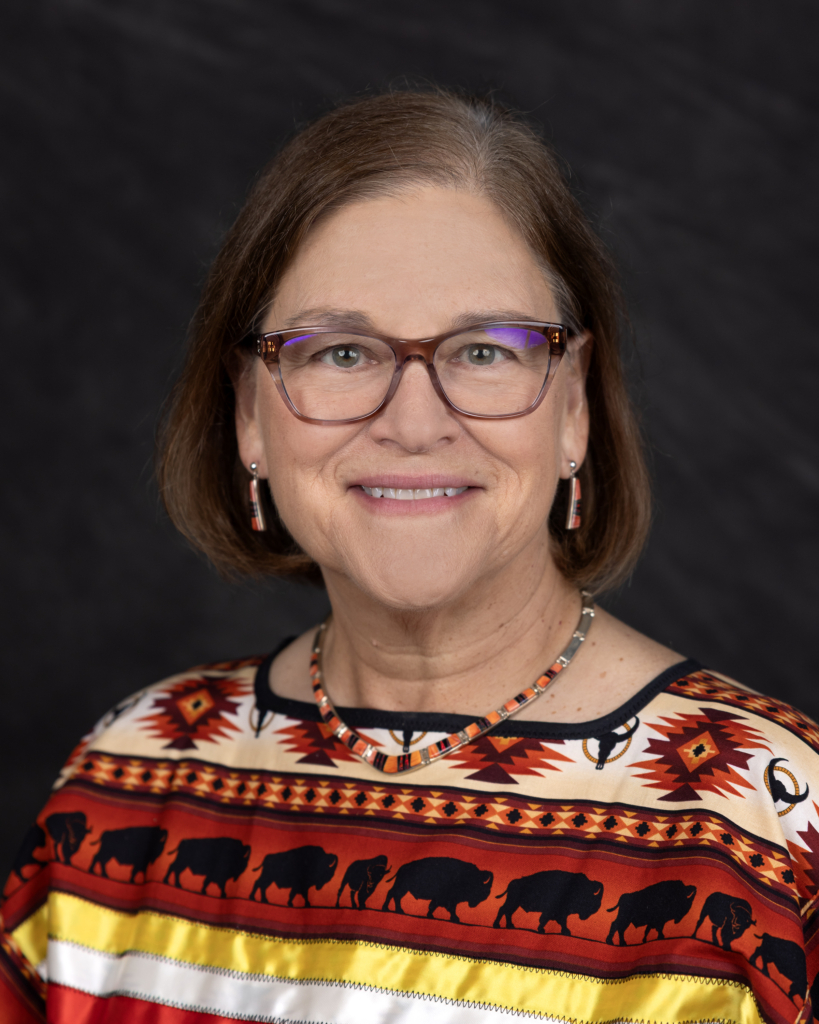
Bozho jayek (Hello, everyone)!
The numbers at our meet-and-greets are growing. On Feb. 21 in The Woodlands, we had 30 RSVP and 20 attend. This is more than double the number that attended the prior meeting. My hope is that the trend will continue. It is such a privilege to meet each of you face-to-face.
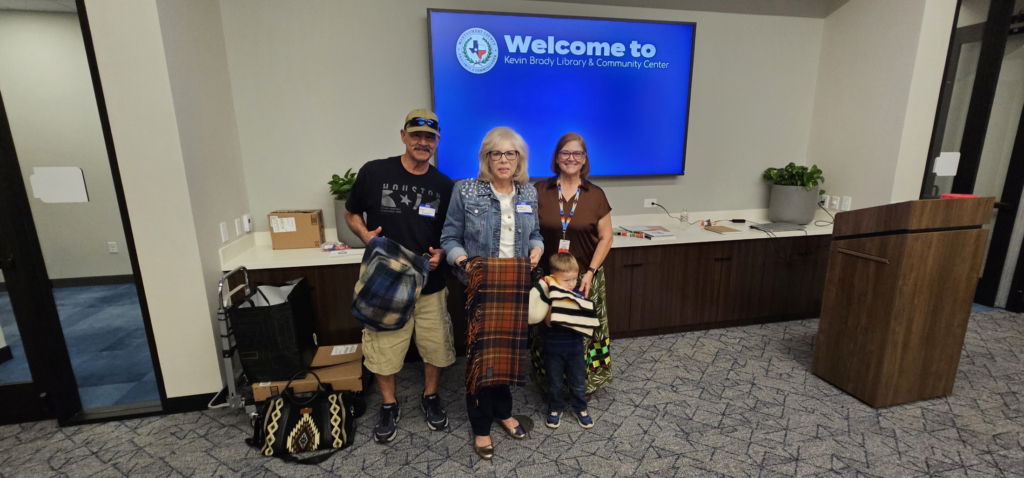
I have included a photo of the wisest (Katherine Meier), the youngest (Matthew Morgan) and the one who traveled the farthest to attend (Gary Risinger) at The Woodlands meeting.
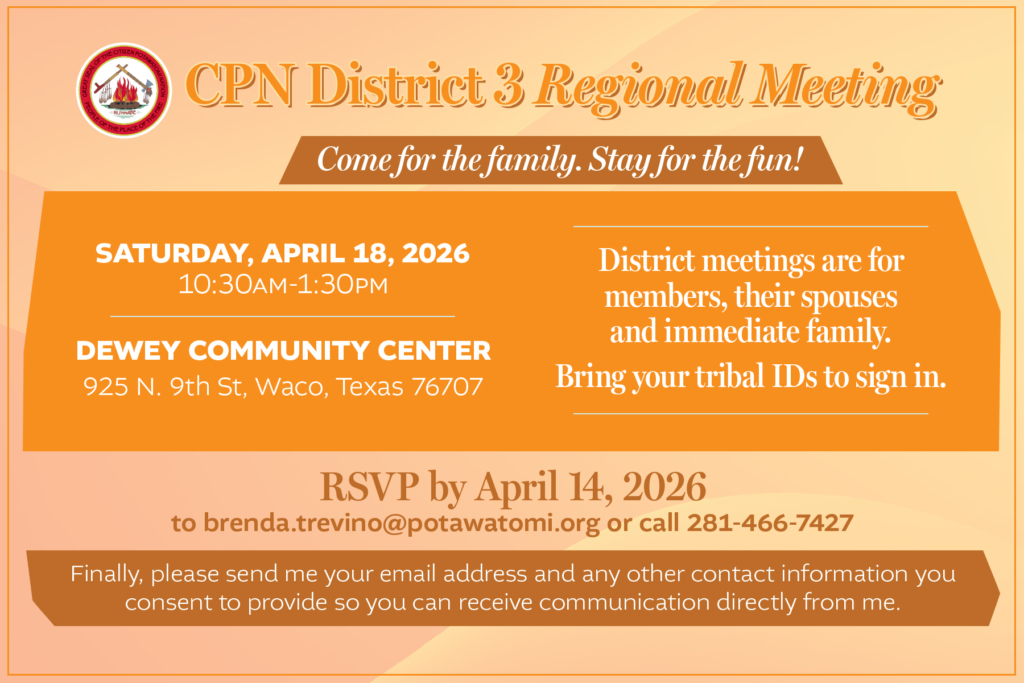
The graphic included with this article provides details for the larger upcoming meeting in Waco in April. Similar to the earlier meetings, there will be announcements from our Nation, handouts on our website, portal, the CARE program, Department of Education and Language Department. For the Waco meeting our special topic will be the CPN Community Development Corporation.
I ask those who plan to come also to bring questions and ideas about what you would like to see for our district in the future. If you have a particular interest in learning a specific aspect of our culture or services, I want to know. A suggestion box will be provided if you would like to share your ideas that way.
Feedback so far has been:
The small/rural meeting format is personable and easier to attend because they are closer to where we live. (Most who are coming have been to a meeting in the past, but it has been more than five years).
There is a broad multi-generational interest in our history and cultural teachings.
Updates on the Nation’s benefits and enterprises bring connection. They give us a sense of pride and a basic vision for the Nation’s future along with the understanding of how and which of the services that can be applied outside of Shawnee and surrounding areas of Oklahoma.
Several have indicated they plan for the first time (or for the first time in multiple years) to attend the Family Reunion in Shawnee this June.
I will continue to share feedback in the coming months and plan to use the feedback to improve the way we communicate and grow as a district.
May the peace of our God and Creator be with you always. Aho!
Migwetch (Thank you) for allowing me to serve each of you! Please reach out if I can be of assistance.
Brenda Trevino | Mkedewankwetkwe (Black Cloud Woman) | [email protected] | 281-466-7427
Jon Boursaw
District 4

The Departure of Tracy Kinderknecht, RN
As the Legislator for District 4, I have the privilege of having a few things that are not found in the other seven Districts outside of Oklahoma. One is rather high concentration of Tribal members within an hour’s drive from where I live, numerous Tribal historic sites nearby, and a Tribal housing complex and community center. But most important, I’ve had the privilege of working with a CPN Registered Nurse; and for the past 13 years that nurse has been Tracy Kinderknecht. A few weeks ago, Tracy announced that her last day will be May 21. What has she done for us? Tracy got us through COVID, she has administered hundreds of flu shots, she has always been willing to listen and give sound advice, and she has trimmed enough toenails to fill a large trash can. She has made countless home visits, filled dozens of pharmacy trays, treated and bandaged cuts and bruises, distributed food commodities to the homes of CPN members, and the list goes on. In addition to all of her nurse’s duties and services, for the past two years she has served as the Housing Manager for the CPN Housing Complex in Rossville. Wait, one more, since being hired she has also served as the chief cook and organizer of the monthly Elders Potluck held in our Community Center. Needless to say, we will all miss Tracy and wish her well.
Upcoming CPN Elders’ Potlucks
Dates for the Elder Potlucks held in Rossville at noon are:
May 8 | Fried Chicken | RSVP by the 4th
June 12 | To be determined | RSVP by the 9th
Bring your favorite side dish or dessert. Please RSVP to Tracy at 785-584-6171.
My Story-Part One
I recently received a request from a high school student in Westbrook, Maine, requesting my life’s story. I thought you might relate to what I sent him.
Part One of Three:
- I mowed a lot of yards, and it was several years before we had a power mower.
- During my High School summers, I picked up and stacked hay bales at farms in the area.
- The majority of my spare time as a kid was spent outside playing sports, Cowboys and Indians, and war.
- Obviously, we did not have cell phones. If you were away from home, you used a pay phone for a nickel.
- We had one phone, on a party line, until I was probably 16, as there was an additional fee for a second phone.
- We didn’t have a TV until I was probably 14, and then we only received two channels (NBC and CBS) and they were in black and white.
- TV Broadcasting ended at midnight with the national anthem and the poem “High Flight.”
- Before we had TV, I went to neighbor’s house on Saturdays to watch football games.
- I was a Cub Scout and later a Boy Scout.
- I was on the Safety Patrol in the 8th grade, entitling us to free movies. Some Saturdays we attended three movies.
- I participated in three sports (Football, Basketball and Track) all four years of high school.
- I played the trombone in my high school band all four years.
- I was selected to attend Boys’ State the summer between my junior and senior years.
- I was elected as the Associate Judge on the Student Court my senior year.
- Sneakers (or tennis shoes) were only worn during gym class.
- Girls wore dresses or skirts every day — no jeans or shorts allowed.
- The guys wore jeans.
- In the second semester my senior year I was a student teacher in an Algebra I class.
Migwetch (Thank you),
Jon Boursaw | Wetase Mkoh (Brave Bear) | [email protected] | 785-608-1982
2007 SW Gage Blvd. | Topeka, KS 66604 | Office Hours: Tuesday 9-11 a.m. | Thursdays 3-5 p.m. | Other times as requested
Mark Johnson
District 7

Bozho nikanek (Hello friends),
The first week of March, official ballot request forms should have arrived in your mail. Tribal members 18 and older are eligible to vote each year during the general election, with in-person voting and election results announced during the general council meeting held on the last Saturday in June at the Family Reunion Festival. Participating in the 2026 Tribal elections for the Citizen Potawatomi Nation is both a civic responsibility and a vital expression of Tribal self-determination. For a sovereign nation with almost 40,000 enrolled citizens, voting in these elections shapes how the government functions.
Tribal citizens can vote in person or use absentee ballots if they are unable to travel to Oklahoma, ensuring broad access irrespective of where they live. These elections make voter engagement crucial to shaping the Tribe’s future and how services and programs that directly impact individuals and families are protected, or not.
This year, key legislative seats are scheduled for election, including Vice-Chairman and your District 7 Representative. Please study the candidates and issues, make an informed vote and participate in your Tribe. Voting in Tribal elections is especially important given recent patterns of voting participation. In recent election cycles, fewer than 10% of eligible Tribal citizens cast ballots. Tribal elections also embody the exercise of sovereignty. The Citizen Potawatomi Nation governs itself under its own constitution and laws; voting is one of the clearest ways Tribal members assert that sovereign authority. High participation signals to those governments that don’t necessarily have the best interests of the Citizen Potawatomi Nation that our political will is unified and actively engaged in contexts where tribal sovereignty and federal, state or local policies intersect.
If you didn’t receive your ballot request form, or if it was misplaced, look for one in this publication or online at the Tribal website, potawatomi.org. One of the reasons that I have heard for not sending back the ballot request form is that your personal information including Tribal ID may be stolen; remember that you can always place the card inside another envelope, to the same address as the card and mail it back to the election committee. Remember that all Tribal citizens over the age of 18 are eligible to vote, and voting in the Citizen Potawatomi Nation’s 2026 elections is important. Tribal citizens who vote are not just fulfilling a duty, they are actively shaping the future of our Nation and honoring their heritage.
And speaking of heritage, attending the Family Reunion Festival is a great way to reconnect with yours. If you haven’t been before, or it has been a while, start planning now and join us June 26-June 28 in Shawnee. You can then vote in person at the festival. There is no better way to spend your summer vacation. The honored families in 2026 will be: Acton, Bergeron, Bruno, Curley, Delonais, Greemore and Slavin.
Once again, I would like to say what an honor it is to serve you as your District 7 representative. As always, give me a call and I will be happy to work with you on any questions you may have or provide you with additional information you may need to access Tribal benefits that are available to you. Please also take the time to give me a call or send me an email with your contact information so that I can keep you informed of the happenings within the Nation and district.
Migwetch (Thank you),
Mark Johnson | Wisk Mtek (Strong as a Tree) | 559-351-0078 | [email protected]
Dave Carney
District 8

Bozho, nikan (Hello, friends),
Spring is just around the corner and the daffodils are springing up, reminding us that summer isn’t too far away. However, if you’ve lived in the Northwest any length of time, you are aware of what we call “fake spring” and “fake summer.” In preparation for more indoor time, I am revisiting the topic of good books regarding our Tribe. On the other hand, a worthwhile book on the beach this upcoming summer sounds pretty inviting too.
These books are readily available in the Potawatomi Gift Shop at our Cultural Heritage Center and on Amazon. Like everyone else, I love the (almost instant) gratification of Amazon.
The Potawatomis: Keepers of the Fire (Volume 145) (The Civilization of the American Indian Series), paperback – 1987 by R. David Edmunds, (about $25).This is a serious history book that details the history of the Potawatomi from the fur trade through alliances with the French and English, wars and treaties. A “need to have” for your library.
The Last Blackrobe of Indiana and the Potawatomi Trail of Death, paperback – 2010 by John William McMullen, (about $25). This is the true story of Benjamin Petit, a French attorney turned missionary priest, and his mission to the Potawatomi people. Petit joined the northern Indiana Potawatomi in 1837, a year before their forced removal west. The author retells the incredible journey of Petit, who traveled with the Potawatomi people and became part of their history.
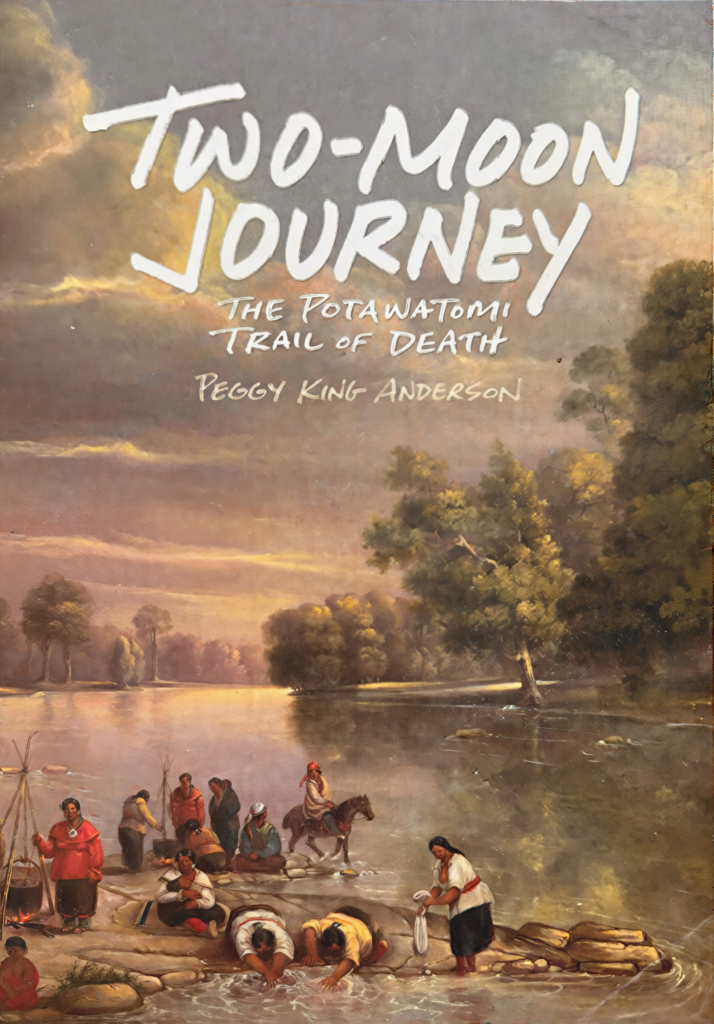
Two-Moon Journey: The Potawatomi Trail of Death, paperback – 2018, by Peggy King Anderson, (about $10). You’ve heard me talk or write about this book several times, but it is dear to my heart. It is a work of historical fiction and is written by the widow of a Tribal member. It is the story of a young Potawatomi girl named Simu-quah and her family and tribe who are forced from their village in Indiana, where they have lived for generations, to Kansas.
If you are looking for a really nice gift for a young Potawatomi in your life (even possibly yourself) I’d say take a look at Dancing for Our Tribe: Potawatomi Tradition in the New Millennium, hardcover, 2022, by Sharon Hoogstraten (about $80). This very beautiful book was crafted by Citizen Potawatomi Nation photographer Sharon Hoogstraten as she visited nine Potawatomi Nations capturing modern day Natives in their regalia. It contains more than 150 portraits and corresponding handwritten statements from our members.
There are several good books written by George Godfrey, a CPN citizen, academic and fixture on the powwow grounds during the Family Festival. Some of his writings are historical and some are historical fiction. Titles include: Watchekee, Walking in Two Cultures, Once a Grass Widow, Watchekee’s Destiny and A Perilous Journey. Mr. Godfrey lives in Illinois and is involved with the Trail of Death Association and caravan.
Of course, no Potawatomi reading list could be complete without mentioning Robin Wall Kimmerer’s whole body of work. Her books are available in paperback, for about $17, making them accessible to just about everybody.
I am looking forward to seeing Potawatomi family in Oklahoma and in the district in 2026. Don’t forget that the Family Festival (powwow) is June 26 through June 28.
The date for this year’s fall feast has been set for Saturday, Oct. 24 for a meeting and mid-day meal at the Great Spirit Church in Portland. We have met at this location in the past and found it to be accommodating, friendly and with ample parking.
It is my honor to serve as your Legislator,
Dave Carney | Kagashgi (Raven) | [email protected] | 360-259-4027
Paul Wesselhöft
District 9

Bozho, nikan (Hello, friend),
Eradication
Native Americans, African Americans, Jews
The mass killing of a people did not and does not occur in a vacuum — it takes decades, no, centuries, of dehumanization. For such a killing to happen, one people must reduce another people to the level of animal, below the animal. Most animals are not despised, and only necessarily killed for food and survival.
A person must be convinced over time that a certain people do not constitute a human being, that they are not human as humanity is conceived and defined. These lowly creatures, they believe, are a thing that need not exist and should never exist in their neighborhood, their world.
The Darwinian theory of evolution and the eugenics philosophy and movement led to many killings. The Nazis, for example, believed that they were the super-race and they wanted to eliminate those “lesser” humans.
All genocidal killings, Native American, African American, Jews, and others, is visceral hate but much deeper than hate: it’s a fear, a fear that a certain people will personally harm them, threaten their believed superiority, or contaminate and degrade the human species. Their answer, historically, for African Americans is segregation, their answer, historically, for Native Americans and Jews — eradication.
Paul Wesselhöft | Naganit (Leader) | [email protected] | [email protected]
David Barrett
District 10
Bozho (Hello),
What are heavy rare earth elements and why are they crucial for the United States?
DYSPROSIUM and TERBIUM are used in high-temperature magnets for electric vehicle motors and wind turbines. China’s processing capacity for these specific elements is extremely high, making the West heavily reliant on its supply chain. China also has a near-monopoly on the processing of these light rare earth elements (NEODYMIUM and PRASEODYMIUM), which are also used in permanent magnets for various electronics and motors.
Beyond these heavy and light rare earth elements, China has dominance that extends to a wider “basket” of 17 rare earth elements that are critical for technology like smartphones, televisions and fighter jets. China is the world’s largest supplier and processor of rare earth elements, the minerals used in a broad range of key products. These elements have become a key area of contention in the trade friction between the United States and China.
Although negotiations have slightly resolved the impasse lately, dependence on China for these key components remains a vulnerability in the manufacturing supply chains for many military and high technology products.
In late 2025 and early 2026, the United States launched major initiatives to reduce reliance on Chinese rare earth elements by signing deals with Australia, Japan and several Southeast Asian Nations. Key agreements include an $8.5 billion U.S.-Australia deal for processing, a strategic framework with Japan, and pacts with Malaysia, Thailand, Vietnam and Cambodia.
The United States, European Union and International Partnerships planned a memorandum of understanding (MOU) to increase transatlantic rare earth production, while a broader, multi-country initiative (involving over 50 nations) was discussed to create a secure, non-China supply chain.
For too long, the United States has sat on the sidelines while China forged ahead with the mining investments throughout the Asia Pacific. These new agreements indicate a strategic shift. Washington now intends to build its own minerals investment presence in the region and actively counterbalance Beijing’s dominance.
China’s refining process turns them into the final components needed in manufacturing. China mined 69% of the world’s rare earth ores in 2024 (cpn.news/rareearthores).
Environmental and regulatory costs and risks are the main reason why supply chains are not yet fully developed outside of China.
Take time to thank a veteran, first responder and a person in blue when you have an opportunity.
It goes without saying that it is both a pleasure and an honor to serve you and our great Nation.
Migwetch (Thank you),
David Barrett | Mnedobe (Sits with the Spirits) | [email protected] | 1601 S. Gordon Cooper Dr. | Shawnee, OK 74801 | 405-275-3121