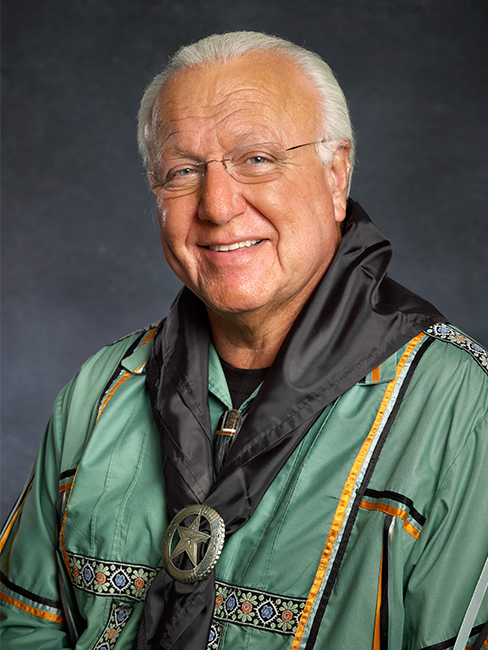
John “Rocky” Barrett
Tribal Chairman
Bozho, nikan, (Hello, my friend),
Most of you will have received your “Request For Ballot” form from the Tribal Election Committee by now. PLEASE FILL IT OUT AND SEND IT BACK AS SOON AS POSSIBLE! Fewer people are voting in our elections each year. We have worked too hard to create what we have and have too much to lose to not care who our leaders are. Your parents and grandparents sacrificed for a hugely valuable earning asset that you own a part of and that will always be there for you: your TRIBE.
We are not sure why voting is declining, but we intend to find out. We believe scheduling regular Tribal meetings around the state will help generate participation and interest in family histories, stories of our forced relocations and how we overcame hard times to grow as a Nation. We also want to initiate a two-way dialog with our membership in Oklahoma — internet works, but face-to-face makes us kin.
One of the candidates for Vice-Chairman, Jason Smalley, suggested we take a Smart Screen (like we use for our Legislative meetings) to our in-state meetings so those who could not attend could ask questions. The meetings will be to inform CPN members about the benefits that are available to them, the way our government works, and what opportunities we have for members looking to work for the Tribe or move closer to headquarters. We also plan to have cultural activities to teach about Citizen Potawatomi ceremony, dance, singing, language, heritage, history and some of our ancestors’ religious practices.
I envision these Oklahoma town meetings as a sharing and exchange of Tribal, family and personal history and current ideas from both old and young, men and women. The long-range objective is to increase our sense of community and thereby increase the level of participation and VOTING.
Please notice that I distinguished these meetings would feature “Citizen Potawatomi” cultural activities. There is a difference between our ceremonial and cultural activities in Oklahoma and those of the other six Potawatomi tribes. We have been separated from the Prairie Potawatomi People in Mayetta, Kansas, for 158 years and from the Potawatomi of Michigan, Wisconsin, and Indiana for over 180 years. All of us should know the reasons for the separation, the effect that separation had on us, and what our lives have been like since we moved to different parts of the country. We need to know what we share and what was different. This kind of sharing is for the betterment of each Potawatomi Nation with which we engage.
In history, each Potawatomi Tribal Nation developed its own territory, forming new governments customs. All of us suffered hardships, tragedies, wars, losses and gains. It made us unique, but still Potawatomi. In our Tribe’s case, our people faced four relocations and had to leave their homelands, culture and traditions. There was a great diaspora of CPN from the Dust Bowl Days through the Great Depression and war years of the 1940s. Imagine the loss of family cultural contact and knowledge they suffered when they were relocated by the Bureau of Indian Affair’s Urban Relocation Program after our move to Oklahoma. With each move, our culture and traditions underwent changes unique to each generation. They may not have been the same as those of our sister Potawatomi Tribes. We can learn things of great value from them and need to know about their struggles and losses. We worked to keep many of the old ways and learned some from the generosity of our distant cousins. We need to pass on this old, life-guiding knowledge that is is invaluable to our unique identity as a people. We share blood but not current histories — our common history is only the years before 1867. The recent organization of a Potawatomi Confederation gives us renewed hope for future exchanges of knowledge and reciprocal business and commerce.
As Tribal Chairman since 1985, and active in CPN government affairs since 1973, I feel the need to tell what Tribal history I was a part of, where we achieved success and where we failed, and why. We are losing a huge body of tribal knowledge with the retirement of Vice-Chairman Linda Capps. She is a true treasure. She will, hopefully, have time to participate in some of these new meetings here in Oklahoma.
Here at home, we have grown so large and have had such an important impact on the local and state economies. It is vital that all of us, who own these assets, have an understanding of how we grew, how we operate, and what our collective goals are.
We did not grow to over 40,000 Citizen Potawatomi Citizens, with over $3 billion in assets; 2,400 employees; a $750,000,000 budget; 33 separate federal contracts, compacts, and programs; 10 large commercial business establishments; an award-winning modern health system with multiple locations; and the largest tribally-owned bank in this country without expertise and experience. Our success is the product of those who are employed and who lead the government and manage our business. We need to meet those who are willing to work for your people, to know what your abilities are and what goals you hope to accomplish that could help CPN. We are a great opportunity for you.
To do this, you have to make the following minimum effort: 1) make sure Tribal Rolls and the Hownikan has your current address, especially members who have moved; 2) VOTE, make sure your family VOTES, and be sure you are voting for the kind of candidate you would trust to manage YOUR tribe’s money, businesses, and institutions — vote for someone with sufficient education and experience who has demonstrated through their accomplishments that they are qualified and of good character. BUT AT ALL COSTS – VOTE.
Thank you for the honor of serving as your Tribal Chairman these past 40 years. It is the greatest honor of my life.
Migwetch (Thank you),
John “Rocky” Barrett | Keweoge (He Leads Them Home) | Tribal Chairman
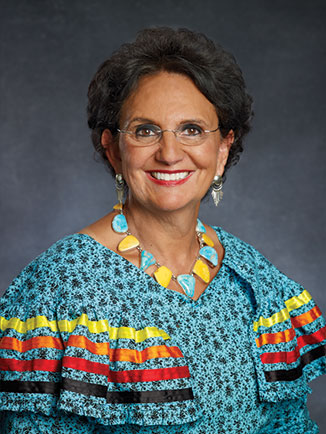
Linda Capps
Vice-Chairman
Bozho (Hello),
The first day of spring is March 20, and the people of Oklahoma are in high hopes of getting some much-needed rain to offset the dry winter. We have just finished the warmest February on record. Many of the 77 counties of Oklahoma are under an official burn ban, including Pottawatomie County.
Last month, I indicated to my readers that I want to share some of the highlights of my tenure during the 36 years I spent as Vice-Chairman. One major accomplishment during those years was CPN’s purchase of Rural Water District 3, which serves over 60 percent of Pottawatomie County’s geographic area, including the communities of Asher, Wanette and Dale. The district is the only tribally-owned enterprise that is a public utility. Rural Water District 3 began serving the region in 1997, but the district was in dire economic straits when the Citizen Potawatomi Nation took over in October of 2007. Since then, the district’s water treatment plants have ramped up production by twice the original output. Rural Water District 3 provides water to residential customers as well as schools, churches and businesses.
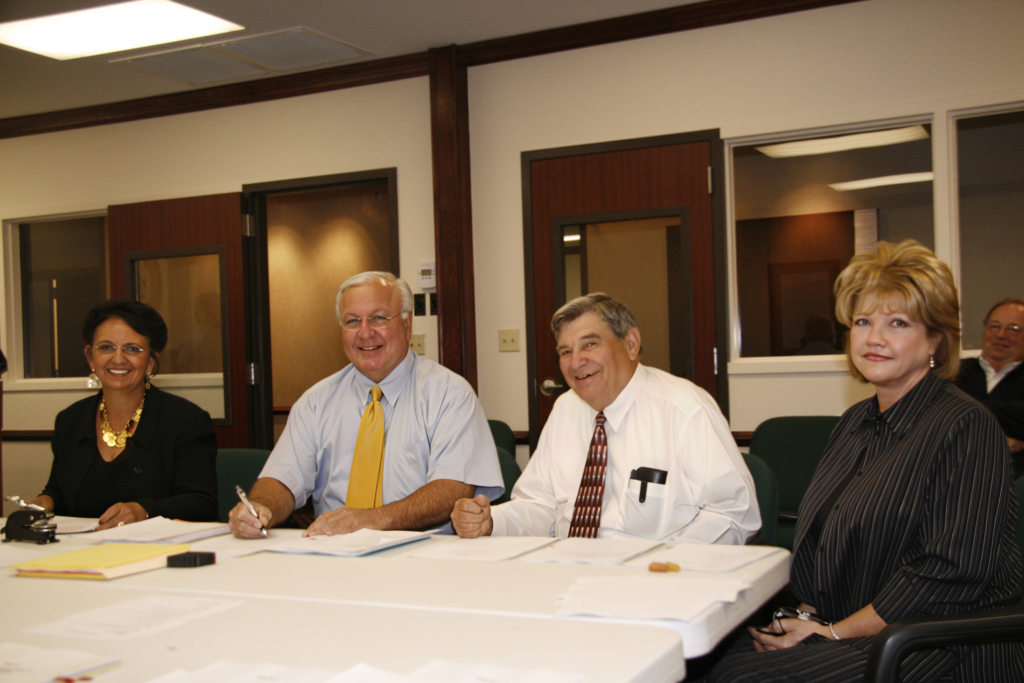
The district has installed over 2,300 meters, but that number is misleading compared to the number of people being served water. Some of the meters serve a few hundred people instead of a family. As an example, several schools are being provided with water by the district. The water distribution system is a huge undertaking, not only for Rural Water District 3 but for the entire Tribe, with an abundance of responsibility to customers and the public. I am proud to say that CPN has overcome huge obstacles to provide water to so many homes and other entities. The Tribe took over some infrastructure that was outdated and in poor repair. The work to bring the system up to par was tedious and laborious, but CPN had employees in place that were determined to make necessary repairs and replacements.
The water district has two water plants. The original plant in Macomb, Oklahoma, has received a complete overhaul within the last few years. Six acres of land adjacent to the plant were purchased to provide necessary expansion. The water source for the plant comes from the Atoka water line from Lake Atoka Reservoir, approximately four miles north of Atoka, Oklahoma. The Atoka water line also feeds water to Oklahoma City, and that line is tapped by the Macomb Water Plant. The other water plant near the Grand Casino is not only served by Atoka water, but also by five additional water wells near the former North Canadian River (renamed the Oklahoma River).
CPN has received much recognition and numerous visits by other tribes to assess what it takes to start a water district. The monetary investment is extensive, and the sweat equity is massive, but the rewards of having safe, sanitary, sufficient water for the future outweigh the financial burden. I am so pleased that I had the opportunity to play a small part in the procurement, implementation and daily administration of Rural Water District 3. It thrills my heart to see so many people (including Tribal members) enjoying the quality water that they deserve. Hats off to all the CPN elected officials and employees that were in the trenches and in the details of making this great public service program work for the good of CPN and the public. They are the true heroes, whether they are an elected official, director, supervisor, foreman, equipment operator, electrician, mechanic, office worker, meter technician, truck driver or other participant, their contribution is acknowledged and greatly appreciated.
Migwetch (Thank you),
Linda Capps | Segenakwe (Black Bird Woman) | Vice-Chairman | Work: 405-275-3121 | Cell: 405-650-1238 | [email protected]
Steve Livingston
District 1

Bozho (Hello),
In February, the City of Maumee, Ohio, hosted a screening of “Sugarcane,” a film that examines the abuse and lasting trauma caused by Indian boarding schools. I attended expecting to watch the film as a local resident, but through a series of conversations, I was asked to participate in a post-screening discussion and share my perspective as a Potawatomi citizen.
The film is difficult to watch. Like many stories shared by our elders, it reveals painful truths: forced separation, abuse and efforts to strip Indigenous children of their identity. While much of the public conversation around boarding schools focuses on physical and emotional harm, I spoke about another lasting impact that is often overlooked: the loss of language.
Language carries more than words. It holds a worldview, values, humor and identity. Boarding schools understood this, which is why children were punished for speaking their languages and given new names. Today, across all Potawatomi communities, less than a handful of first-language speakers remain. That reality is not accidental, and it is the direct result of historical policy.
I shared how these policies shaped my family. With each generation, removals, boarding schools and economic hardship caused connections to language and community to weaken. Reclaiming our language later in life, with the help of elders and mentors, most especially that of my good friend Thomas Loftis, helped me to live more intentionally and rebuild a relationship with something greater than myself.
What struck me most during the event was how little many attendees knew — not just about boarding schools, but about our continued presence as Native people today. Our history is often overshadowed by monuments and place names tied to colonization, while Indigenous stories remain absent. It was a reminder of the work we all share in educating our neighbors.
I shared that despite centuries of loss and hardship, our people continue to come together — to speak our language, to share our stories and to restore what was nearly erased. Every powwow dance, every language class, every bead sewn into regalia and every prayer lifted to the Creator is more than tradition; it is survival, resilience and healing.
Speaking of coming together in community, I had a conversation with District 1 Tribal citizen Tyler Spencer, who is participating in the Mdamen Program. Mdamen is a nine-week virtual program designed to help Tribal citizens connect and explore their heritage. Tyler shared how impactful the experience has been and how eager he is to build relationships with other Potawatomi in his area.
Our conversation turned to the challenge of connection across a district that spans 16 states, from Missouri to Maine. Distance can make it difficult to feel informed or connected, and no single meeting or location can reach everyone.
Community shows up in many ways — from the Potawatomi Gathering in Crandon, Wisconsin, this summer, to February’s virtual finger weaving with Anna Johnson, to locally organized gatherings like Kevin Roberts’ event at the Illinois State Museum.
Community is not built by elected officials alone; it grows through the actions of individuals. Small gatherings, shared meals, cultural teachings and local meetups matter deeply. If you are interested in hosting something in your area, I want to help support and connect you with others.
Please visit cpndistrict1.com and sign up for the newsletter. I can only send updates to those who request them, and just 127 citizens are signed up. You can also visit cpndistrict1.com/events for the most up-to-date information on virtual and in-person gatherings.
My goal is for District 1 citizens to feel informed, connected and supported. It is truly an honor to serve you.
Steve Livingston | Legislator, District 1 | [email protected]
Eva Marie Carney
District 2
Bozho, nikanek (Hello, friends),
District 2 Meetings
The Crystal Bridges Museum in Bentonville, Arkansas, recently unveiled its new “Visions of America” galleries. I will be looking into a tour of the museum for a future District 2 get together. The museum has reimagined its galleries to reflect recent collecting priorities in craft and Indigenous art, including commissions by two Potawatomi artists, Jeri Redcorn and Kelly Church. I will report back on plans (a fall 2026 gathering, if I can make it happen) if and when they come together.
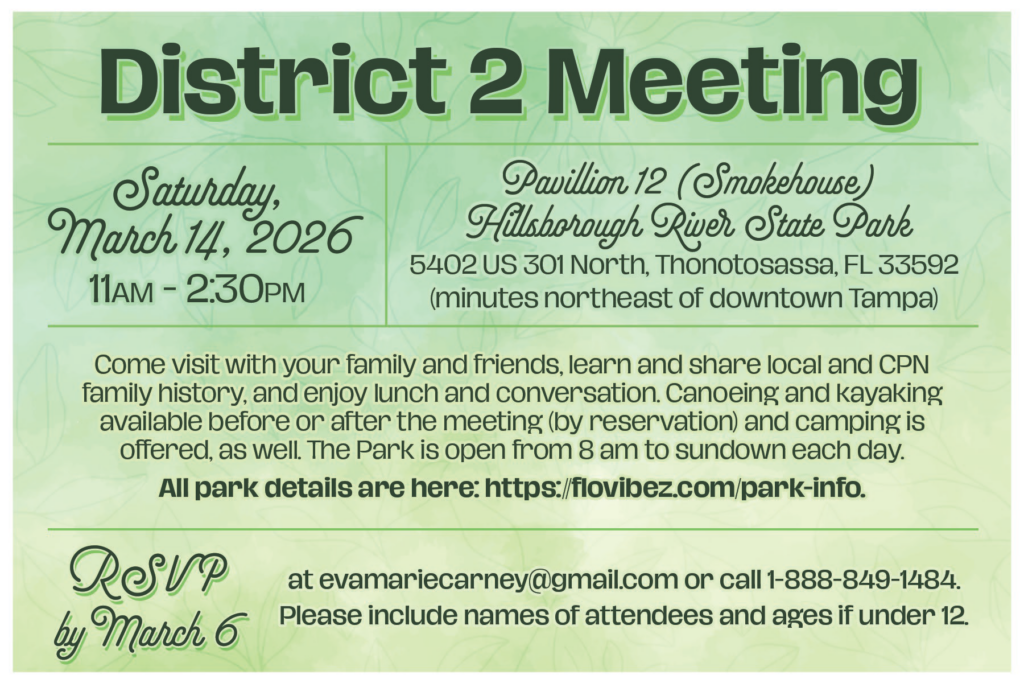
Our next meeting will take place just outside Tampa, Florida, on March 14 at Hillsborough River State Park. All the details are in the postcard and on my website calendar page, evamariecarney.com/calendar. If interested, you can canoe, kayak, camp (each by reservation) before or after the 11 a.m. to 12:30 p.m. meeting. I hope to see as many area folks there as is possible. Please RSVP.
Tips for Using Your Tribal ID for U.S. travel
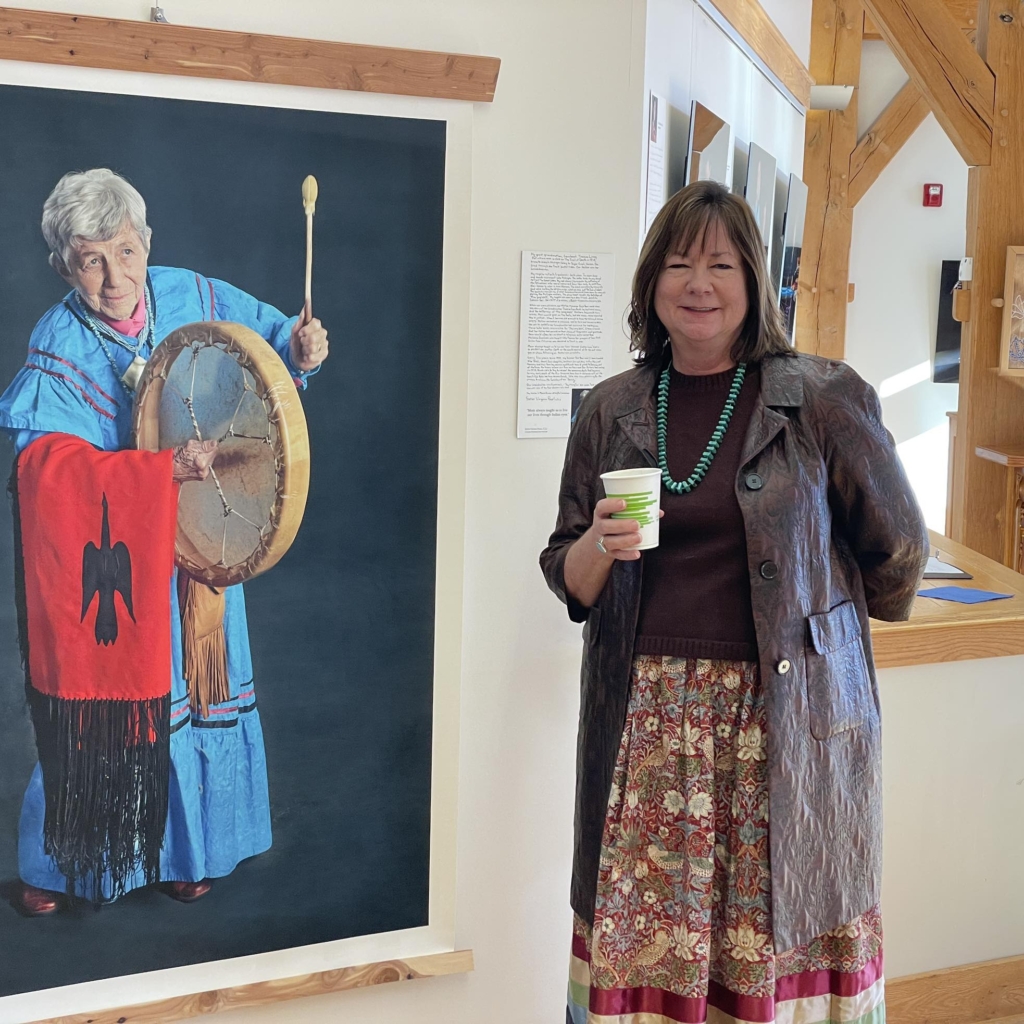
I travelled to Indiana in late January to attend the Pokagon Band of Potawatomi and its Four Winds Casinos’ Community Investment Check Presentation Ceremony in South Bend on behalf of The Kwek Society (kweksociety.org). During that trip I was also able to attend Sharon Hoogstraten’s presentation about her work that is on exhibit at MoonTree Studios (cpn.news/MoonTreeStudios) in Plymouth, Indiana. (MoonTree was showing some of Sharon’s beautiful modern regalia photographs, including the photograph of Sister Virginia Pearl, CSJ (Slavin family), included here.)
I was able to use my Tribal ID at our airport, with only a slight delay to confirm that I was authorized to use it. Some tips for successful Tribal ID use are to tell the TSA agent, when presenting the ID, that what you are handing the agent is a Tribal ID that does not scan. After that, it’s helpful to say, “This is what I want to use,” when asked if you have another ID. You may be asked to wait while a supervisor is called to confirm that your ID will be accepted. (Occasionally, an experienced agent will look at the ID and wave you through.) The ID verification process typically takes less than 10 minutes and, in my experience, ends with the agent saying something like “I haven’t seen one of these before; that’s cool.” That is when I like to respond, “That is why I like to use it, so you see what a Tribal ID looks like and because I want folks to know that Native people are still here.”
Red Nation Television Network
Recently I learned about Red Nation TV, a Native Indigenous-owned and operated streaming service. The network reports it is the first and longest-running Native and Indigenous content provider, dedicated exclusively to Native American and World Indigenous storytelling. You can visit rednationtv.com to learn more and buy a plan. I would love to hear your thoughts about the network if you are a subscriber.
Family Interview Opportunity
Did you know that you can schedule and take part in a video interview with CPN’s Cultural Heritage Center staff from the comfort of your home? If you are a CPN citizen, you can share your family’s story by scheduling an interview through the form at cpn.news/heritageinterview. And through the Potawatomi Portal (portal.potawatomi.org), you can search for and view video recordings made by others.
Request to Share Family News
Do you have family news to share? Please send me a note as I would love to include it in a future column.
Migwetch (Thank you),
Eva Marie Carney | Ojindiskwe (Bluebird Woman) | [email protected] | [email protected] | evamariecarney.com | PO Box 5595 | Arlington, VA 22205 | Toll Free: 888-849-1484 (voicemail)
Brenda Trevino
District 3
Bozho jayek (Hello, everyone)!
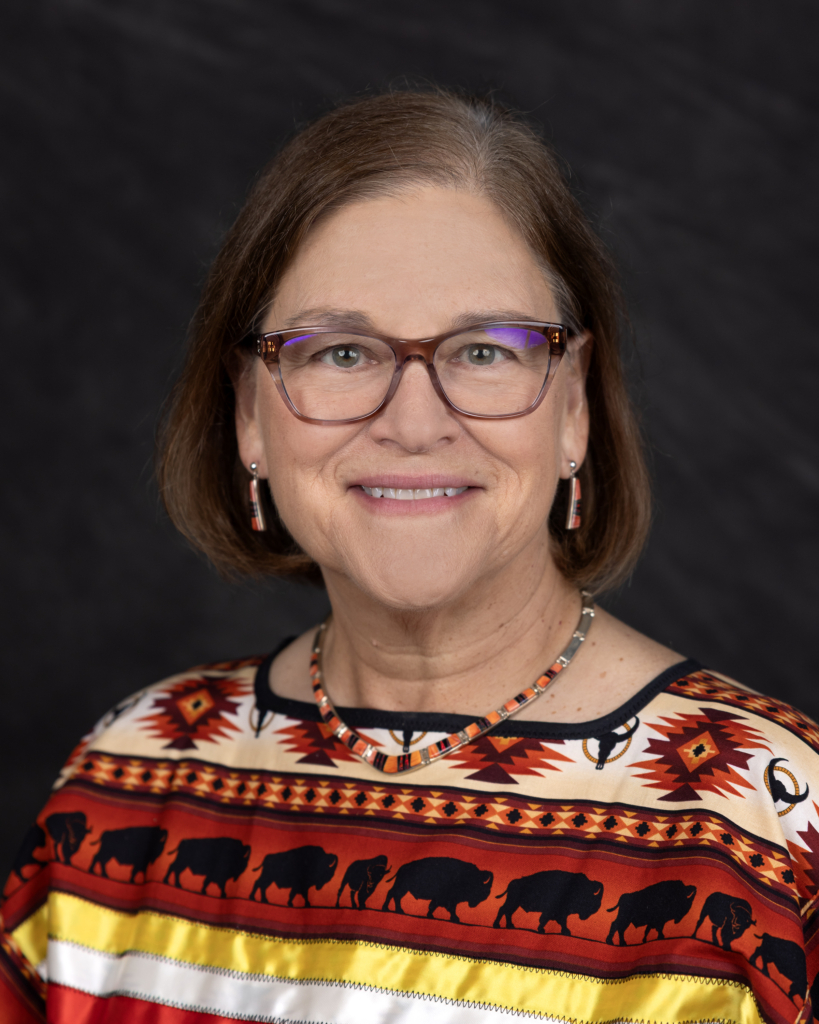
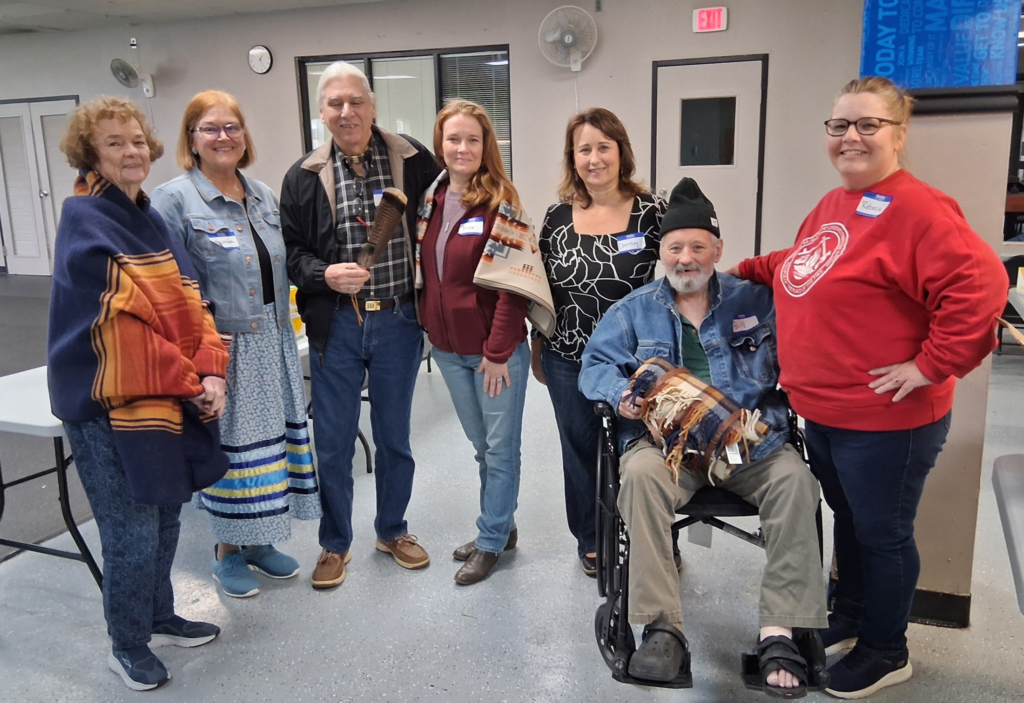
The meet-and-greet in Corpus Christi will always be special because it was my first. It was a little chilly outside, but warm and inviting inside at the YMCA. Invitations went out to households in over 30 counties, with the hope of attracting as many as could come. Over a dozen responded with RSVPs and six attended. The time spent was engaging and allowed us to get to know each other. The majority expressed an interest in being named in the near future as well. The overall goal of the meet-and-greet was achieved by learning and listening to each other, sharing our family’s stories and strengthening our connections.
The photograph was taken to include the wisest (Linda Teal), the youngest (Diana Pena) and the one who traveled the farthest to attend (Bill Easley) as well as Rebecca Johnson, Rick Attebery and Chrissy Thompson. The Woodlands meet-and-greet will be reported next month. It is scheduled for Feb. 2 (after the cut-off date for this newsletter issue).
Each meeting includes information from our executives, a special topic of the day and a cultural message. The Corpus meeting reviewed the available information on our potawatomi.org website and the Portal. The Woodlands meeting will review offerings from our Education Department. The March 7 meeting in Georgetown, Texas, will include information from our Language Department and availability of classes for all ages.
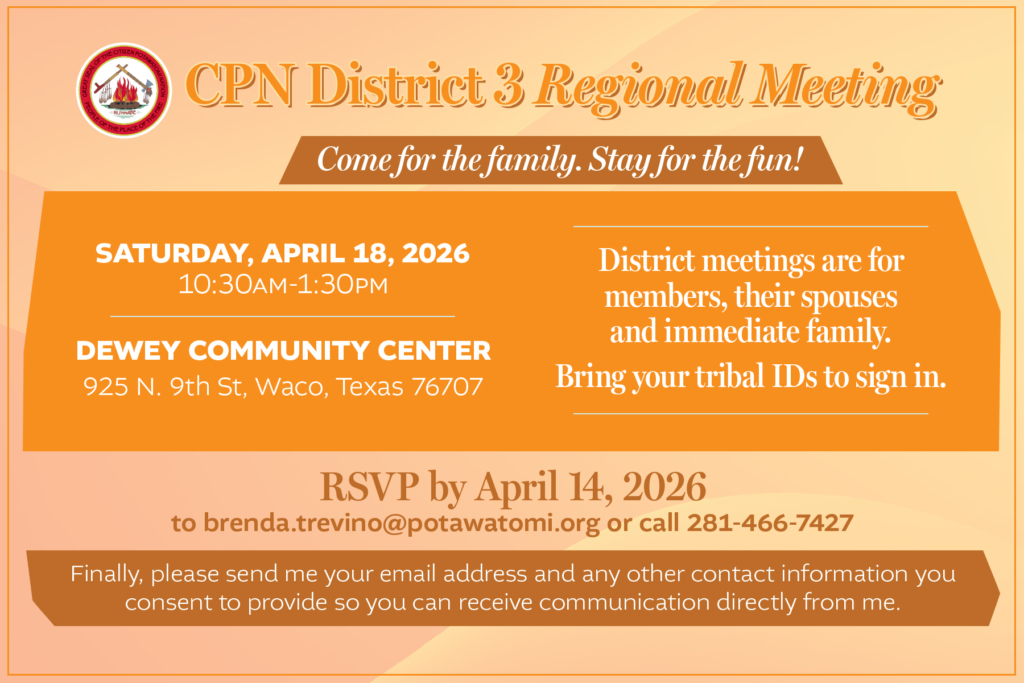
Our next opportunity to gather with District 3 relatives will be in Waco on April 18. Postcards will be sent to targeted counties near the meeting, but as with any of our gatherings, all District 3 members are welcome. Don’t forget, RSVP for Waco’s meeting by April 4 (two weeks ahead) so plenty of food and resources are available. And if it slips your mind, even a week ahead I can add you to the list.
This is also a very important liturgical time for Christians as well as our ancestral teachings. A time to remember the sacrifice of Christ, the importance of the Holy Spirit and the Spirit given to our ancestors by the Creator through all creatures/nature on Mother Earth. We live in an uncertain time, but with belief in God as his children and the part we play in overall creation, we can respond to the situations around us in the recognition of that spirit, with grace and with mercy. May the peace of our God and Creator be with you always. Aho!
Migwetch (Thank you) for allowing me to serve each of you! Please reach out if I can be of assistance.
Brenda Trevino | Mkedewankwetkwe (Black Cloud Woman) | [email protected] | 281-466-7427
Jon Boursaw
District 4

Who was Mary L. Nadeau?
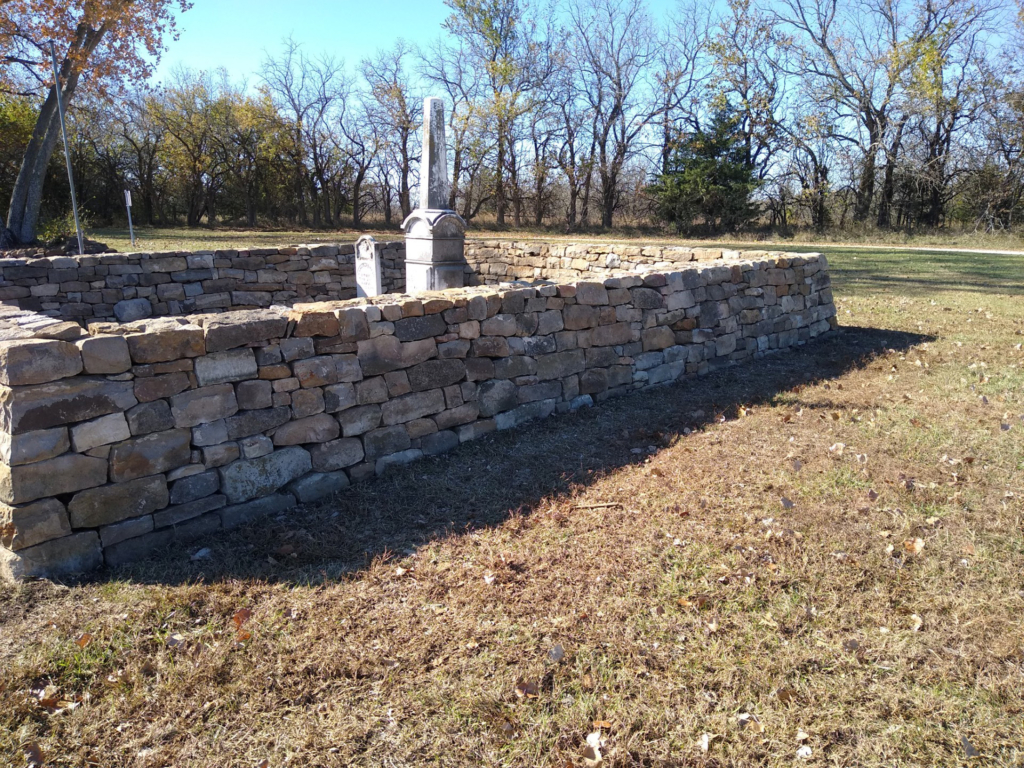
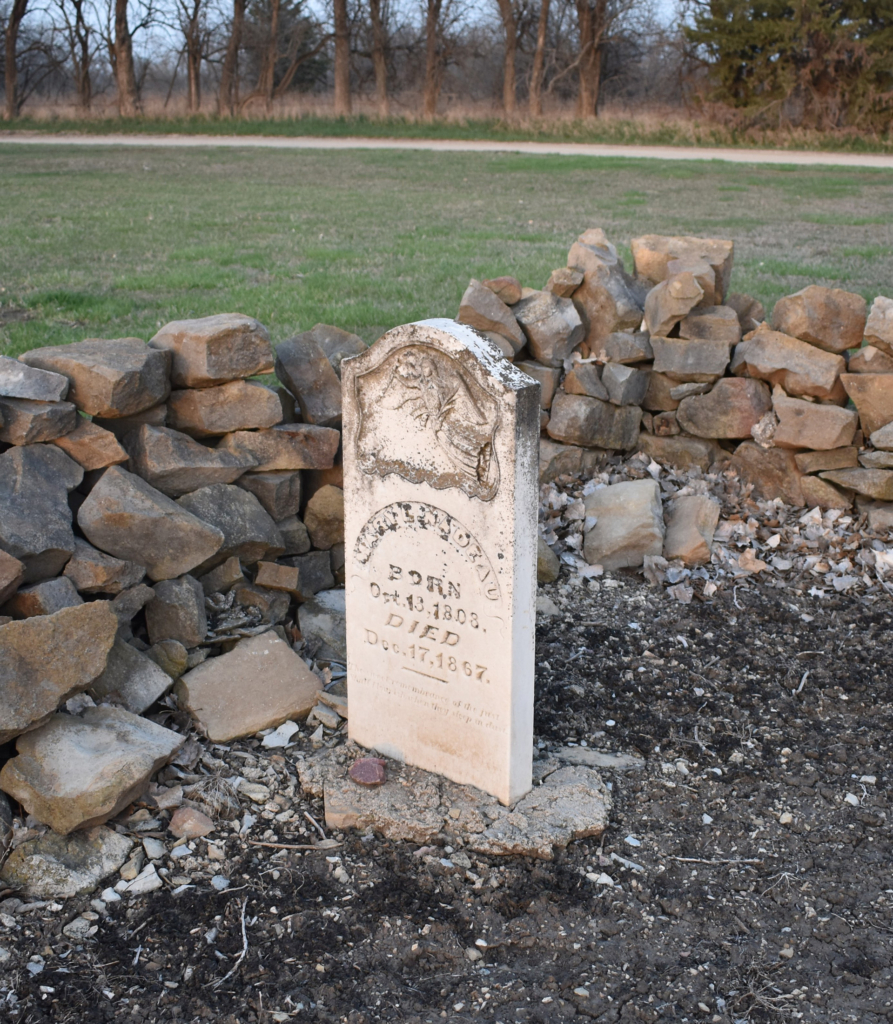
Until recently, all I knew about Mary L. Nadeau was that she was the mother of Mary E. Bourassa, the third wife of Joseph Napoleon Bourassa, my great-great-grandfather and that she died in 1867 and is thought to be buried in the Uniontown Cemetery. For those who may not know the location of that cemetery, it is about a mile east of Willard, Kansas, and directly south across the Kansas River from Rossville, Kansas. Her tombstone is located in what is called the Bourassa burial site, which is a stone walled area within the cemetery. The site only has tombstones for deceased members of the Bourassa family. But we have recently discovered, after numerous sophisticated surveys, that there are no remains associated with these tombstones and markers. That is another story.
A few weeks ago, I received the first in a series of emails from Ryan Williams, a descendant of Peter Alexander Nadeau, whose mother has been identified as Mary Rousseau. That is where this story begins. In Ryan’s research, he has found that Mary’s real name, while married to Pierre Nadeau, was Mary Therese LaVigne. In addition, he discovered Mary was born in 1808, the daughter of Anishinaabe parents Marie LeFevre LaVigne and Kougawma LaVigne, an Odawa medicine man. Following Kougawma’s death, her mother married Joseph Bailly, a fur trader, and they lived on Mackinac Island, Michigan.
Mary and the Bailly family eventually moved to a trading post along the St. Joseph River near the Indiana border on an area which later became Bertrand, Michigan, named after John Bertrand and his Potawatomi wife, Madeline Bourassa Bertrand. This was also the location of the St. Joseph River Band of Potawatomi led by Chief Topinabee, which later became the Pokagon Band.
Beginning in 1822, Mary’s stepfather built the Bailly Homestead along the Little Calumet River at the southern tip of Lake Michigan. Mary’s mother, called Monee, was known for her refined graciousness in receiving Native Americans, travelers and new settlers to the Homestead. Monee is the namesake for the town of Monee, Illinois, which recently unveiled a sculpture in Monee’s honor.
During the 1820s, Mary attended school at the Carey Mission in Niles, Michigan, possibly at the same time as Joseph N. Bourassa. Mary married Pierre Nadeau in 1829. They had four children together, Peter Alexander, Eli Gilbert, Mary Elizabeth (b. 1833) and Catherine Alexandrine.
In 1837, Father Benjamin Petit was sent to the mission St. Mary du Lac in South Bend, Illinois, while also serving the Potawatomi Band at Twin Lakes, Illinois. He is on record for having baptized Catherine Alexandrine. The mission at St. Mary du Lac would later become Notre Dame University. Pierre died in 1838 and in 1840, Mary appears to have joined the Nottawaseppi Huron Band of Potawatomi during their forced migration to Kansas. She arrived there with her four children and started a new life. Mary died in 1867 at age 59 and was laid to rest in the Uniontown Cemetery. Her daughter, Mary E. Bourassa, died in 1872 during childbirth and is also buried in the Uniontown Cemetery.
I would like to express my thanks and appreciation to Ryan for providing this information, and I hope he accepts my apology for omitting a lot of his information due to space limitations.
Upcoming CPN Elders’ Potlucks
Date for the Elder Potlucks held in Rossville at noon are:
April 10 | Ham | RSVP by the 7th
Bring your favorite side dish or dessert. Please RSVP to Tracy at 785-584-6171.
Migwetch (Thank you),
Jon Boursaw | Wetase Mkoh (Brave Bear) | [email protected] | 785-608-1982
2007 SW Gage Blvd. | Topeka, KS 66604 | Office Hours: Tuesday 9-11 a.m. | Thursdays 3-5 p.m. | Other times as requested
Mark Johnson
District 7

Bozho nikanek (Hello friends),
I received a call from a member who had recently moved and was out of their medication while waiting for the mail order pharmacy to catch up with them. CPN Care could have been a great resource to help them out with a prescription for non-controlled medications for a few days until they got their normal prescription, but unfortunately, they had not signed up for the service. Please sign up now for CPN Care; this benefit is available to you and your family, including non-Native children under 18 years old and non-Native spouses. It will take two to three days for your account to become active, so sign up now, before you need it at 2 a.m. It is at no cost to you and your family to join. Besides being able to talk to a doctor 24/7/365 for general telemedicine, CPN Care includes life assistance and pharmacy discount services. Sign up at potawatomi.org/cpn-care. Even if you have good insurance, it may come in handy in the middle of the night when your regular doctor is not available.
The CPN Health Aid Program application is available through the Tribal portal at portal.potawatomi.org and helps Tribal members purchase glasses, hearing aids, dentures and other medical devices. All Tribal members born on or before Dec. 31, 1980, are eligible for the CPN Health Aid Program. Program monies are used to purchase prosthetic devices, glasses, hearing aids, dentures, partials, crowns, wheelchairs, mobile chairs, CPAP machines, prescription sunglasses, contacts, and mobile chair lifts and ramps for vehicles. Please remember the health aid program pays 75 percent up to $750, except for eyewear. Eyewear is covered up to $250. There is a limit of $750 per year. If you have questions, please call 405-964-4025.
Election season will also be coming up before you know it. If you have recently moved, please update your mailing address with Tribal Rolls; this can also be done at portal.potawatomi.org. It is your duty as a Tribal member to participate in your Nation. One great way is through voting when our Tribe has elections. With only about 8% or so of our eligible members voting each year, it is vital that you exercise your right to vote. Pay attention to the issues on the ballot, and vote for who you feel will best represent those values, not just now but into the future.
Again, as a reminder, attending the Family Reunion Festival is a great way to reconnect with your history. If you haven’t been before, or it has been a while, start planning now and join us June 26 to June 28 in Shawnee. I am always available to talk, and I love visiting with our members at the Festival. There is no better way to spend your summer vacation. The honored families in 2026 will be: Acton, Bergeron, Bruno, Curley, DeLonais, Greemore and Slavin. Please join us!
Once again, I would like to say what an honor it is to serve you as your District 7 representative. As always, give me a call and I will be happy to work with you on any questions you may have or provide you with additional information you may need to access Tribal benefits that are available to you. Please also take the time to give me a call or send me an email with your contact information so that I can keep you informed of the happenings within the Nation and district.
Migwetch (Thank you),
Mark Johnson | Wisk Mtek (Strong as a Tree) | 559-351-0078 | [email protected]
Dave Carney
District 8

Bozho, nikan (Hello, friends),
In January, I filed an application with the election board to continue my work as your District 8 legislator. I learned recently that I am unopposed and will continue for another four years. I am excited for the opportunity to serve and would like to say migwetch (thank you) for your support.
Another candidate that is unopposed is D. Wayne Trousdale, who will continue as the Nation’s Secretary/Treasurer. He has been in this role since 2002, and we are very fortunate that he is willing to serve another term. His resume is impressive, being both an outstanding businessman and community leader. He is a steady hand on the steering wheel of the Nation’s finances.
Though some of us will be continuing in our offices, this will be a transition year — most significantly since Vice-Chairman Capps did not file to run. There are three candidates in that race: Jason Smalley, Charles Scott and Martha Kimberly Nootbar. I don’t really know any of these candidates, so I will be looking at their online presence, work history (experience that may be applicable to the position) and the information they share in the upcoming editions of the Hownikan. I suggest looking for qualities that showcase BOTH business and cultural focus. As much as the Chairman has forged the direction of the Nation, the role of Vice-Chairman had been extremely significant also. I suggest we all have a heightened interest in this important race — and vote!
As we are drawn in by national and international conflicts of news making headlines, the quiet business of our lives as Citizen Potawatomi continues. Our citizens continue to have babies, educate our children, practice some of the “old ways” and bury/cremate our family members that walk on. I am proud of the programs that CPN has in place to assist our citizens, who now number almost 40,000. I’m always happy to receive inquiries about these programs from folks residing in District 8 and will always do my best to help you.
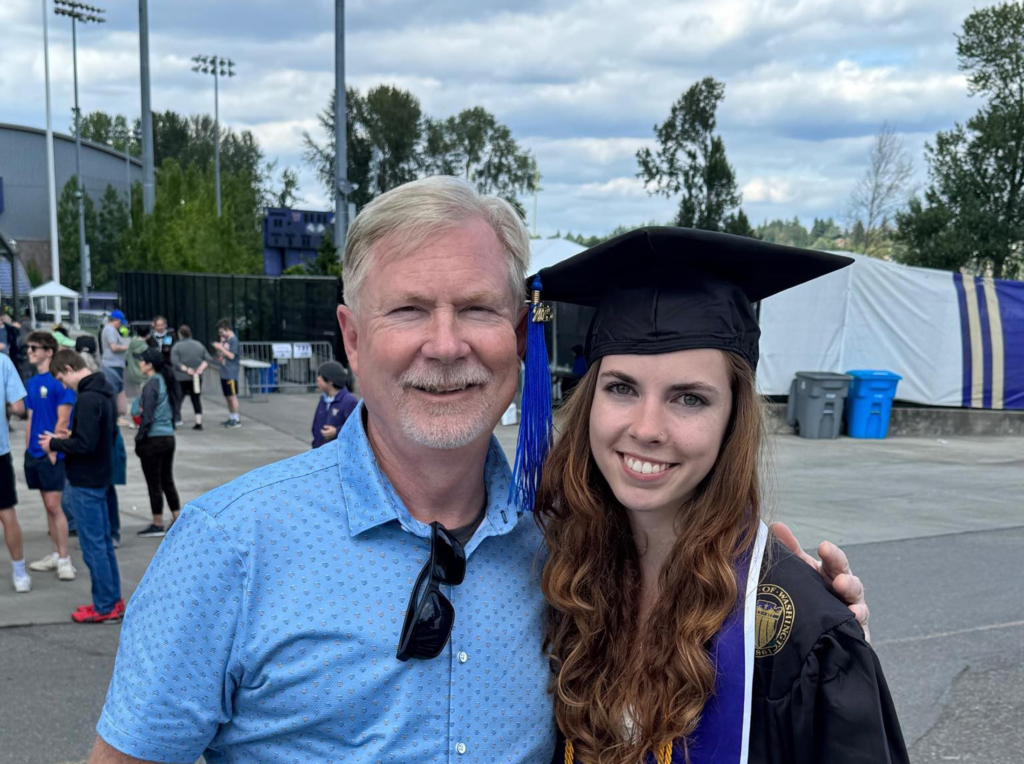
In June 2026, my daughter Sophia will be graduating from a master’s program in accounting from the Foster School of Business at the University of Washington. This is our last child of four to finish their education with the much appreciated help of the Tribe. I’d like to not only acknowledge the Tribe, but also the Nation’s education department. They have been truly excellent.
For those planning summer travel — the Family Reunion Festival this year in Oklahoma will be June 26-28, 2026. Honored families are Acton, Bergeron, Bruno, Curley, DeLonais, Greenmore and Slavin. I would like to challenge my founding family, the Juneaus, to start planning now for 2028. The last time our family was honored, we had a very small group.
I am looking forward to being able to meet in person with District 8 members. I am already in the planning stages of the Fall Feast. The date has been set for Oct. 24, for a mid-day meal and gathering held at the Great Spirit Methodist Church in Portland, Oregon.
If you are a subject expert on anything to do with the Citizen Potawatomi Nation’s history, culture or issues impacting Indian country and would like to make a presentation at this district event, I would like to hear from you. One of the things that has made our Fall Feasts so rich and diverse has been speakers from our district.
It is my honor to serve as your Legislator,
Dave Carney | Kagashgi (Raven) | [email protected] | 360-259-4027
Paul Wesselhöft
District 9

Bozho, nikan (Hello, friend),
Ashes to Ashes
— Paul Chrisstarlon Wesselhöft
The American Corporal said,
“The reign of terror, horror, is over.
We defeated the fascists.
Sir, let me help you onto the truck.
You are liberated. You are free.”
The pale, frail, man replied,
“May I have one last moment, please.”
He slowly went down to the ground on bended knees,
Scooped up some ashes.
“My wife, Yakira, and daughter, Adira, are there, somewhere.
And now they are with me.”
(Native Americans, African Americans and Jews have suffered at the hands of the dominant, ruling class more than any people throughout our history.)
Migwetch (Thank you),
Paul Wesselhöft | Naganit (Leader) | [email protected] | [email protected]
Andrew Walters
District 11
Bozho (Hello),
The other day, I received an email from the Tribe announcing those folks that are running in the next election. Some of the names were new, some old. Some were running unopposed, some with contenders. Some names were uplifting, folks I know from my past as having true caring for the Tribe. Some were names of those who, for whatever reason, have conflict with the administration either real or imagined. Some super intelligent. Some who couldn’t pour pee out of a boot with instructions on the heel.
I was saddened. It wasn’t the list that bothered me. It wasn’t who was “running” that caused my emotional recoil. Afterall, every year we go through this process. Every year WE, or should I say, “some of us,” decide who we should vote for…whether that decision is educated or the result of past grievances from old injuries not personally suffered but rather learned through angry myth and legend. Ugly things are said. Feathers are ruffled, feelings hurt and butts stuck up in the air. That’s unfortunately the process. But it wasn’t any of that. I was saddened by what was missing…a name. The name that over the years has become so important to us all. A name that symbolizes generational leadership. That name is Linda Capps.
It would be easier to just say that I don’t know when I first met Linda, when I first knew who she was. I don’t remember that spark striking, that flash of incite, when I first realized her quiddity. I realized how important she was not only to the Tribe, but to all of us as individuals. It was years ago, but through stories from my Tribal family and friends, she has a refreshed presence.
I will proudly and unashamedly say, I love Linda Capps. I love her as the Vice-Chairman, the balance and grace she brings. I love her for the philanthropy she shows. I love her for caring for the Tribe and the greater community. I love her for the deep commitment I know she has for each and every one of us. I love her for her family, all staunch upstanding citizens in our community. And, I love Linda as a friend…no…a big sister, a member of my family.
I have seen Linda “at work.” Her disarming charm and grace open doors for the Tribe. Her history and knowledge of the Tribe is priceless. I have seen her pull out her rapier intellect and cut those who underestimate her down to size, smiling coyly as she does it. I have seen her face soften at the sight of a child, and I have felt her sympathy when she thought Cora and I needed help.
I know there are some rotten old corpses out there. People who, in their vile, hateful minds rejoice over Linda leaving her office. Rotten corpses, broken shells, whose only outlet is to sit at a keyboard and spew hatred and dissent. May they be less than forgotten in our future. Their spirit is a poison. It was Linda who was the antidote. A vast majority of this Tribe feels the same as I do. We love you, Linda.
Each burden, no matter large or small, must, at some point, be put down. Linda has carried the burden of leadership for years. I hope for Linda a time where she can sit under the cool shade of friends and family, remembering her extraordinary service filled life and be untethered to the burden that we have placed on her for so long.
“Los tiempos van cambiando” (The times are changing)
We love you guys; Cora says hi!!!
Andrew Walters | [email protected] | [email protected]