The Citizen Potawatomi Nation’s Cultural Heritage Center provides resources to keep the Tribe’s history safe and accessible for generations to come. One key way the Nation does this is through the CHC’s archives and video interviews. To highlight some of the archive’s holdings, the Hownikan is featuring photographs and family history of every founding Citizen Potawatomi family. If interested in assisting preservation efforts by providing copies of Citizen Potawatomi family photographs, documents and more, and to schedule family interviews, please contact the CHC at 405-878-5830.
Bergeron family beginnings
The Bergeron Potawatomi family roots begin along the Kankakee River in Bourbonnais Grove, Illinois, with Watchekee, the daughter of Potawatomi/Odawa headman Shabonna and Monashki. Shabonna was an ally of Tecumseh and Tenskwatawa during the War of 1812. He joined Main Poc and other Potawatomi leaders, including Waubansee and Winamac, to fight American forces. However, after the war, Shabonna eased his opposition of the United States.
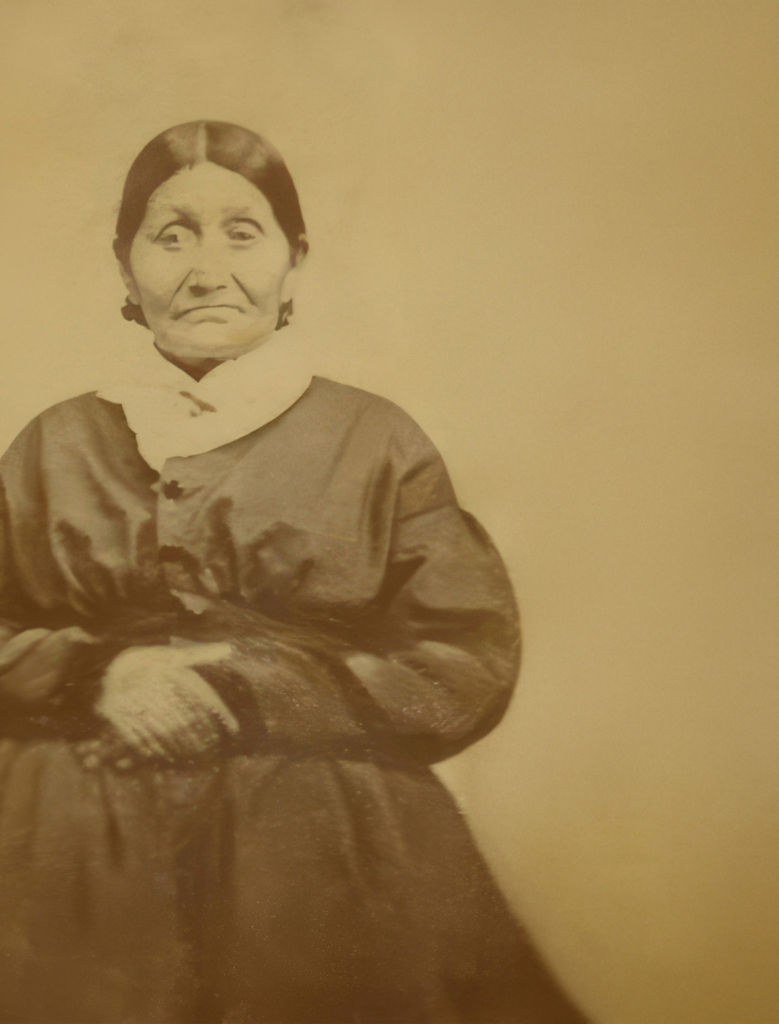
Watchekee was born around 1810 and had a reputation for being intelligent and beautiful. Although she had mixed tribal heritage, because of her father’s leadership with the Tribe, Shabonna raised her in a Potawatomi village. Family records indicate she was born during a bright star. Potawatomi often used natural phenomenon to denote time rather than years. After the Potawatomi signed the 1833 Treaty of Chicago, she was among those removed to Council Bluffs, Iowa, in 1837.
Watchekee never forgot her home in the Great Lakes and traveled back and forth from the reservations west of the Mississippi in Iowa and Kansas to Illinois by foot on multiple occasions, and because of this, was ultimately removed numerous times. Bergeron descendants estimate she walked more than 6,000 miles on her travels. She was known to return to a particular campsite along the Kankakee River each spring, where she would remain until summer.
French-Canadian Francis Xavier Bergeron was born between 1815 and 1819 and arrived in the Great Lakes region as a young man where he met Watchekee on one of her trips back to the region. In 1840, she received the Christian name Josette or Zozetta after her baptism. She and Francis wed around that same time, but it was not her first marriage. Before marrying Bergeron, she had two other husbands named LeVasseur and Hubbard. She had four children: Jean Batiste, Catherine (Kate), Matilda and Charlie.
Watchekee’s children grew up in a pivotal, difficult time in Potawatomi history. They experienced forced removal many times and the challenges associated with being Woodland people on the prairies of Kansas. The resources they could depend upon in their ancestral Woodland home were no longer available to them in Kansas. Other resources promised by the U.S. government never arrived.
Although Potawatomi had hoped the reservation would be safe from outside encroachment, it did not go unnoticed by settlers and travelers. The Oregon Trail brought thousands through the area, and the railroad saw many economic opportunities.
As a result of westward expansion, the Tribe approached the federal government about the chance to take allotments and become U.S. citizens in 1861. The Bergeron family were among the Citizen Potawatomi listed on the 1863 census. However, this did not prove advantageous as the allotted lands quickly passed from Potawatomi ownership to white settlers. A clause in the 1861 treaty provided opportunity for the Potawatomi to sell their remaining lands in Kansas and purchase a new reservation in Indian Territory.
Creating community after removal
In 1872, the Bergeron family joined six other Kansas-based families to become part of the original Potawatomi to settle on the new reservation in present-day Oklahoma.
Watchekee’s daughter Catherine (Kate) Bergeron was born in 1853. She married Frenchman Joseph L. Melot, and they became the principal founders of the Mission Hill community, now known as Wanette, Oklahoma. They had seven children: Joseph Edward, William W., Louis, Leander, Joseph Thomas, Theresa and Benjamin. Kate walked on in 1933, and was buried near Wanette, Oklahoma.
Wanette was founded on March 19, 1894, according to a January 1995 article in the Shawnee News-Star. The Bergerons occupied 240 acres on which the town was first built. However, in 1903, the Santa Fe Railroad began developing a new rail line and the citizens of Wanette voted to move the town one mile north to its present location so they could access the railroad.
Jean Baptiste Bergeron married Mary Hollaway in Wamego, Kansas. They had two children, William Oliver and Frank Alexander. Sadly, Mary passed when the children were young, and Jean Baptiste left William and Frank with the Indian Agency to find work out west. As a French last name, sometimes Bergeron was spelled Bazhaw by teachers with the agency. John walked on in about 1921.
Matilda was born Sept. 20, 1846, in Council Bluffs, Iowa. She wed Wesley Lewis, and they had Francis Lester, Ivy Bell, Sylvester, Josephine, Charley, Annie May, Omer Dee, Flora May, Edward James, David Albert and Martha. Matilda walked on March 8, 1886, and was buried in Louisville, Kansas.
Watchekee’s youngest son Charles married Mattie Leslie in 1876, and they had one son, Robert.
The first inhabitants of what would become southern Pottawatomie County worked incredibly hard. Arriving in Wanette and other rural areas meant digging wells, building farmhouses, stables, pens and corrals. Hundreds of acres of land were cleared by hand so families could sustain themselves by raising livestock and planting corn, beans, potatoes and other food.
The area’s first schools, post offices and even cemeteries were a direct result of the initiative of the Potawatomi.
A place in history
Watchekee was one of the very few to live in the Great Lakes, experience removal and eventually settle on the reservation in Indian Territory. However, her influence in the Great Lakes region remains today with the city of Watseka, Illinois, near the Indiana border derived from her name. According to Daily Journal, community leaders renamed the town in 1865 from Middleport to Watseka to honor her kindness toward settlers. Today a large mural in town features Watchekee, serving as a visual reminder of the community’s past.
The vast majority of the infrastructure of southern Pottawatomie County would not have existed if not for the Potawatomi people who created it. Today, Bergeron descendants continue the family legacy of leadership and service to others as Tribal historians, writers, safe-keepers of Potawatomi traditions and more.
If interested in assisting preservation efforts by providing copies of Citizen Potawatomi family photographs, documents and more, and to schedule family interviews, please contact the CHC at 405-878-5830. Schedule interviews online at portal.potawatomi.org. Learn more about the Family Reunion Festival at cpn.news/festival, and find research resources online at potawatomiheritage.com.