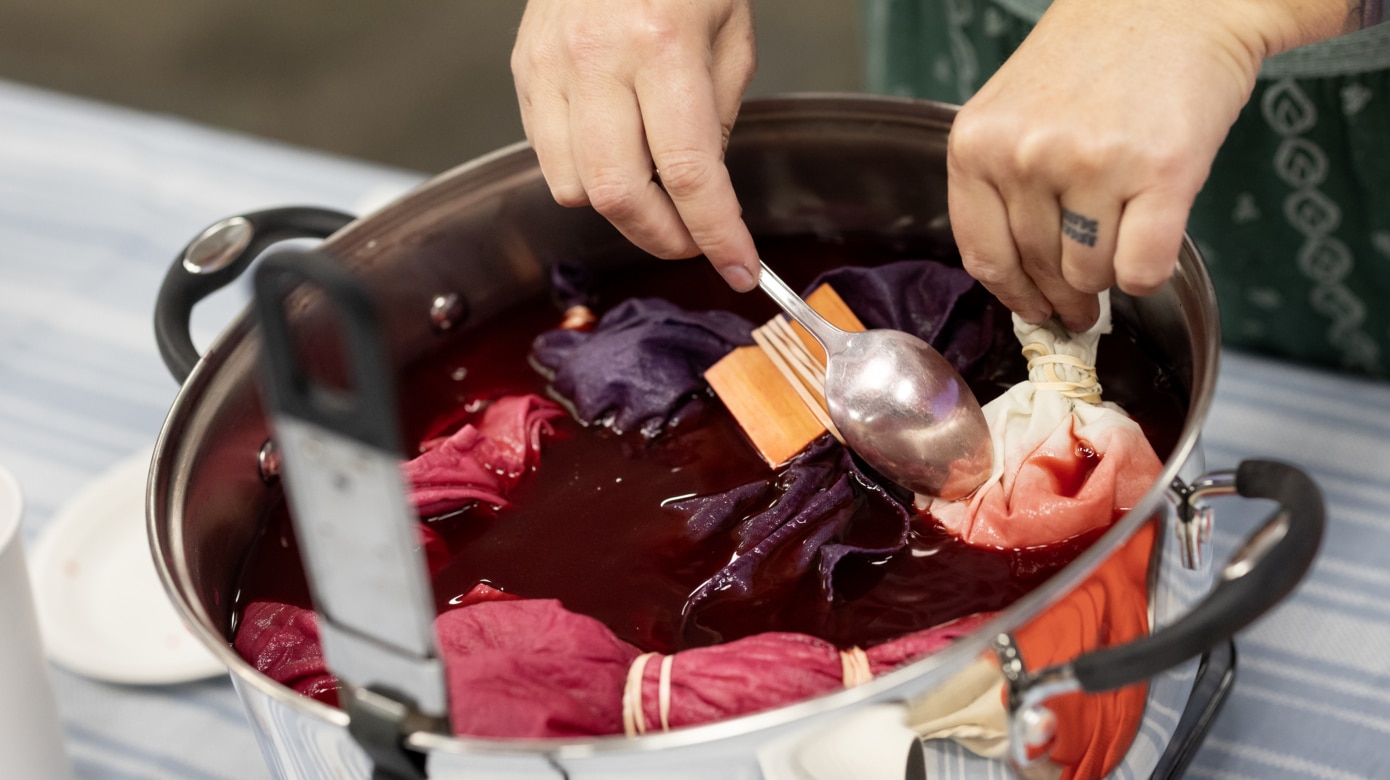
Like many cultures, Native Americans have used a variety of plants and animals to produce natural dyes. A Citizen Potawatomi Nation tribal member hopes to revive interest in natural dyes.
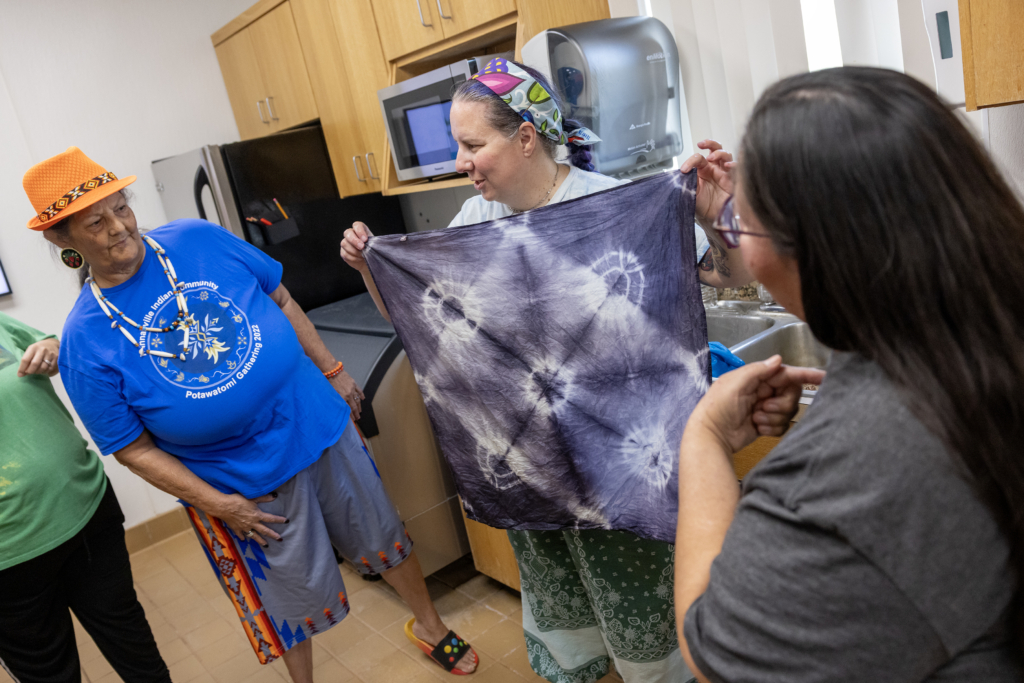
Daisy Bourbonnais-Pelletier shared some of her knowledge during a Sept. 17, 2025, presentation at the Cultural Heritage Center. She has been interested in the technique for many years.
“I have wanted to do this my entire adult life, but I actually started learning about natural dyeing in 2018. I took a class on hand stitching, and we also did some natural dyeing,” she said.
Bourbonnais-Pelletier said most of the resources she has found are from a global, rather than an Indigenous, perspective. However, some knowledge could still be applied to Indigenous practices.
“The references I have seen could apply to some plants that are native to North America that we would have used for natural dyeing. Walnut hulls, for instance, and then obviously some other plants that are more native to north America,” she said.
Reusing and recycling
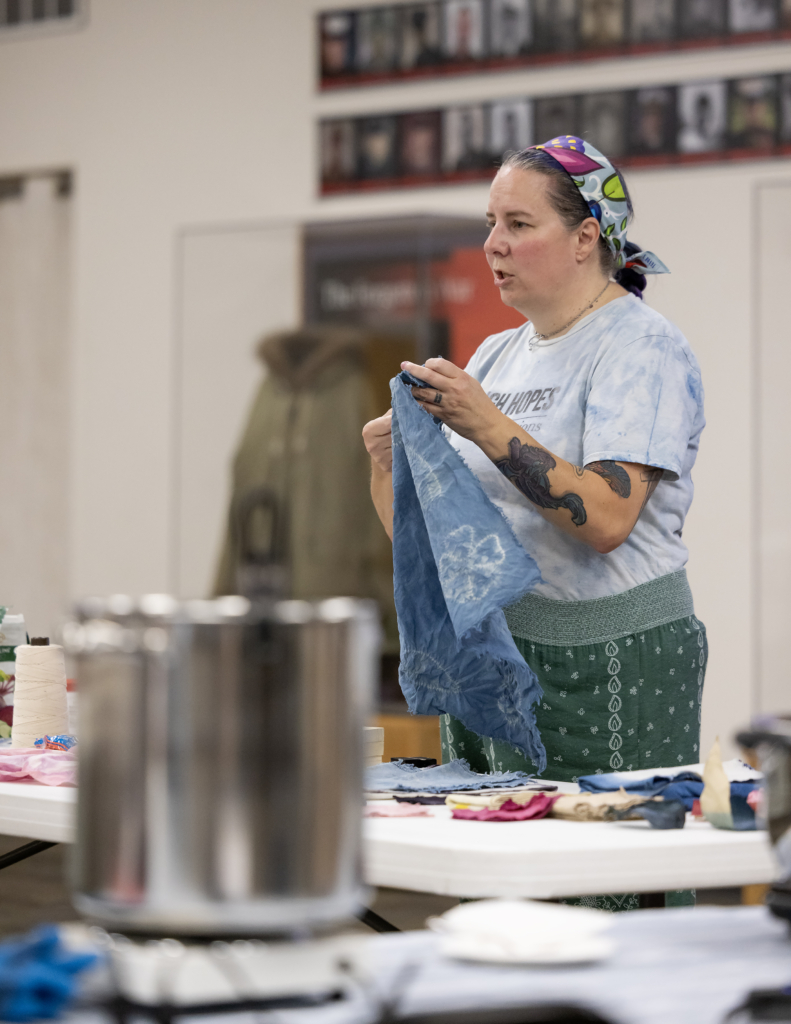
After the invention of synthetic dyes, natural dyes became less popular. Bourbonnais-Pelletier hopes to see more people experimenting with natural methods as the process can give new life to items that might otherwise be thrown away.
“Today I shared a couple of things that I made. Both of those were just some stained napkins that I dyed with indigo and now they’re pretty again. We have gotten to a place in our wider culture, where everything is done synthetically and we don’t have that hands-on experience.”
Using natural dyes allows the user to connect with each plant or substance.
“Marigold is a really good one because marigolds are in everybody’s garden. They’re in every plant center so they’re very easy to find. They make a really beautiful yellow color; they’re easy to use. When you take your t-shirt or your napkin that’s all stained and then you suddenly turn it into this beautiful art that you’re excited to use again then that makes it more fun. The next time you go out and you see those marigolds, you’ll say, ‘I made this, and I have this marigold still in my garden.’”
Research is important
Bourbonnais-Pelletier advises research to determine which kinds of plants are best for dyeing to get the best results. It’s also important to know the difference between which plants can be used, or which may be invasive to the local environment.
Some plants may not be native to North America but likely came to the continent through trade routes. Research indicates indigo plants from the Sonoran Desert may have been used by Indigenous North Americans.
“Indigo is not native to North America. We have false indigo, but it doesn’t dye. People might find that in their garden and think they would be able to dye something with it, but they won’t. So, that would be very disappointing,” she said.
Another popular ingredient, cochineal, possibly came to North America from a South American source.
“I think cochineal actually is native to Peru. So, that might have been something that our ancestors might have had access to through trade routes, but not necessarily what we would have had to access to just in our surroundings,” she said.
Bourbonnais-Pelletier hopes to plant a dyer’s garden with native Oklahoma plants that are environmentally beneficial, while potentially helping local pollinators.
“I want it to all be plants that are either native to Oklahoma or are going to be good for the environment of Oklahoma, even if they’re not native here. I don’t want to plant something that will be invasive and will cause problems for our native grass,” she said. “For the pollinators, for the birds, we want our songbirds to have a good source of food as well. It’s a big circle.”
Plants like Dyer’s Woad have long taproots, which is environmentally beneficial, but is considered invasive in some parts of the United States, particularly in the west.
“Long taproots transfer nutrients down deep into the ground, but it’s considered invasive because the seeds scatter well. Since (Oklahoma is) not that far from the west and it spreads really easily, I’ll avoid it,” she said.
Supplies to gather
There are a few basic items she recommends people have on hand.
A stainless steel pot, dedicated only to dyeing, is essential. Pots should not be used for both food preparation and dyeing, Bourbonnais-Pelletier said. A spoon for stirring mixtures, gloves, a mask for mixing powders, a bowl and a bucket are also needed.
Pots should be stainless steel or enamel. No cast iron, copper or aluminum should be used because they can cause unexpected chemical reactions.
“I have a five-gallon bucket, but you don’t need something that big. You could have something smaller if you’re only dyeing a small amount of things. Your dye goods need to move freely in the liquids. So, whatever you’re going to be dyeing that’s what you need to keep in mind when you’re choosing the size of the container that you’re using,” she said.
The technique isn’t limited to fabrics. Bourbonnais-Pelletier has used natural dyes on a variety of materials, even rawhide. Before the presentation, a CHC employee suggested putting porcupine quills in the dye mixture to see if the quills would accept the dye. Bourbonnais-Pelletier was eager to try.
“I’ll put anything in the dye pot once. I’ve dyed all kinds of fiber, yarn and other things. The quills, that was exciting. The rawhide was because I want to make some rattles,” she said.
She recalled a yarn project that didn’t turn out how she expected, but she kept the yarn for years until she learned about a new process and tried it on the yarn.
“We did some Easter egg dyes on yarn one year, and one of them didn’t work. It was terrible, but I had that yarn for probably five years,” she said. “Then I took this class, and I said, ‘Well, let me put it in the indigo’ and it turned out beautifully. It still had all the variation in color from before, but then it had beautiful soft blues over the top of it. You never know what you’re going to get when you put things in natural dyes.”
Bourbonnais-Pelletier said those surprises are part of the fun.
“It really, really is. You just open it up and then it’s a surprise every time,” she said.
More tips on getting started can be found at Maiwa, naturaldyes.ca. Retailers Botanical Colors (botanicalcolors.com) and Dharma Trading (dharmatrading.com) also have resources.
For more information, contact [email protected] or follow Bourbonnais-Pelletier on Instagram at @The_nomadic_mermaid.