By Justin Neely, CPN Language Department Director
Bozho, jayek (Hello, everyone),
Gshatemget ngom. It is a hot one today.
Gi Mno gishget. It was a good day.
We are just starting the second week of our eight-week immersion classes. We are on the final year of a three year Endangered Language grant. But we are currently evaluating ways to streamline the classes. We are thinking next year about splitting them up a little bit: doing two weeks of beginner language instruction, taking a week off, and then doing two to three weeks of intensive language instruction for more intermediate level folks. We are also considering possibly doing a children’s week-long course. That way it won’t be so difficult for folks to be away from their families/plants/animals for too long. We have discussed ways to involve our online folks as well.
We have had some great attendance up to this point. We have had folks join us from Hawaii, Texas, Tulsa and all over Oklahoma, Anet Mshkodéniyek mine shishibéniyek, some Prairie Band folks and Citizen Potawatomi. So far, we have had eight children join us at different times, which is awesome to see our next generation in attendance and learning our language. We have had 24 people total join us so far. Many are staying for the full eight weeks, which is great. It’s eight hours a day, five days a week. One day of class is the equivalent of a class held for one hour once a week for eight weeks. So a week of classes is the equivalent of about two years of class. After Week 8, it’s close to 320 hours, or almost like taking five to six years of Potawatomi all jammed into a couple of months.
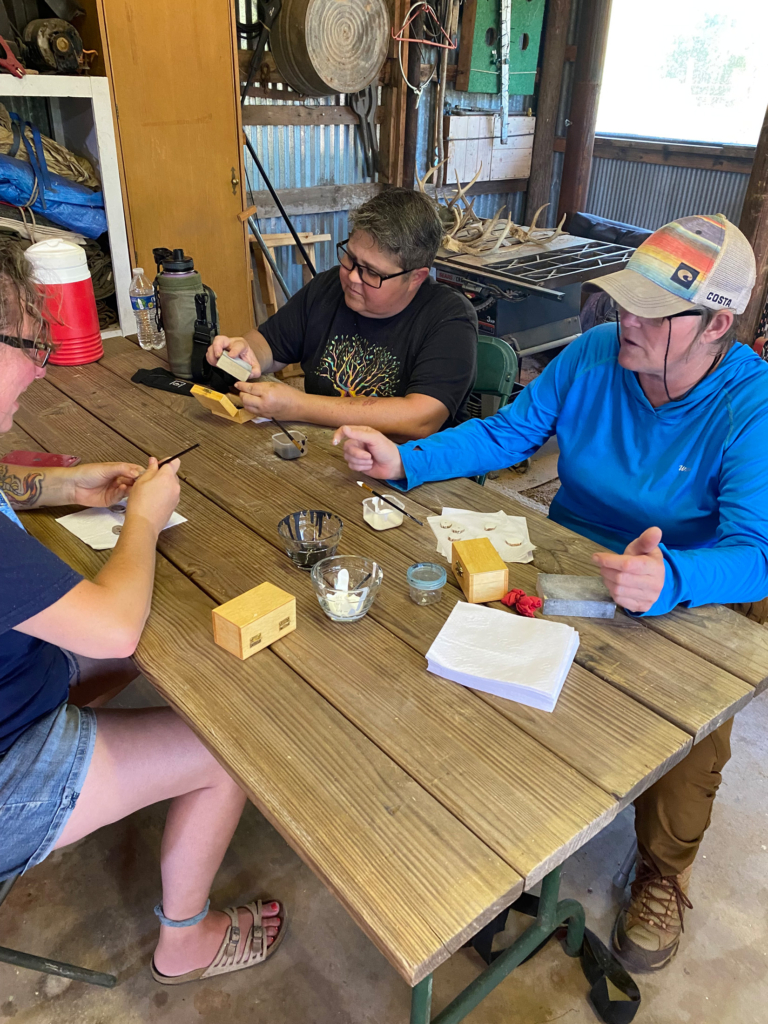
Folks are learning the language, but we are also trying to impart cultural knowledge as well. Folks learned how to make pegna, a traditional Potawatomi cornbread. They made their own dice and bowl set and learned how to play. They also made medallions and later will make traditional moccasins. Learning the language is a way of life. It’s not something you pick up with one class or a couple of classes. It may take you a whole lifetime of experiences and understanding to truly feel like you understand the way our ancestors saw the world. The key is to be patient with yourself. Sometimes we are our own hardest critics.
Znegetnangodgen: It’s difficult sometimes. As you learn the language, you start to see the world in a completely different way. You start to understand the world around you in a different way. The language in many ways is like a window into the past where one can see what was important to our ancestors but also what we continue to value as traditional Potawatomi people.
As I write this article, I would be remiss if I didn’t mention it is my 20th anniversary working for our Tribe. I have been truly blessed to have been given this opportunity to teach, learn and help our people. It is a very humbling experience. I was just a teenager when I first started learning the language. Never in a million years did I think not only that I would work for my Tribe but that I would work with our language to help carry it into the future. I am deeply appreciative of this fact. I have been blessed so many times over and hope that each of you will take a moment to start learning a little of our language and ways. I promise you that you will never regret your decision.
Iw (End).