Chairman John “Rocky” Barrett spoke to the Harvard Kennedy School of Government class on Native Nation Building Jan. 16.
The class, Native Americans in the 21st Century: Nation Building I, led by Prof. Joe Kalt and Prof. Angela R. Riley (CPN’s Supreme Court Chief Justice), “examines the challenges that contemporary American Indian nations face as they endeavor to rebuild their communities, strengthen their cultures, and support their citizens.”
“The class is a flagship offering of Harvard’s John F. Kennedy School of Government,” a letter to Chairman Barrett from Professor Kalt said. “It has been taught every year for more than 25 years.”
Chairman Barrett spoke on turning history around through government reform.
“As a key part of the course, we expose our students to leaders working in various capacities in Native governance around Indian Country,” Kalt said. “As we do every year, we will feature approximately 20 Indigenous leaders during the five days of the course.”
In the letter, Kalt also said that Chairman Barrett had spoken to the class several times, and that hearing from experienced leaders such as Chairman Barrett helps students understand the “real-world challenges of nation building.”
Riley and Kalt presented the Chairman with questions to lead a conversation with adult students, focusing on what CPN has “built in both the provision of government services and in economic development” and what key governmental reforms CPN has put in place to help build the Nation into what it is today.
Students were given information on CPN and its background before the course, and Kalt explained the class was not made up of typical young college students.
“The students in the class are almost all mid-career professionals, usually in their 30s and 40s (sometimes into their 60s and even 70s) and with their own amazing records of leadership and accomplishment,” Kelt said.
The class was also open to students from other departments, schools and even area universities, including those who fly in to audit the course.
“Not surprisingly, it attracts most of the Native students at Harvard; but the course has also become particularly popular with students and leaders from developing countries (who immediately see the parallels of the colonial power loosening control but leaving its legacies behind as communities struggle to chart their own courses),” Kalt said.
He added that students who have enrolled in the class have included former members of Congress, past presidents of African countries, finance ministers of Latin American countries, tribal councils from tribes in the U.S. and Canada, and delegations of Maori and Australian Indigenous leaders.
Other speakers that day included Meredith Drent, chief judge of the Tulalip Tribes Tribal
Court, and Lance Morgan, president and CEO of Ho-Chunk, Inc., Winnebago of Nebraska.
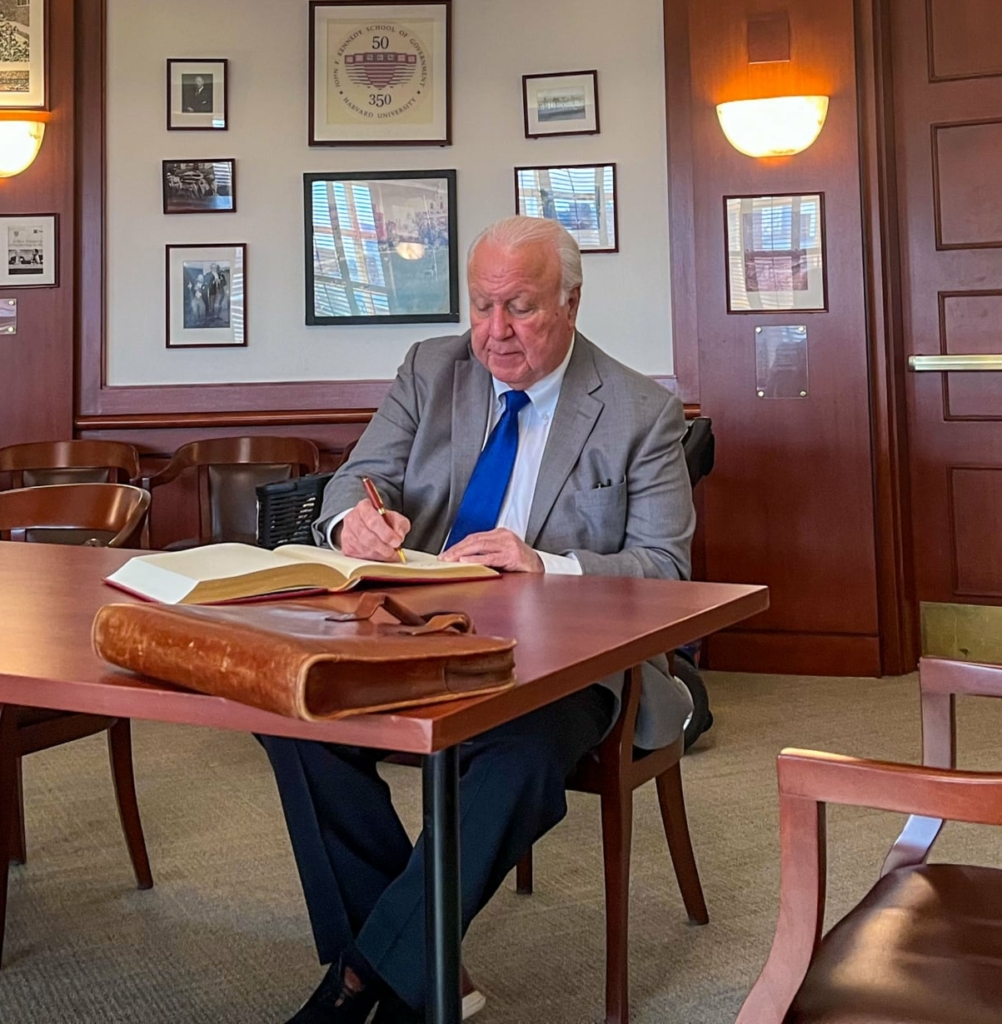
While at Harvard, Chairman Barrett also signed the registry of Heads of State, which is signed by all heads of state who have spoken at Harvard, from George Washington to Winston Churchill to King Charles of England. The signing was conducted by Harvard University Marshal Katherine G. O’Dair, Ph.D, the University’s Chief of protocol. Her position is described as:
“The Marshall connects and represents the Harvard community to the world, welcoming guests and celebrating key moments, while also providing guidance and support to university partners, all in service to the mission of the university.” The Marshall’s Office has been of cial since 1896.