A pattern for a collaborative beaded artwork, designed and submitted by Laura Hewuse, has been selected as the winner of the 2026 CPN Department of Education Art Contest. The piece is titled Mno Bmadzewen, meaning “good life” or “good health.”
Several years ago, former District 1 Legislator Alan Melot and Hewuse created a Zoom Loom Beading Group that meets every other week, allowing participants to connect and share their talents. Over time, the group has grown into a close-knit community with the addition of District 1 Legislator Steve Livingston.
“It’s a community formed, bonded and blessed, shared across all districts,” said Hewuse. “We represent CPN proudly. Not only are we beadwork artists, but we are also mothers, fathers, grandparents, aunts, uncles, brothers, sisters and friends.”
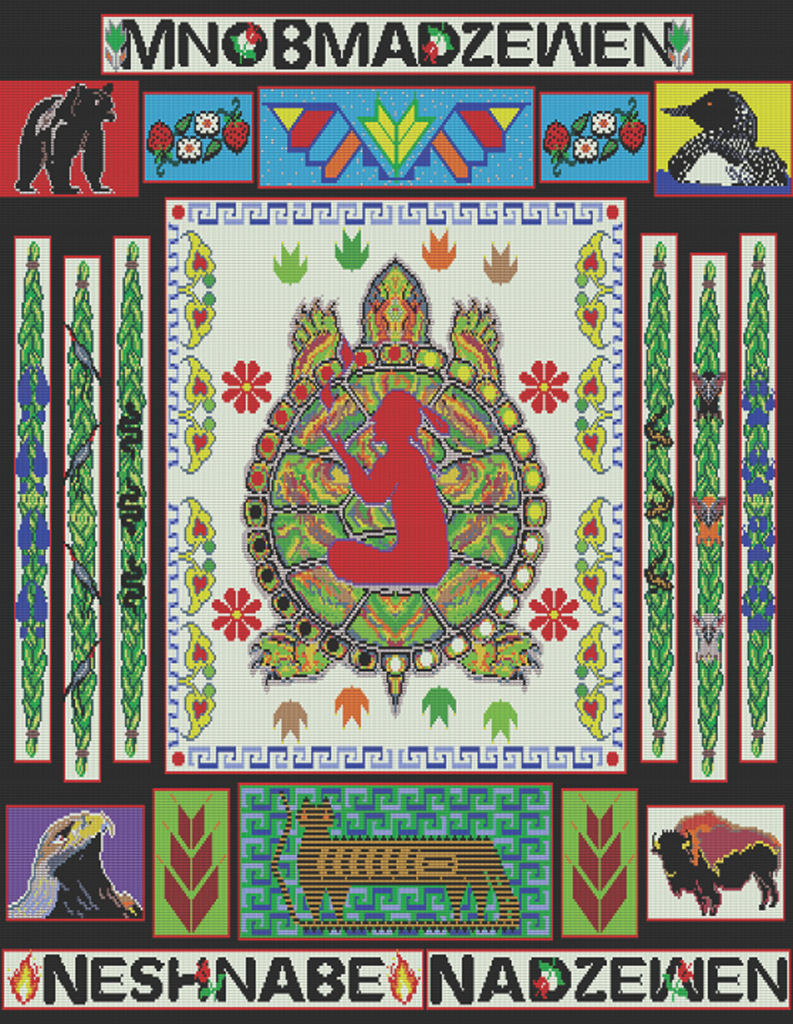
For the project, Hewuse and Jennifer Dye collaborated with District 1 members to launch a district-wide beading project, as an extension of the Zoom Loom Beading Group. The intricate design consists of 229 bead columns and 206 bead rows. The panel measures 25 to 30 beads wide and 13 inches long.
In addition to Hewuse, Dye, Melot and Livingston, other contributors include Madison Waters, Anna Johnson, Brian Hewuse, Kristy Nichols, Kortney Seeley, Rosanah Ziegler, Lorrie Underwood, Sierra Waterman-Wells, Kristina Komara, Dixie Summers, Rebecca Lewis, Danny Ferris, Brandy Schmitt, Robin Schwartz Harvey and MaryEllen Godinez. Each participant created a small section of the overall design, which will eventually be joined into a single piece.
The finished beaded panel will be presented as a gift to the Cultural Heritage Center for public display.
Hewuse shared the special meaning behind Mno Bmadzewen in her art submission:
“It’s deeper than that — it’s physical, mental and emotional; holistic health. It’s knowing our songs, dance, regalia, stories and the language is the thread which ties it all together.”
She added that for her, Mno Bmadzewen represents community and a shared expression of identity.
“This project may have physical symbolism in depicting our medicines, clan animals and our language. But the underlying symbolism is we’ve stitched all the different but remarkable pieces together into one piece and that is what we’ve been able to do in this project — stitch together people from all over.”
Participants range from experienced crafters to beginners, from those newly reconnected with the Tribe to members who have been active in the Tribe for years.
“We are all in different time zones, different parts of the country, have varying levels of reconnection to our identity and experiences. This is community — bringing together parts to make a whole, and that’s what we hope for the CPN people,” Hewuse told the Hownikan.
She continued to share that projects like this go beyond learning beadwork.
“All of us have our own lives, surrounded by friends or extended family that aren’t CPN and likely not Native at all,” Hewuse said. “This creates a space to be around other people with a shared identity and purpose, and to build friends, connections and conversations. We have built a place for people to connect and be Potawatomi.”