At a 2019 TEDx event, Siobhan Marks greeted the crowd in her Ojibwe language and told the story of what she calls “Our Grandmothers Dress,” or the strap dress. The strap dress is believed to be the dress worn by Woodland tribes before contact with Europeans. Much knowledge about the dress has been lost through removal and colonization, but Marks is hoping to bring the dress back.
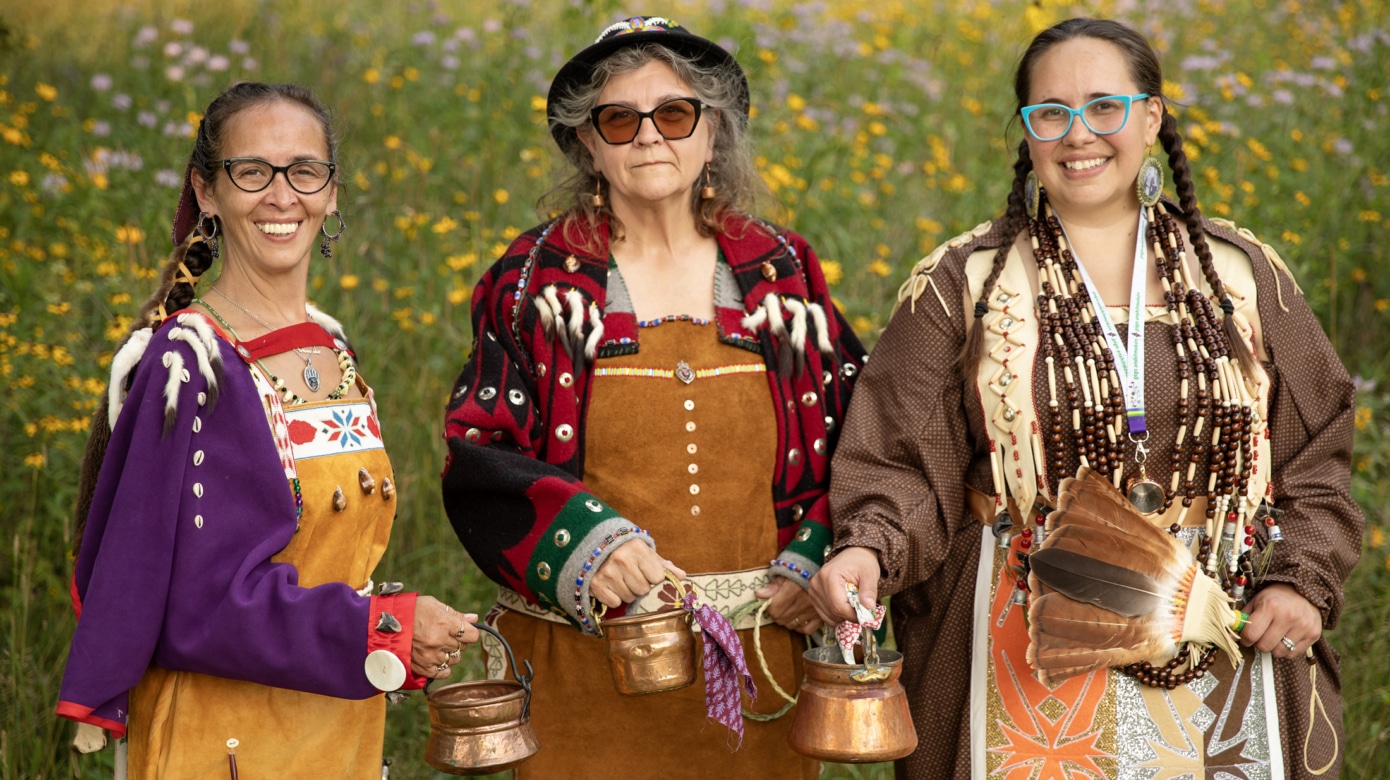
CPN tribal members Alychia Wooton, Anna Johnson and Laura Hewuse are hoping to be part of that effort, and the three collaborated to create their own strap dresses.
Hewuse found information from Marks and called Johnson and Wooton to ask if they would like to help her with the strap dress movement. Once all three decided to take the project on, they spent several months planning and creating the dresses.
One challenge in making the dresses is the lack of a pattern.
“It was pre-contact,” Hewuse explained. “The Native women started wearing the dresses they saw the French women wearing … and our original strap dresses slowly dwindled away, and there’s not a pattern for them. They have not found a pattern.”
All the three had to reference while designing the dresses were pictures and also dolls that had been found wearing strap dresses.
“I have always been drawn to fascinating pieces of history, and I actually minored in history in college,” Johnson said. When dolls were found wearing strap dresses, she continued, “I thought it was one of the most clever ways to pass down our culture — hidden in plain sight and passed down through play during a period in time when Natives were treated less than.”
With those photos and dolls as a guide, Hewuse, Johnson, Wooton and others are hoping to bring back the old style of dresses.
Wooton said designing and sewing the dresses with no pattern to work from was a challenge, but a fulfilling one.
“It’s definitely a labor of love, and I’m hoping that I can help others create the strap dress that represents them and their story,” Wooton said.
Creating their own versions
“I’ve made the contemporary style strap dress, which is combining the leather dress with the wool cape,” Hewuse said.
For her dress, she also incorporated silver, cowrie shells, old trade beads, ermine tails, and beadwork from a pattern created by her late father, Jerry Lee Maisch Sr. Because her family is Bear Clan, she used bear claws she had gifted to her father on her straps. She also loomed the belt for him, adding claws on the belt, and honored him with beadwork down the sides of the dress. The cape, she added, was made from a Pendleton blanket that had been gifted to her by Cathy Wamego when Hewuse’s second husband walked on.
Johnson’s strap dress was inspired by a photo of Ellen and Charlotte Vieux, where Charlotte wore regalia with ribbon work in the Vieux family pattern. She also wore earrings she had made with sweetgrass wrapped around them, red white-heart beads she had been gifted from her father, an eagle feather in a fan from her Mdamen class, and a necklace she tried to replicate from her great-great-grandmother’s regalia.
“I tried to go more ‘old-style’ traditional with mine; stitching with sinew, using trade beads and even finding fabric that looks like an 1800s reproduction. I was intent to craft a strap dress that resembled my great-great-grandmother’s regalia in her honor, but with some modern tweaks,” Johnson said, adding that she also added a pocket because utility and resourcefulness is important.
For Wooton’s dress, she made sure she had shells from the area Potawatomi people originally came from, leaves to represent the Potawatomi people, a fire keeper on each side, an eagle and eagle feathers, and drops to represent her clan, the Bear Clan.
The three also assisted each other through the process. Hewuse and her husband designed the beadwork on Wooton’s dress, as well as helping Johnson design the strap for her bandelier bag. And Wooton, in turn, helped collaborate on designing the dresses too.
“It was a coordination between all three of us, and we spent many hours of chatting back and forth and visiting,” Hewuse said. “We really worked hard to get our dresses.”
Dancing at Gathering
The three women wore their strap dresses for the first time at the Potawatomi Gathering in Michigan in 2025.
“I’ll wear it again down in Oklahoma when I go, because it’s hot in Oklahoma,” Hewuse said. “That’s the purpose of these dresses. They’re summer and winter. You can wear them in summertime without the cape, and then in winter you put the cape on. That’s what makes them unique.”
“These strap dresses are supposed to be for utility and are constructed for everyday wear. The cape provides warmth in cooler weather, and protects our arms and shoulders from the sun, wind and everyday work; but when it gets too warm, we can remove the cape and continue on with our day. The cape provides modesty during ceremony and can later be removed when we’re working and when it’s hot. I just love the fact that it’s very versatile and it’s making a resurgence,” Johnson said.
Wooton and Johnson both said it was a unique experience dancing at Gathering, because there is no dance style associated with strap dresses.
“Alychia and I were having a whole heck of a lot of fun dancing at Gathering,” Johnson said. “Neither of us knew what category we would fall under, and our best guess was Women’s Traditional. However, we didn’t carry our shawls or use traditional steps, because we were in strap dresses. It was the first time I danced without sleeves, just the straps, and it was wonderful. I was able to do storytelling with my dance, and it felt so good. I was a little fearful of negative comments or ‘side-eyes,’ but that didn’t happen. I think because even though it was sleeveless, it was still modest.”
Wooton echoed those thoughts.
“The thing that is nice is that we get to start from the beginning, so there’s nobody really going to tell you if you decide to wear a strap dress that you’re dancing those steps wrong. There are no steps for it,” she said. “We were gatherers, we were water bearers when we wore those. We were hunters. So you can dance how you feel.”
To learn more about strap dresses, there is an “Our Grandmothers Dress” group on Facebook. You can also listen to Siobhan Marks speak about the strap dress at cpn.news/strapdresses.