By Bree Dunham and Jennifer Randell, CPN Eagle Aviary Managers
For the Aviary, the release of the two young golden eagles, Mnotagwzékwé (She Brings the Good News) and Nëmkis (Little Thunder), this past October was monumental. Becoming the first Native American Aviary to hatch and release both bald and golden eagles was an amazing achievement for the program, but for the eagles, this release is the final step to permanently amending the aviary permit to allow the release of any eagles hatched here in the future. According to the teachings our ancestors have passed down to us through countless generations, these young eagles now have an integral role in our society. Our oral traditions tell us that it was Kno (Eagle) who saved mankind from being destroyed by the Creator through the act of carrying our prayers to Mamogosnan. He fought for us, he advocated for us, and he believed that we were worthy of saving. Kno (Eagle) continues to do this for us today; they are warriors and messengers for the Neshnabe people. We are compelled by that to release them whenever we can and in doing so, we continue to respect and honor Kno in that spirit of reciprocity.
Looking back at photos of the release, it is hard to convey the enormity of that brief moment. How incredible it was to watch them take in the expanse of the Montana countryside and fly off the mountain doing exactly what the Creator intended them to do.
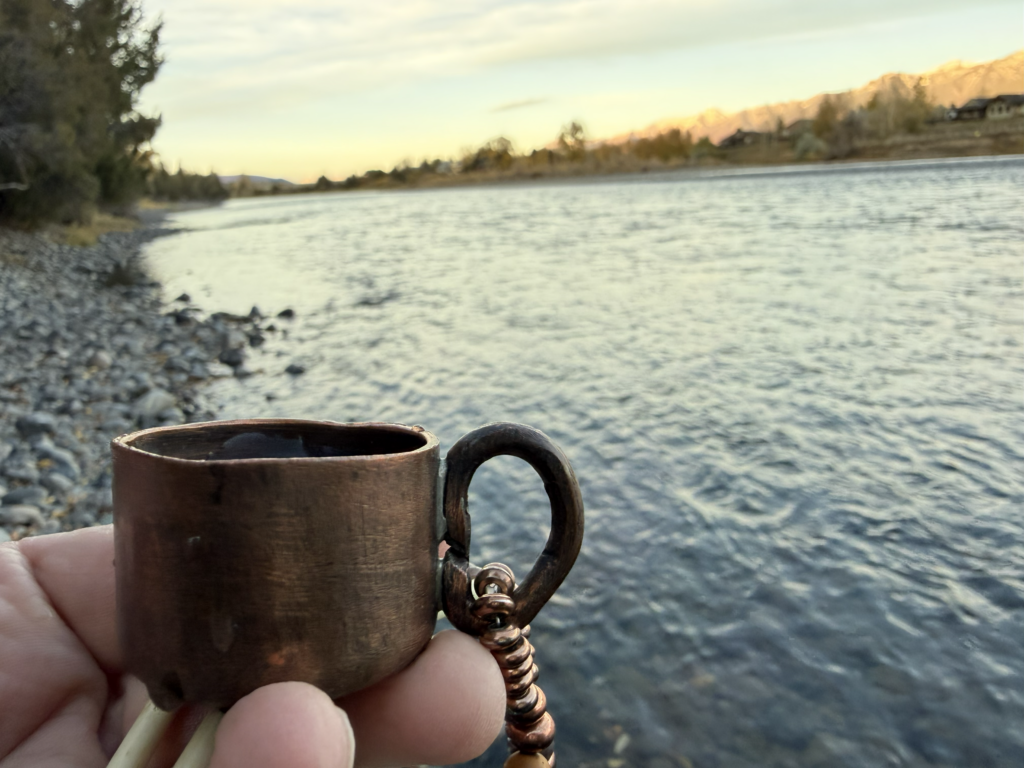
Through frozen binoculars, we watched as long as we could see the outline of an eagle against the landscape. With precipitation coming, we made our way off the mountain, down to the base cabin where the two were banded and parted ways with our banding group. The rest of the CPN team flew home that evening and we made our way to Bozeman for the night. Since we only get telemetry every three days, we planned to stay in the area just in case there were sightings or any signs of trouble. The following morning, we returned to Helena National Forest to see if we could catch a glimpse of the two in the area. With no word and no sightings, we decided to pick a migratory path of our own home. Looking at telemetry studies in the Absaroka Range of the Rockies, it seemed that our best chance to see other goldens was to head down through the Tetons or through Yellowstone. We opted to follow the Yellowstone River into Wyoming. We stopped at sunset along the river to put down sema and thank the Creator before stopping for the night at Mammoth Springs. The next morning, we got a message from Bryan Bedrosian from Teton Raptor Center. He said the group of students they were working with to trap and band golden eagles in the same area caught a juvenile golden. To their surprise, when they got to the trap, they saw the telemetry. They had caught Nëmkis. He had spotted their pigeon in the trap and made a somewhat awkward but successful catch of his prey. They double-checked the fit of his telemetry and fed him for his troubles before sending him on his way. We reminded Bryan that Dokmeté, Nëmkis’s dad, had actually came in from Wyoming and was treated at Teton Raptor Center. After looking back at their clinic’s records, the student on the mountain that day who had caught Nëmkis was actually working at the center when Dokmeté was there. What a full circle moment to be a part of both of their stories. A day later they spotted Mnotagwzékwé further up the mountain near the release site. They left food in the area but didn’t know for sure whether she took advantage of the free meal. Their banding season had come to an end and from that point forward we would have to rely on telemetry.
As we made our way through Yellowstone, we marveled at the breathtaking landscape that surrounded us and imagined what it must be like to take this all in from the sky. The wide open, untouched spaces are prime golden eagle habitat.
But with one parent found in Wyoming and one from South Dakota, where would they go?
Once back home we began to download telemetry and settled into that three-day routine. Impatiently waiting, worrying, holding our breath and checking telemetry, breathing a sigh of relief, celebrating, studying maps and starting the whole rollercoaster process all over again.
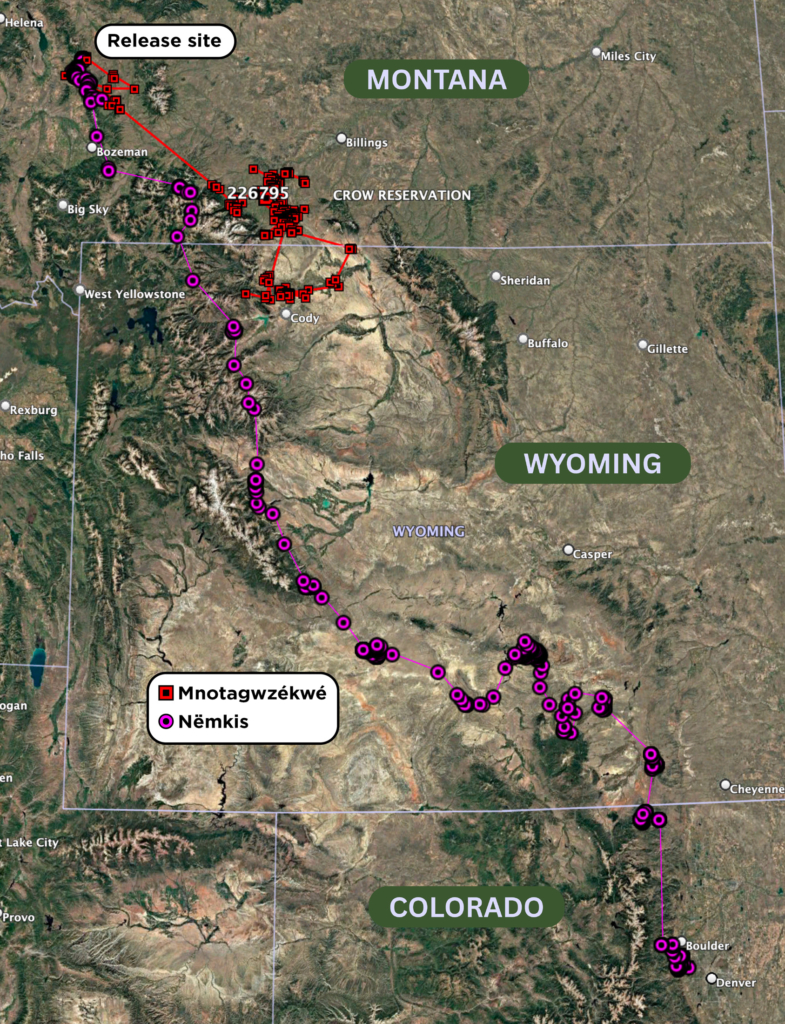
Studying the telemetry, we were surprised that the day of the release is the last time the two were together. In the first 10 days, Nëmkis had already made his way into Wyoming. He cut through the center of the Custer Gallatin National Forest and took a path through Yellowstone, nearly coming in the same north entrance we had just days earlier. He continued south through the Shoshone National Forest and across the Wind River Reservation before turning east, where he spent the better part of November near Medicine Bow-Routt National Forest. The first of December he was on the move again. He continued further south down into the Arapaho National Forest outside Boulder, Colorado. By the end of December, he had flown well over 800 miles since he was released.
Mnotagwzékwé has spent significantly more time in Montana. She stayed near the release site until the end of October before heading southeast along the eastern side of the Custer Gallatin National Forest. Mid-November she was just a little more than 150 miles from the release site. She seems to be spending most of her time in the valleys along the edges of the mountain areas, working her way around an area called Elk Basin between the town of Red Lodge and Custer National Forest to the east near the Crow Reservation. By the end of the year, she crossed into Wyoming, stopping north of Cody for the better part of January before heading back to the Elk Basin valley area in Montana. There’s roughly 80 square miles of area along the Clarks Fork of the Yellowstone River she seems to be settled into for now.
Rob Domenench from Raptorview Research Institute told us he would consider two weeks in the wild a success. Making it for two weeks on their own proved they could hunt. But this past winter brought extreme challenges with one of the worst winter storms on record for much of the nation. Surviving days with temperatures well below zero in blizzard conditions proved they were consistently finding food and thriving. Spring is a little further out on the horizon for them in the north, but it is coming.
We are excited to learn all we can from the telemetry data and reevaluate our release plans for the eaglets we hope to come. We will continue to update you on Mnotagwzékwé and Nëmkis’s progress. As always, we encourage you to keep your eyes out for any banded eagles because you never know. Share your encounters with eagles or raptors at [email protected]. For more information about CPN’s Eagle Aviary, please visit potawatomiheritage.com.