Katie Lynch has devoted her higher education career to advocating for Indigenous access to health care. She has been honored as a 2025 Champion for Change by the Center for Native Youth of the Aspen Institute.
The Champions for Change program is a Native youth leadership initiative designed to highlight positive stories of impact from Indian Country, according to the CNAY website.
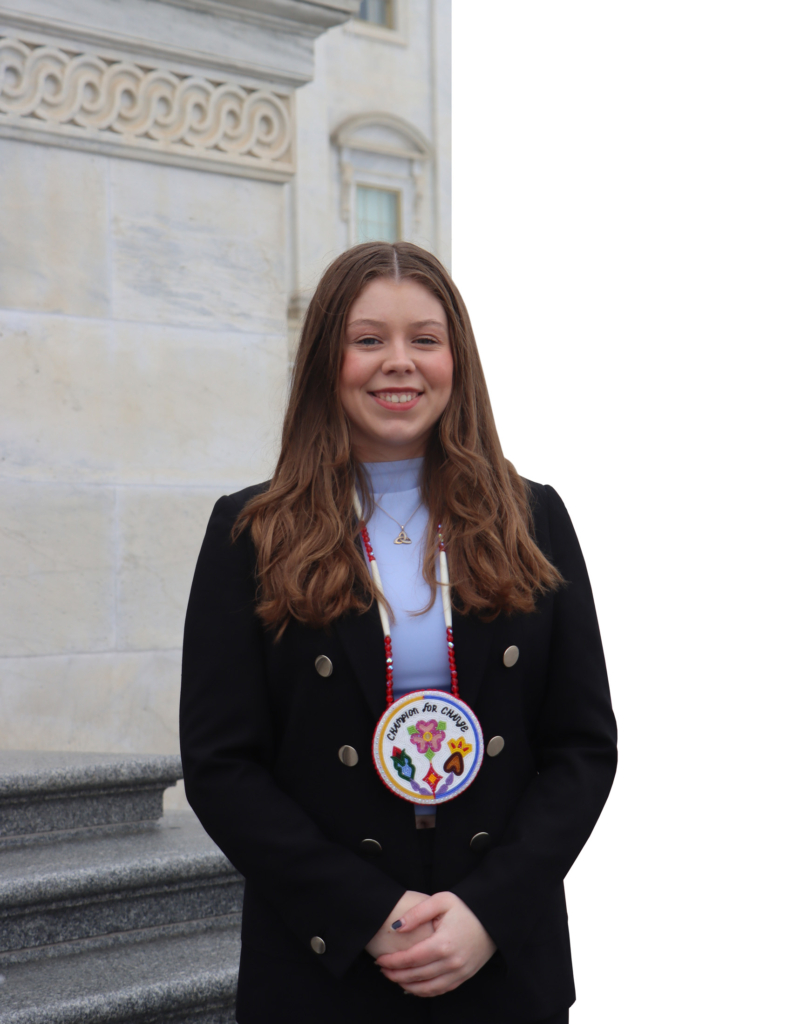
Inspired by a 2011 White House initiative, Champions for Change develops young Indigenous leaders through experience based learning and tailored advocacy training.
Each year, CNAY selects five inspirational youth to serve as Champions for Change: young leaders from across the country with a desire to better their communities. This can be done in schools or programs, on reservations or in urban environments – anywhere there is opportunity to cultivate positive impact.
A Smith family descendant, Lynch completed her bachelor’s degree in biomedical engineering at Rutgers University. She is now a Ph.D. student at the University of Michigan medical school, studying health infrastructures and learning systems.
Lynch has focused her studies on access to care for Indigenous communities and the importance of including the community in any research.
She was surprised to learn she had been named a Champion for Change.
“We’re just in the beginning of the program and it’s already been so rewarding. I’ve been reflecting on the ups and downs that I’ve had to get here. I think being in engineering as a woman, and as a Native woman is not easy. The fact that I even graduated with a bachelor’s degree in engineering as a Native woman was an achievement in and of itself,” she said. “I just feel grateful to be here and to be surrounded by other passionate Native youth because I didn’t grow up in community. That’s not always something that I had access to. So being able to interact with CNAY and the Champs program is so rewarding.”
Career goals
As her term with the Champs program kicks off, she is excited about the experience and how it could guide her career goals.
“I’m thinking about (working for) access to health care for Indigenous communities, ways that we can prioritize strength-based research. A lot of the research that’s being done in Indigenous communities is being done on the communities instead of with the communities. I’m thinking about how we can partner with Indigenous communities instead of just using them as research subjects,” she said. “Whether that’s advocating for access to care, increased funding for urban Indian health organizations, a lot of the work that I do really intersects policy and science.”
The Champs program has provided some of those opportunities. When Lynch was in Washington, D.C. for Champs week, she met with (New Jersey) U.S. Sen. Cory Booker’s office and (New Jersey) U.S. Sen. Andy Kim’s office about ways increasing funding for urban Indian health organizations.
She also plans to encourage land grant institutions, like Rutgers, to provide access to more funding for Native students.
“I’m going to be working with one of the other Champs, Sage Phillips (Penobscot), who has done a lot of land grant work. I want to hold universities accountable for these promises that they made,” Lynch said. “I’m at the University of Michigan, they occupy Potawatomi land, so I’m learning how they support Native students. All of this work feels even more important than ever right now.”
Her future plans could include working in academia, where she can speak for change and work directly with students.
“I think I want to become a professor and to stay in academia. I’ve been really privileged to have a lot of female role models, but when I was an undergrad, I didn’t have a single Native professor in my entire four years there. To be in academia, have a research lab and to guide students is something that is really important to me because I like the idea of taking a step back so that others can take a step forward.”
“I also see myself involved in the policy world as well. The balance between policy and academia is not easy to strike. But I think I can be involved, whether that’s being on advisory boards or interacting with Congress or the White House in other ways,” she said.
Her focus on science is not surprising as it meshes perfectly with her creative side, something her mother recognized early in Katie’s life.
“My mom loves to talk about the scientific connection between folks that are good at STEM and folks that are creative. Anything related to drawing, painting, I love to do all of that. I love beading. I was born and raised in coastal New Jersey. So being by the beach, I was just like always on the beach in the summer. And even in the winter, every time I go home to Jersey, I always need to see the beach. Now that I’m in Michigan, it’s hiking or going to the lakes, but spending time outside is really therapeutic for me. It’s so important to have a work-life balance.”
Strong role models
Her early examples of strong, Indigenous leadership provide inspiration. Lynch strongly believes that Native people must be in spaces where they are being discussed.
“Growing up I was always surrounded by strong women, so I think my voice and my desire to speak up for the things that I care about comes from that. My parents always told me you can do whatever you put your mind to. Having that upbringing really influenced not only my perspective as an urban Native, as a woman in STEM, but also the way that I show up in spaces as an advocate, as an organizer,” she said.
Lynch said she didn’t always think of herself as an activist, but she has always felt strongly about speaking out for Indigenous people.
“I’ve been privileged to have been given not only this platform as a Champion but also the privilege of being a Ph.D. student. That also comes with a lot of responsibility. One of the other Champs, Josh, he talks about this idea of kuleana which is a Hawaiian word that means responsibility, and responsibility is a privilege. You have this power in order to advocate for people,” she said.
Her experiences have motivated her to push back against inequality.
“The Covid-19 pandemic ignited my passion for tribal health care because I saw the disproportionate impact on Indian country. I remember watching TV and I saw that the federal government was sending the Tohono O’odham Nation body bags and that just hit me,” Lynch said. “I also saw the lack of representation as an undergraduate student. I was one of maybe three Native students on my campus and every time I tried to talk to administrators about (acknowledging) Native students, they would say, ‘Oh there’s not enough of you.’ Being constantly met with that resistance is something that made me want to push even harder.”
Finding where change is needed and then advocating for change can be a long but necessary process, Lynch said. Fortunately, she has a network of inspirational figures.
“The first person that comes to mind is definitely my mom. She is so determined and has always been a really strong role model for me,” Lynch said.
A pre-college preparation program also introduced her to another inspiring figure.
“We took a course taught by Dr. Adrienne Keene, who’s an amazing Cherokee scholar and artist. She was the first person that I really saw myself in. She hadn’t been raised in her homelands and hadn’t always been surrounded by community, but she really took the time to make those connections for herself and recognize the intergenerational joy and brilliance that she comes from.”
Lynch recently met Abigail Echo-Hawk, an advocate in the healthcare and data sovereignty space. University of Michigan professor Dr. Tara Maudrie, who works in nutrition and strength-based research for Native communities, is another inspiration
“To see other Native women who are so incredibly successful and recognized for their work is really awesome,” Lynch said.
New perspectives
Lynch hopes more Native youth will step into leadership, even if the prospect is daunting. “The first thing I would say is just jump out of your comfort zone any time you’re given the opportunity. Do things that scare you because there will probably be something that you’re able to take away and learn from it,” she said.
Failure can also be a time for personal growth.
“There were times in my undergraduate career where maybe I didn’t end up in spaces that I thought I would end up. That’s when you can reflect on how far you’ve come and use that as a space to think about how you can propel yourself forward,” she said. “With my graduate school applications, I got rejected from some schools. But I ended up getting accepted to Michigan and I couldn’t picture myself anywhere else.”
Lynch feels strongly that Indigenous students come from cultures that can uplift them.
“Native youth come from intergenerational joy and so much brilliance. We’re often told that we come from all this trauma and so much struggle, but as we recognize that, we also need to think about the joy that comes from our communities and how that can give us strength,” she said
Attending college can be a challenging time for Indigenous people. Being away from community can feel isolating, but support is always close, she said.
“Dr. Keane said you have ancestors wherever you go even if they’re not yours. I thought about that a lot when I was at Rutgers because I wasn’t on Potawatomi lands, but I was still very much connected to my community,” Lynch said. “It’s not easy but you have so many people there to support you. There’s so many support networks that can be there for you.
“I think Native youth are often coined like the leaders of tomorrow but, we’re leading and we are scientists, we are artists and musicians today. The more that tribal leaders can really recognize the power of Native youth right now, the more beneficial that will be for our communities