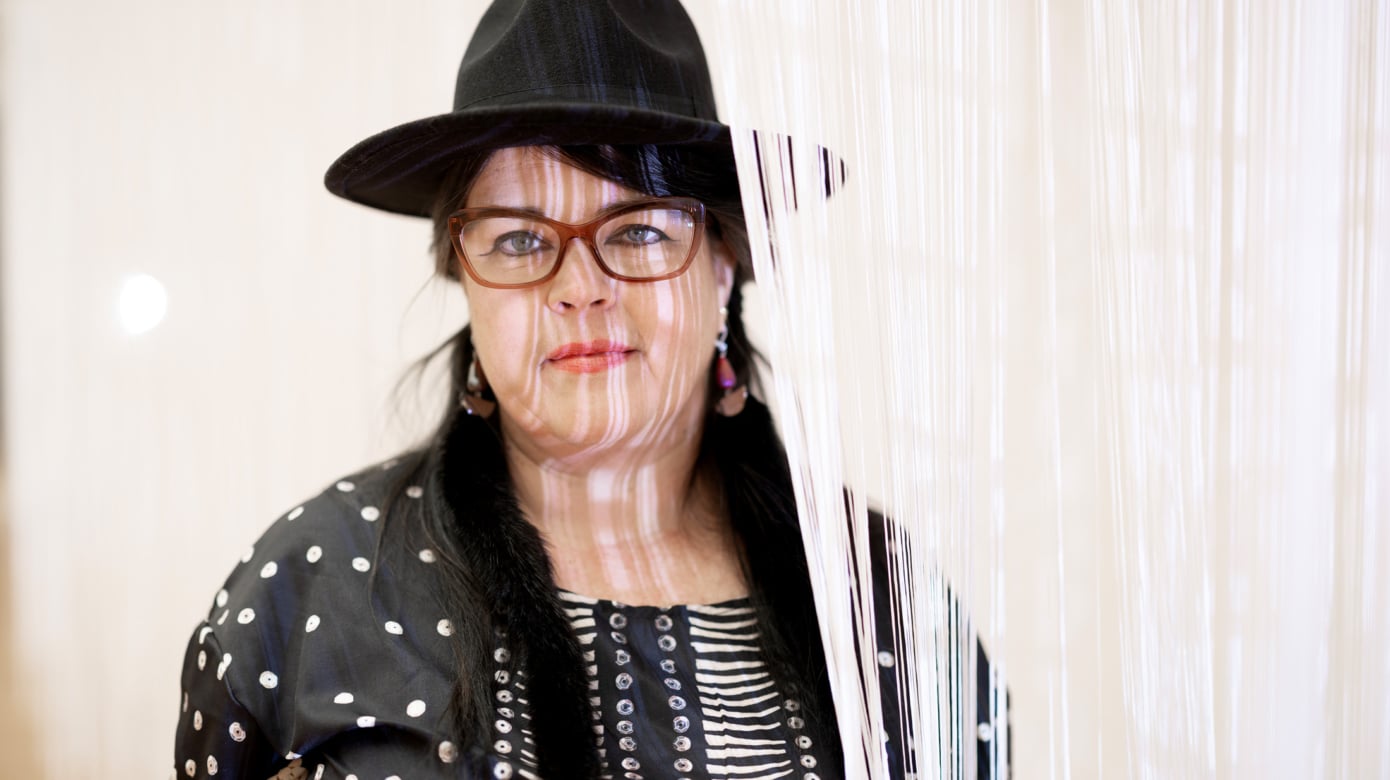
An exhibition by a Citizen Potawatomi Nation artist that examined the forced removal of the Potawatomi people was the first exhibition in the University of Oklahoma’s Lightwell Gallery for spring 2025.
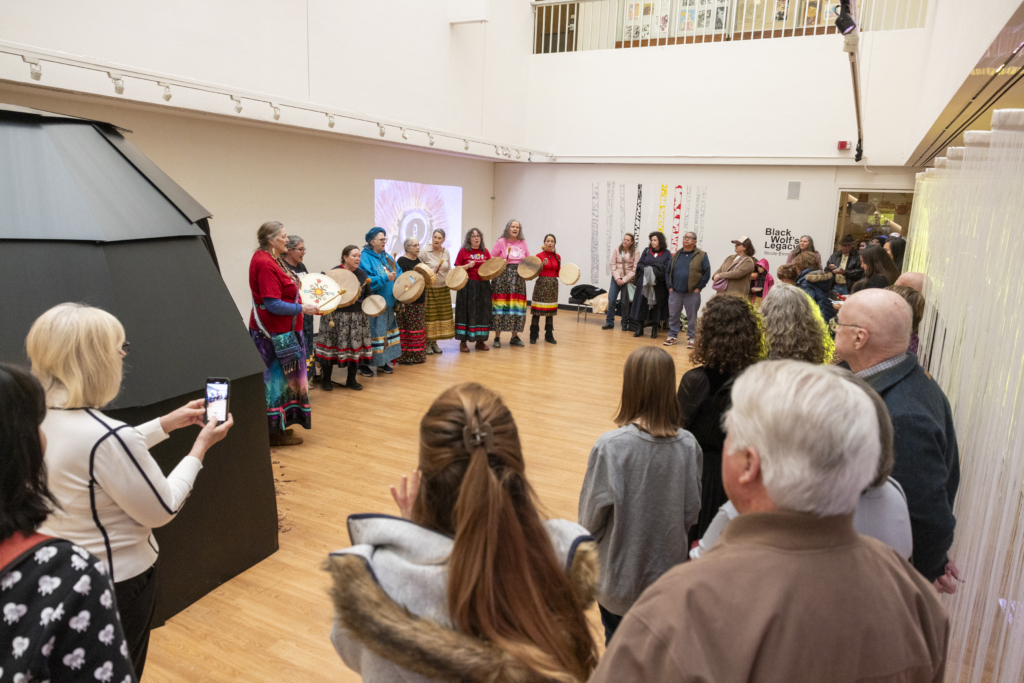
Nicole Emmons, a filmmaker and mixed media artist based in Oklahoma City presented “Black Wolf’s Legacy” on Jan. 23, 2025. The exhibit combined history and contemporary art to educate patrons about cultural identity and survival.
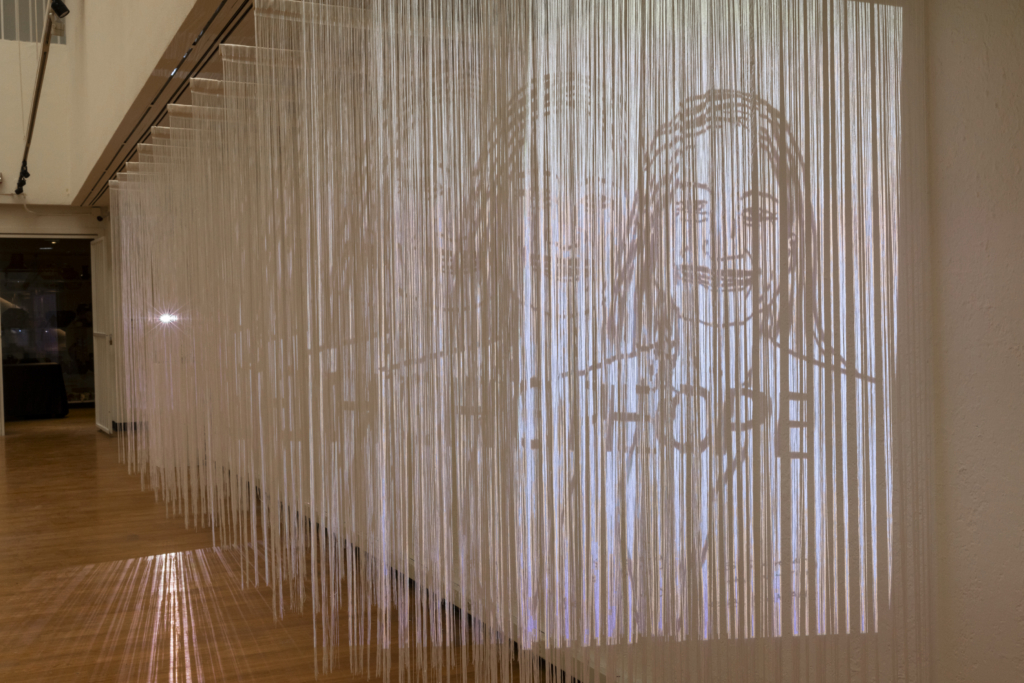
During her artist talk, Emmons said she intended “Black Wolf’s Legacy” to be an immersive experience that combined animation, projection and mixed media to tell the story of the 1838 Trail of Death, in which the Potawatomi were forcibly removed from Indiana to Kansas.
“On Sept. 4, 1838, (the Army) rounded up the four main chiefs by gunpoint and put them in a jail wagon. Then they rounded up the rest of the people, with about 100 soldiers to marshal everyone together, and started the long march. It was about 660 miles, and it was a two-month march,” Emmons said. “It was very, very dry and there was very little water. There was typhoid going around at the time. Nearly every day somebody died.”
Emmons said that Black Wolf’s story stood out to her because of his resistance.
“People like Black Wolf escaped and went to Michigan. He escaped once and went to Nottawaseppi, which is the Huron Band of the Potawatomi. Then he was captured and brought back to Kansas. Later in 1840, he got away again. But he was captured once again and brought to Kansas.
“What does he represent? He represents the idea of going against societal pressure. All these forces are coming together to tear this community apart and to tear this Nation apart. But Black Wolf saw through that and said, ‘No, I’m not going to stand for this. I’m going to fight and I’m going to go back and I’m going to keep our culture,’” she said.
Black Wolf’s fierce resolve inspired Emmons.
“What he represents is that spark of knowing who you are and standing for who you are. The legacy is about practicing your culture and how that can actually be in rebellion to what was meant for us as far as colonialization,” she said. “The forced removal is an aspect of colonization that they used to break us down and break us apart. And it was ultimately unsuccessful because we are still here and we’re thriving.”

Elements reflect culture
“Black Wolf’s Legacy” took patrons on a journey from the Great Lakes to forced removal to embracing culture in the Citizen Potawatomi Nation’s adopted home of Oklahoma.
“(Portions) represent the Great Lakes. It’s representing nostalgia, things that we’ll probably never get back, the purity of that time before colonization. But you can still have relationships with our family of animals and fauna and flora. There are still ways when you practice culture, you’re able to get in touch with that,” she said.
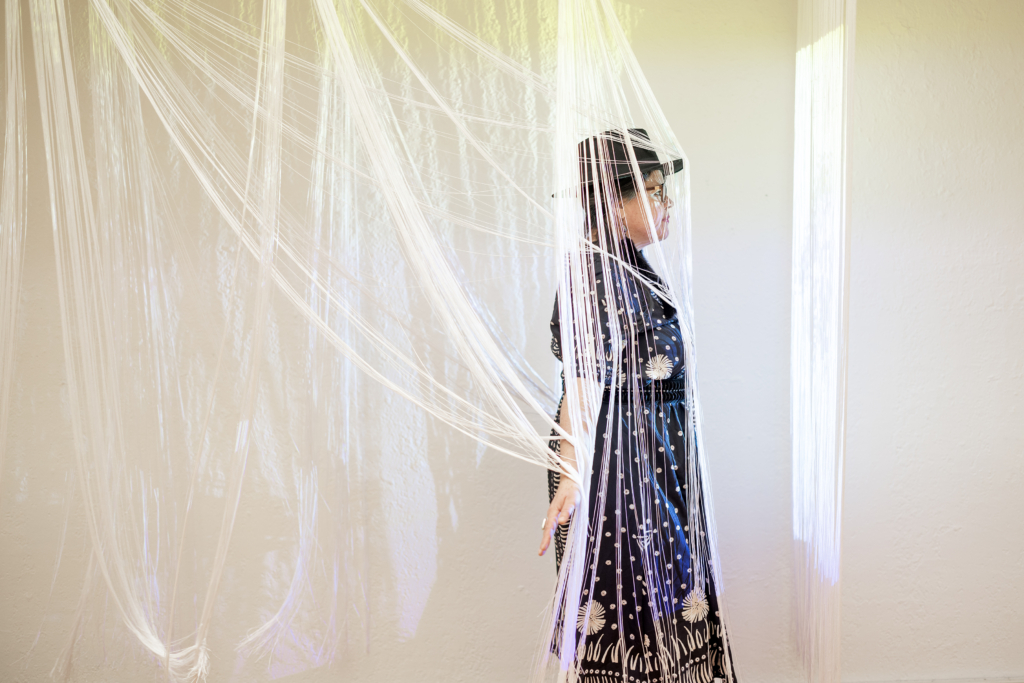
Visitors were encouraged to walk through several long curtains of fringe, representing a journey.
“I tried and tested a bunch of different materials and of different thicknesses. It’s the idea of going from one place to the next. I can never reproduce the Trail of Death or what people went through, but you can have moments where you can sit and take time and think about what that might have been like,” Emmons said. “On the opposite end, the images are other methods of colonialization.”
The animation also reflected Indigenous elements.
“Everything is based on the number four. Four is a sacred number, such as the four directions, but it’s also the different medicines. I did my drawings in cycles of four, so there’s 40 individual drawings, and then there’s four drawings of each of each image,” she said.
The wigwam structure represented reflection, a place where Potawatomi ancestors would have thought about all that had happened to them.
“During the day when you’re marching, people are dying and (you’re forced to keep) going and going. At night you have time to rest and process what happened during the day and all the people that we lost. And think about ‘What options do we have?’ ‘What other things can we do?’
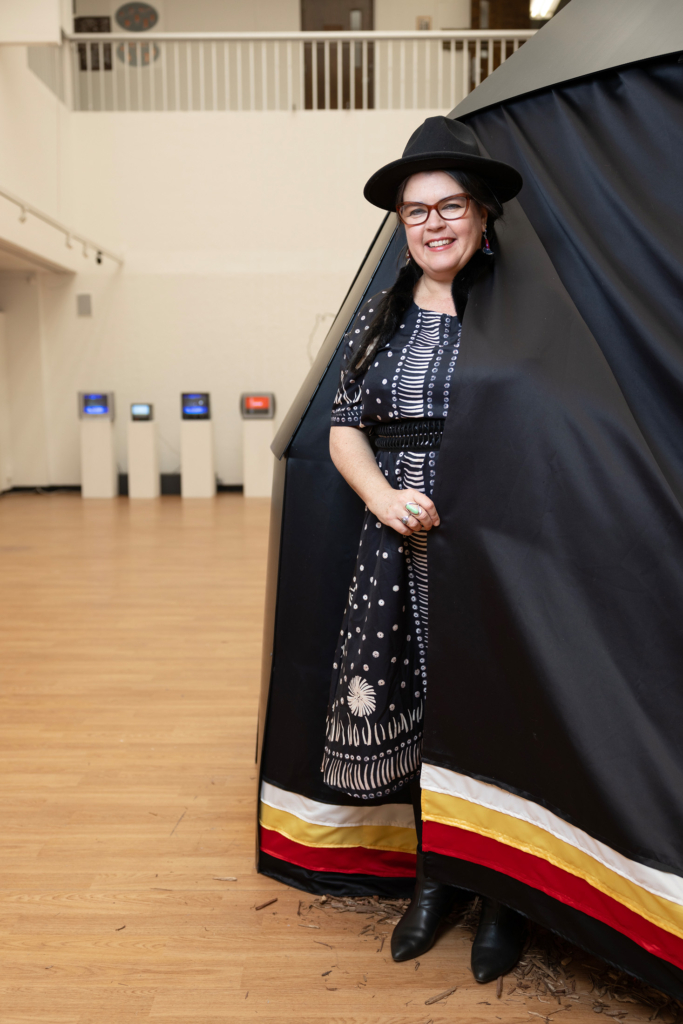
“Night is a time filled with possibility. That was the time when Black Wolf most likely made his escape as well as all the other people that escaped. When you listen to that audio soundtrack in the enclosure, it is a story. You’re listening to the fire, you’re listening to sounds of the encampment, you’re listening to morning sounds, people crying, people singing,” Emmons said.
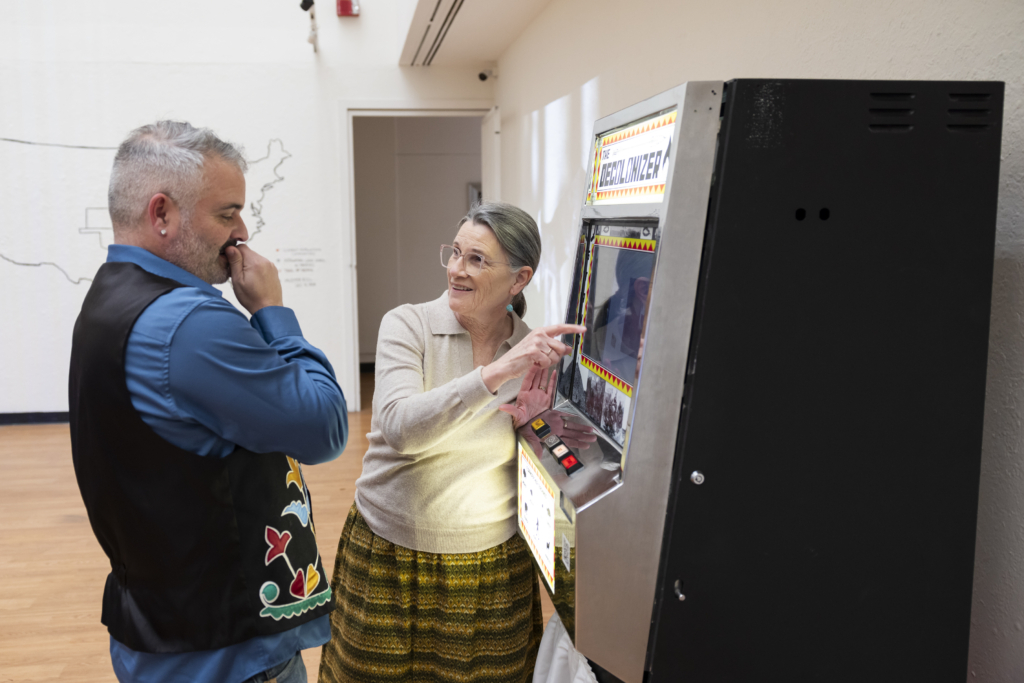
A map of North America showed where the Potawatomi lived in the Great Lakes and their 660-mile journey to Kansas, then eventually to Oklahoma. A document was next to the map.
“That document is the muster roll of the Potawatomi. Black Wolf is actually listed on that document. I thought that would be interesting because you can see the actual names. These are real people. There’s hundreds and hundreds of people that were forcibly removed.
“And that’s just one story. On that muster roll, there’s only 400 names. Obviously, the Trail of Tears encompasses 100,000 people that were removed. So, we’re just one story of all those stories,” she said.
Collaboration
Emmons said her grandfather was a prominent and early influence in her life.
“He was a historian, a superintendent of schools in Tecumseh, and he was a great researcher of Potawatomi culture and history. He really instilled that in me as well,” she said.
Emmons worked for a year on “Black Wolf’s Legacy,” while she simultaneously worked on other projects. She was grateful for the support from the gallery.
“Everyone at the school has been totally amazing and supportive. I came for several testing sessions, and they let me come up as many times as I wanted to work. It’s just been really a great experience working here. It’s beautiful,” she said.
“I was really excited when she got all of her work up. It’s been an awesome process to see this all come together. I’m happy that Nicole is providing us with this great exhibition and installation for our students and bringing in art and technology,” said Amber Duboise-Shepherd (Diné/Prairie Band Potawatomi/Sac & Fox), assistant to the director, OU School of Visual Arts.
Emmons collaborated with Choctaw composter J. Cruise Berry to create the score for “Black Wolf’s Legacy.” The project was supported by the First People’s Fund and the Andy Warhol Foundation, in partnership with the Oklahoma Visual Arts Coalition.
To learn more about Emmons, visit nicoleemmons.com.